




How to use trekking poles for scrambling on Grade 1 ridges in the UK?
Grade 1 scrambling – found on classic UK ridges like Crib Goch (Snowdonia), Striding Edge (Lake District), or Aonach Eagach (Glencoe) – is a thrilling mix of hiking and easy climbing. You’ll need your hands for balance and holds, but the approaches and descents often involve steep, loose terrain where trekking poles are useful. The golden rule: on the actual scramble, stow your poles; use them only for the walk‑in and walk‑out. Here’s how to do it safely.
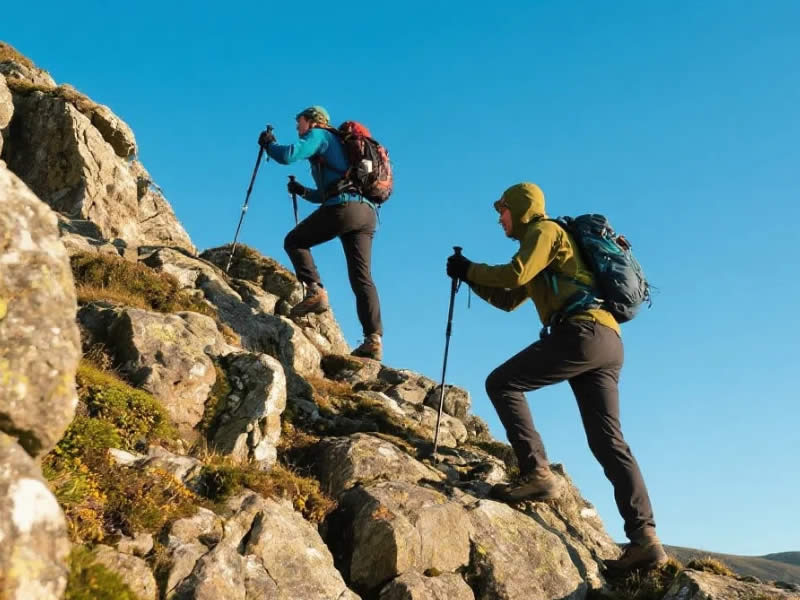
Recommended trekking pole purchase link: https://s.click.aliexpress.com/e/_c4M7OWaN
Understanding Grade 1 terrain
Grade 1 scrambling involves using your hands for balance (and occasionally for short pulls), but the holds are large and the exposure is moderate. You are not roped up. The danger is not technical difficulty but the consequences of a fall on exposed sections. On a true Grade 1 ridge, you will need both hands free – poles become a dangerous hindrance.
Before the scramble: using poles on the approach
The walk‑in to a Grade 1 ridge often involves steep, loose, or boggy ground. Here, poles are invaluable:
- Use two poles for stability on rocky or slippery approaches.
- Keep poles at normal hiking length (elbow at 90° on flat), but be ready to shorten them as the slope steepens.
- Plant firmly on loose scree or wet grass – the carbide tips will bite.
- When you reach the base of the scramble, find a safe spot to stow your poles. Do not attempt the ridge with poles in hand.
During the scramble: stow, don’t hold
Attempting a Grade 1 ridge while holding trekking poles is dangerous. You cannot grip rock holds, and the poles can snag, throw you off balance, or drop down the slope. Follow these steps:
- Collapse your poles completely (telescopic) or fold them (Z‑poles).
- Attach them to your backpack – use side compression straps, daisy chains, or dedicated pole holders. Ensure they are secure and won’t swing.
- Check that no tips are exposed – cover carbide tips with rubber caps or tuck them into a pocket.
- If your pack has no external attachment, you can place the folded poles inside the main compartment (if long enough) or slide them under the top lid.
- Proceed with both hands free. Focus on three points of contact (two feet + one hand) on exposed sections.
After the scramble: using poles on the descent
The descent from a Grade 1 ridge is often a steep, loose, or eroded path. This is where poles shine:
- Retrieve your poles once you are on safe, non‑scrambling ground.
- Lengthen them by 5–10 cm for downhill braking.
- Use double planting on steep sections to protect your knees and prevent slips.
- Take your time – tired legs after a scramble are more prone to trips.
Special case: using one pole on easy scrambles
On a very easy Grade 1 (e.g., a broad, non‑exposed ridge with only occasional hand use), you might keep one pole stowed and use the other for balance. This is only for confident scramblers on low‑consequence terrain. Never risk a fall to avoid stowing both poles.
What to avoid
- Using poles as handholds – they can snap or slip. Use rock holds.
- Planting poles while moving along an exposed ridge – a slip can send you and the pole over the edge.
- Keeping wrist straps tight – if you fall with poles still strapped, you could twist your arm.
- Forgetting to cover sharp tips – carbide tips can puncture your pack or scratch you.
Recommended gear for ridge scrambles
- A pack with good external attachment points – side compression straps or daisy chains make stowing poles quick.
- Rubber tip covers – to protect your pack and gear.
- Trekking poles with lever locks – easier to collapse and extend one‑handed than twist locks.
Final verdict
On Grade 1 ridges in the UK, use trekking poles only for the approach and descent. On the scramble itself, stow them securely on your pack and use your hands. Trying to keep poles in hand on exposed terrain is a common mistake that leads to accidents. Practice stowing and deploying poles quickly, and you’ll enjoy the best of both worlds: stable walking on the way in and out, and free hands for the exhilarating scramble.




