




Are shock-absorbing trekking poles good for painful knees in old age?
Many older hikers or walkers with painful knees assume that a “soft” shock‑absorbing pole will cushion the impact of each step and protect their knees. It’s an intuitive idea, but the short answer is no – shock‑absorbing trekking poles are not particularly beneficial for knee pain, and they can even be counterproductive. The real knee protection comes from using any pair of poles correctly – with proper length adjustment and wrist strap technique. Springs in the poles do not reduce the load on your knees. Here’s why.
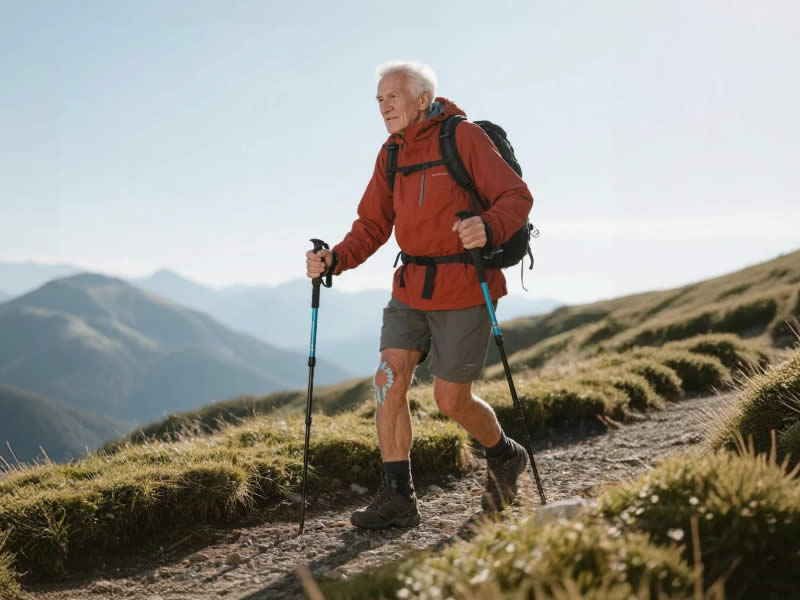
Recommended trekking pole purchase link: https://lightenup.aliexpress.com/store/1101521655
How shock absorbers actually work
A shock‑absorbing pole contains a small coil spring or elastomer in the upper shaft. When you plant the pole, the spring compresses slightly (usually 10–20 mm), absorbing some of the impact that would otherwise travel up your arm. It cushions your wrists, elbows, and shoulders – not your knees. The mechanism does not reduce the vertical force transmitted from your foot to your knee. That force is determined by your body weight, your speed, and the steepness of the slope – not by a spring in the pole.
What actually protects your knees
Several biomechanical studies have shown that using two trekking poles can reduce knee joint loading by 20–25% on descents. This reduction comes from:
- Transferring weight to your arms via the wrist straps. When you push down on the poles (or pull on the straps), you offload your legs.
- Lengthening the poles for downhill so you can plant ahead of your body, creating a braking effect.
- Using two poles for bilateral support, which also improves balance and prevents awkward twisting.
None of these benefits require a shock absorber. Rigid poles work just as well – and often better because they don’t waste energy in spring compression.
Why shock absorbers may be worse for older knees
- Added weight – Springs add 30–50 g per pole. For someone with weak arms or shoulders, this extra weight increases fatigue, leading to poorer technique and less effective knee protection.
- Bouncy feel – The spring can cause the pole to bounce on hard surfaces, reducing the positive feedback that tells you the pole is planted securely. This can reduce confidence and lead to a less stable gait.
- Energy loss – Each time you compress the spring, you lose a small amount of forward momentum. Over thousands of steps, this adds to your effort.
- Complexity and maintenance – Springs can squeak, jam, or break over time. A broken shock on a walk is not easily fixed, whereas a rigid pole is simple and reliable.
When shock absorbers might help (but not for knees)
The only situation where a shock absorber is genuinely useful is if you have painful arthritis or tendonitis in your wrists, elbows, or shoulders. The damping can reduce the jarring sensation on hard pavement or compacted trails. For knee pain alone, they are unnecessary.
What older adults with knee pain should look for in a pole
- Rigid (non‑shock) aluminium poles – Lightweight, durable, and reliable.
- Lever locks – Easier to use than twist locks, especially with arthritic hands.
- Cork or foam grips – Comfortable, sweat‑absorbing, and reduce hand fatigue.
- Padded, adjustable wrist straps – Used correctly, they transfer weight from your knees to your arms. This is the most important feature for knee relief.
- Rubber tips – For walking on pavement or indoors.
How to use poles to reduce knee pain (with or without shocks)
- Set the correct length for the terrain – On flat ground, your elbow should be at 90° when the tip is on the ground. Lengthen poles by 5–10 cm for downhill – this is critical for knee protection.
- Use the wrist straps correctly – Insert your hand from below the strap, then grip lightly. The strap should bear your weight when you push down.
- Plant ahead of your body on descents – This creates a braking angle that transfers load from your knees to your arms.
- Always use two poles – A single pole will unbalance you and protect only one knee.
- Shorten poles for uphill – This keeps your arms low and reduces shoulder strain.
Final verdict
For painful knees in old age, shock‑absorbing trekking poles offer no advantage over rigid poles. The real knee protection comes from proper length adjustment (especially lengthening for downhills), correct wrist strap technique, and using two poles. Save your money and the extra weight – invest in a good pair of rigid poles with comfortable grips and reliable lever locks. Your knees will benefit just as much, and your arms will thank you for not lifting unnecessary springs.




