




Can children use trekking poles safely on family walks?
Yes, children can use trekking poles safely on family walks, provided the poles are appropriately sized, the child is mature enough to follow basic instructions, and an adult supervises closely. Used correctly, trekking poles can enhance a child’s stability, confidence, and enjoyment on uneven terrain. However, there are important considerations to prevent accidents and ensure a positive experience.
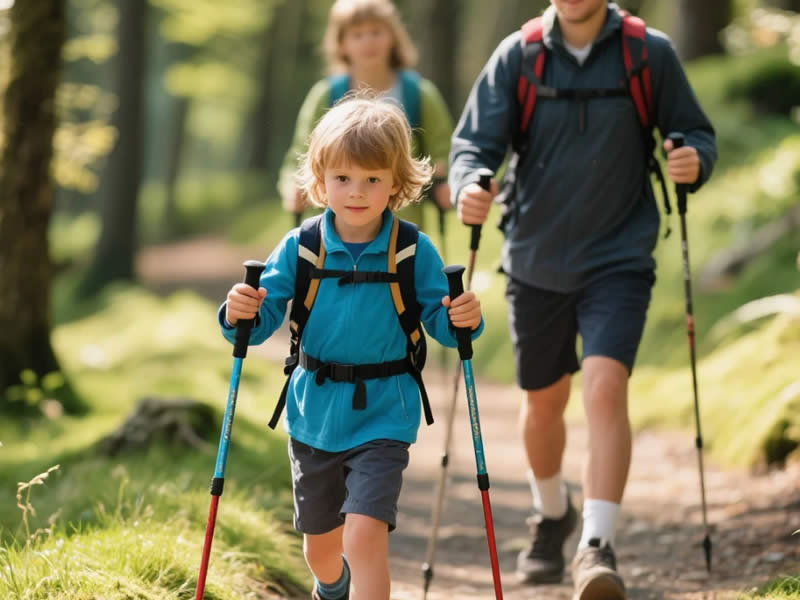
Recommended trekking pole purchase link: https://lightenup.aliexpress.com/store/1101521655
At what age can a child start using trekking poles?
There is no fixed age, but most children around 5–7 years old can begin using lightweight poles with supervision. Younger children (under 5) may lack the coordination and attention span needed to use poles safely; they are better off with hands‑free walking. By age 8–10, many children can handle poles on moderate trails with occasional guidance. Ultimately, assess your child’s physical coordination, ability to follow instructions (e.g., “don’t swing the poles”), and willingness to use them.
Choosing the right poles for a child
- Size: The pole should be adjustable to a length where the child’s elbow is at about 90° when the tip is on flat ground. Many adult poles adjust down to 100 cm, which may still be too long for a small child. Look for junior‑specific trekking poles (e.g., Leki Junior, Black Diamond Child’s poles, or budget options from Decathlon) that start at 80–90 cm. Fixed‑length poles can work if cut to size, but adjustable are more versatile.
- Weight: Children have less upper‑body strength. Choose ultralight poles (carbon or lightweight aluminium) under 200g per pole. Heavy adult poles will tire them quickly.
- Grips: Soft, small‑diameter foam or cork grips are best. Avoid hard rubber grips that may be slippery or uncomfortable for small hands.
- Locking mechanism: Lever locks are easier for children to operate than twist locks. Ensure the locks are secure and cannot slip under the child’s weight.
- Tips: Always use rubber tips (paw covers) when walking on pavement, gravel, or indoor surfaces. Carbide tips are for dirt and grass only; they are sharp and can damage floors or cause injury if swung.
- Baskets: Small summer baskets are fine; remove large snow baskets for summer walks.
Safety guidelines for children using poles
- Always supervise – Never let a young child use poles unattended. Watch for swinging, tripping, or using the pole as a toy.
- Teach the correct grip and strap use – Even for children, the strap should be used correctly (hand up from below) to transfer weight and prevent dropping. Adjust the strap to fit snugly but not tightly.
- Start on flat, easy terrain – A grassy field or a smooth path is ideal for practice. Avoid steep slopes, loose rocks, or crowded areas until the child is confident.
- Teach the alternating rhythm – “Right foot forward, left pole down; left foot forward, right pole down.” Demonstrate slowly. For very young children, a simpler “plant both poles together” technique may be easier.
- Emphasise safety rules – “Do not swing poles near people’s faces. Do not run with poles. Keep tips on the ground or held at your sides when not planting.”
- Use rubber tips on hard surfaces – Carbide tips can scratch pavement, slip on wet concrete, and are dangerous if a child falls onto them. Rubber tips provide traction and reduce risk.
- Consider removing wrist straps for very young children – Some experts recommend removing straps entirely for children under 8, as a falling child could get an arm tangled. Instead, they can hold the grip without straps. Use your judgment based on the child’s maturity.
- Take breaks – Children may tire quickly. Poles can become a nuisance if the child loses interest; be prepared to carry the poles or stow them in your pack.
Benefits of poles for children
- Improved balance – On uneven ground (roots, rocks, mud), poles give extra stability, reducing falls.
- Confidence – A child who feels secure is more willing to explore longer or more challenging walks.
- Engagement – Poles give children a “job” and can make walking feel like an adventure rather than a chore.
- Reduced leg fatigue – Poles help share the load, allowing children to walk further without complaining.
- Posture – Poles encourage an upright stance, which can help prevent slouching.
Potential risks and how to mitigate them
- Tripping – A child may forget to lift the pole and catch the tip on a root. Teach them to lift the pole clearly with each step. Shorten the poles slightly to reduce ground contact time.
- Poking – Children may swing poles toward others. Establish clear rules and demonstrate safe holding (tips down, close to body).
- Fatigue – Heavy poles cause arm tiredness. Choose lightweight models and let the child decide when to stop using them.
- Lost or broken poles – Consider buying cheaper poles for children, as they are more likely to lose or damage them. Decathlon’s Forclaz MT500 junior poles are a good balance.
Recommended junior trekking poles
- Leki Junior Adjustable – Lightweight aluminium, SpeedLock lever, small foam grip, includes rubber tips. Length 85–110 cm. Price ~£50.
- Black Diamond Child’s Trail Pole – Aluminium, FlickLock, foam grip. Shorter length. Price ~£55.
- Decathlon Forclaz Trek 100 Junior – Budget option (£25), aluminium, twist locks (less ideal but fine for light use), includes rubber tips. Length 80–100 cm.
- Cascade Mountain Tech Youth Trekking Poles – Lightweight carbon, lever locks, foam grip. Available online.
Final verdict
Yes, children can safely use trekking poles on family walks when the poles are properly sized, lightweight, and equipped with rubber tips for hard surfaces. Adult supervision, clear safety rules, and starting on easy terrain are essential. Trekking poles can boost a child’s balance, confidence, and enjoyment of walking, turning a family outing into a shared adventure. With the right approach, poles become a fun tool rather than a hazard. Just be patient, keep sessions short, and always prioritise safety over speed.




