




What are the most common mistakes beginners make with trekking poles?
Trekking poles can transform a hike from a painful struggle into a comfortable, energy‑efficient walk. However, many beginners use them incorrectly – sometimes making hiking harder or even increasing injury risk. Here are the most common mistakes and how to avoid them.
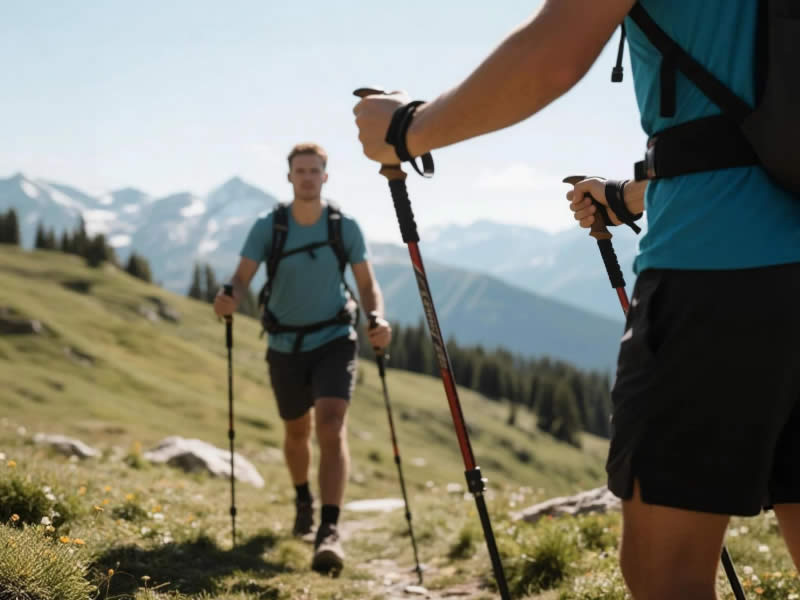
Recommended trekking pole purchase link: https://lightenup.aliexpress.com/store/1101521655
1. Setting poles too long (or too short)
The mistake: Beginners often set poles based on a friend’s height or leave them at the factory length. Poles that are too long force you to hike with your shoulders raised, causing neck and shoulder pain. Poles that are too short make you hunch forward, straining your lower back.
The fix: On flat ground, adjust your poles so your elbow forms a 90° angle when the tip rests on the ground. Mark this length. Shorten poles by 5–10 cm for uphill, lengthen by 5–10 cm for downhill.
2. Gripping the handle like a tennis racket – ignoring the wrist strap
The mistake: Many people slip their hand through the strap from above and then grip the handle tightly. The strap dangles loosely and does nothing. Your fingers bear all the weight, leading to fatigue, blisters, and numb hands.
The fix: Insert your hand up through the strap from below, then bring your hand down onto the grip. The strap should sit between your thumb and index finger, crossing the back of your hand. Adjust the strap snugly. Now relax your fingers – the strap bears your weight. This single change reduces hand fatigue by 50% or more.
3. Planting the pole on the same side as the forward foot
The mistake: A beginner might step forward with their right foot and plant the right pole at the same time – a “same‑side” plant. This twists the torso, wastes energy, and looks like a waddle.
The fix: Always plant the opposite pole to your forward foot. Right foot forward → left pole down. Left foot forward → right pole down. This natural diagonal rhythm mimics your normal arm swing and is far more efficient.
4. Using poles that are too heavy or too stiff
The mistake: Buying heavy aluminium poles (over 600 g per pair) or cheap, rigid poles with no shock absorption? Actually, the mistake is ignoring weight – beginners may buy very cheap, heavy poles (e.g., steel). Heavy poles tire your arms, and you may stop using them.
The fix: Choose lightweight aluminium (500–550 g per pair) or carbon (300–400 g). For most beginners, a mid‑range aluminium pair from Decathlon or Leki is ideal. Avoid ultra‑cheap poles; they are heavy and unreliable.
5. Not using rubber tips on pavement
The mistake: Walking on roads, paved paths, or gravel with bare carbide tips. Carbide tips are hard and slippery on pavement; they also wear down quickly and make a loud clicking noise. On wet pavement, they can skid dangerously.
The fix: Always carry rubber “paw” covers. Slip them on when walking on hard surfaces. Remove them for dirt or rock trails. Rubber tips provide grip, reduce noise, and protect your carbide.
6. Never adjusting pole length during the hike
The mistake: Setting poles once and forgetting them for the entire walk – up hills, down hills, and on flats.
The fix: Adjust length whenever the slope changes significantly. Shorten for uphill (you should feel your arms working low), lengthen for downhill (to plant ahead and brake). After a few hikes, these adjustments become automatic. Lever locks make this much easier than twist locks.
7. Using the poles as levers or pulling on them to climb over obstacles
The mistake: When scrambling up a rock step, some beginners use the pole to pull their body weight up. Trekking poles are not designed for this – the tip can slip, the shaft can snap (carbon), or the lock can fail.
The fix: For moves that require pulling, use your free hand on a rock hold. Stow your poles or hold them in one hand. Never use a trekking pole as a climbing aid.
8. Walking with poles on flat ground as if on a steep slope
The mistake: Using a double‑plant (both poles together) on flat terrain because they saw someone do it on a hill.
The fix: On flat ground, use alternate planting (opposite arm‑leg). Double planting is for steep climbs and descents, deep snow, or stream crossings. On the flat, alternate planting is smoother and more efficient.
9. Not practising before a big hike
The mistake: Buying poles and using them for the first time on a long, challenging hike. The unfamiliar rhythm and technique can feel awkward, and you may revert to bad habits.
The fix: Practice on a short, flat local walk (e.g., around the park) for 30 minutes. Focus on the opposite arm‑leg rhythm, the wrist strap technique, and adjusting length. Then move to gentle hills.
10. Using only one pole
The mistake: Carrying a single trekking pole, often because a friend gave them one or they bought a single pole cheaply. A single pole creates asymmetry, can cause a limp, and protects only one knee.
The fix: Always use two poles. Bilateral support is far safer and more balanced. If you only have one, borrow or buy a matching second.
Final thoughts
Avoiding these common mistakes turns trekking poles from awkward sticks into powerful tools. Focus on correct length, proper wrist strap use, opposite arm‑leg rhythm, and adjusting for terrain. With a little practice, you’ll hike with less fatigue, more stability, and happy knees – wondering how you ever walked without them.




