




Aluminum vs carbon fiber trekking poles — which is better for tropical hiking?
When hiking in tropical environments like the Brazilian Atlantic Forest, the Amazon basin, or Southeast Asian jungles, your gear faces extreme humidity, frequent rain, muddy trails, slippery roots, and sharp rocks. The choice between aluminum and carbon fiber trekking poles is not just about weight – it’s about reliability and safety. For tropical hiking, aluminum is almost always the better choice. Here’s why.
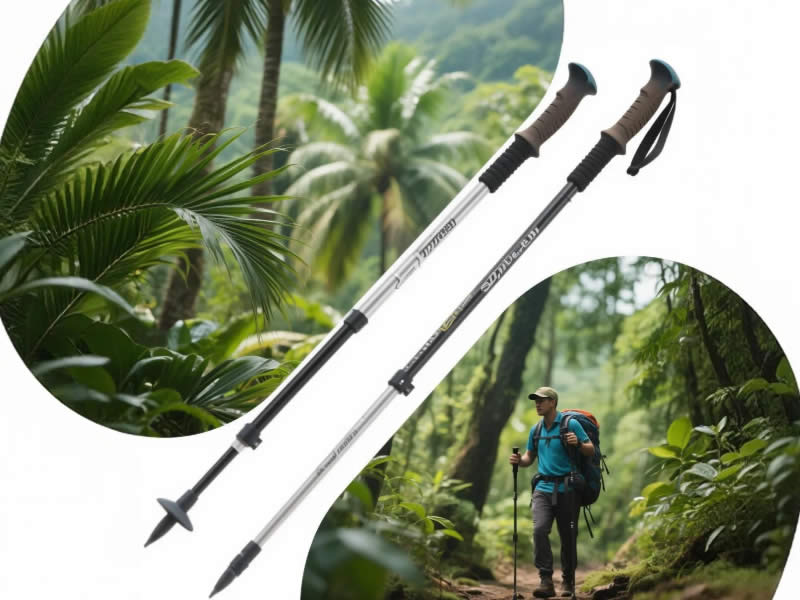
Recommended trekking pole purchase link: https://lightenup.aliexpress.com/store/1101521655
Why carbon fiber struggles in the tropics
Carbon fiber poles are made of carbon strands embedded in epoxy resin. While they are incredibly light and stiff, they have two major weaknesses in tropical conditions:
- Brittleness under lateral stress – In a humid forest, you will inevitably jam your pole between rocks, roots, or fallen branches. When a carbon pole is subjected to a sideways force, it can snap suddenly and catastrophically. There is no warning bend – one moment it’s fine, the next it’s in two pieces. On a remote tropical trail, a broken pole is a serious problem.
- Resin degradation in high heat and humidity – Over time, constant exposure to heat, humidity, and UV light can weaken the epoxy resin, making carbon poles more prone to delamination or micro‑cracks. While modern carbon poles are resistant, cheap ones may degrade faster.
Carbon’s only advantage in the tropics is its light weight. For a long, flat trek, that might matter. But on technical, root‑covered trails, the risk of breakage outweighs the weight savings.
Why aluminum is superior for tropical hiking
- Ductility – Aluminum bends before it breaks. A bent pole can often be straightened enough to finish your hike. In the tropics, where you might be a day’s walk from a road, this field‑repairability is a lifesaver.
- Corrosion resistance – Quality aluminum poles (7075 alloy) are anodised, creating a protective layer that resists rust and corrosion from sweat, rain, and humidity. Carbon itself does not corrode, but the metal components (locks, tips) can – and carbon poles often have steel screws that rust. Aluminum poles with stainless steel hardware are fine.
- Lever locks work better – Most aluminum poles come with reliable lever locks (e.g., Leki SpeedLock, Black Diamond FlickLock). These external clamps are easy to clean when mud gets in and do not slip when wet. Twist locks (common on budget carbon poles) are disastrous in tropical mud.
- Cost – Good aluminum poles are significantly cheaper than good carbon poles. In the tropics, where gear may get lost, stolen, or suffer abuse, you don’t want to risk expensive carbon. A mid‑range aluminum pair (e.g., Decathlon Forclaz MT500) costs a fraction of carbon and performs nearly as well.
When carbon might be acceptable (with caveats)
- You hike only on well‑maintained, smooth trails (e.g., jungle boardwalks or gravel paths) where lateral stress is minimal.
- You are a very light person carrying an ultralight pack (under 8 kg).
- You are willing to accept that a single fall or jam could snap your pole.
- You carry a repair sleeve or spare pole.
For the vast majority of tropical hikers, these conditions are unrealistic.
Practical tips for tropical hiking with aluminum poles
- Choose 7075 aluminium – It’s stronger than 6061. Leki Makalu, Black Diamond Trail Pro, and Decathlon Forclaz MT500 are good examples.
- Lever locks only – Avoid twist locks; they fail in mud and rain.
- Cork grips – They absorb sweat and stay non‑slip. Foam is okay but can become slippery.
- Replaceable carbide tips – Tropical rocks will wear tips quickly. Bring spares.
- Rinse and dry after every hike – Mud and salt (if near coast) can corrode. Extend poles to dry fully.
- Apply silicone spray to lever lock pivots occasionally.
Final verdict
For tropical hiking, aluminum is better than carbon fiber. It is more durable, field‑repairable, and cost‑effective. Carbon’s weight advantage is not worth the risk of sudden breakage on root‑filled, rocky, or muddy tropical trails. Invest in a good pair of 7075 aluminum poles with lever locks and cork grips. Your knees and your safety will thank you as you navigate the lush, challenging terrain of the world’s tropical forests.




