




Do I need anti‑shock trekking poles for rocky Brazilian terrain?
No – for the steep, rocky, and often slippery trails of Brazil, anti‑shock trekking poles are generally not recommended. While they may seem like a helpful feature, the added complexity, weight, and reduced feedback actually make them less suitable for the challenging terrain found in places like Serra dos Órgãos, Chapada Diamantina, or the coastal Serra do Mar. Here’s why rigid poles are a better choice and when anti‑shock might still be considered.
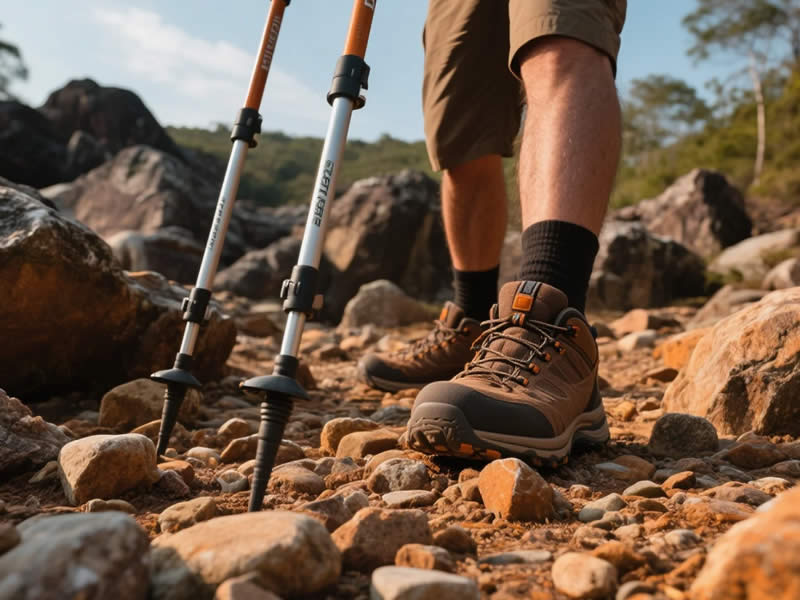
Recommended trekking pole purchase link: https://lightenup.aliexpress.com/store/1101521655
What anti‑shock poles actually do
Anti‑shock (or spring‑loaded) poles contain a small coil spring or elastomer in the upper shaft. When you plant the pole, the spring compresses a few millimetres, absorbing the initial impact that would otherwise travel up your arm. This can reduce jarring in your wrists and elbows – particularly on hard, flat surfaces like pavement or compacted dirt. However, the spring does nothing to reduce the load on your knees; that benefit comes from using any poles correctly (wrist straps, proper length, and planting technique).
Problems with anti‑shock on rocky Brazilian terrain
- Loss of direct feedback – On rocky ground, you need to feel whether your pole tip has found secure purchase or is sliding on a polished surface. A spring delays that feedback, making the pole feel “mushy” and reducing your confidence, especially on steep descents or when hopping between boulders.
- Bounciness and reduced stability – When you plant on uneven, jagged rock, the spring can cause the pole to bounce or deflect, making it harder to maintain a solid plant. This is particularly problematic on loose scree or quartzite slabs, where a stable plant is critical.
- Additional weight and complexity – Anti‑shock mechanisms add 30–50g per pole. Over a full day of hiking, that extra weight tires your arms. More moving parts also mean more potential failure points – springs can squeak, get clogged with red mud (terra rossa), or even break, leaving you with a floppy pole.
- Energy loss – Every time you push down on a spring, some of your energy goes into compressing the spring instead of propelling you forward or providing braking. On long, rocky climbs and descents, this inefficiency adds up.
- No proven knee benefit – The primary reason hikers use poles is to protect their knees. Studies show that knee load reduction comes from load transfer via wrist straps and pole length adjustment, not from springs. Rigid poles achieve the same knee protection without the downsides.
Why rigid poles are superior for rocky Brazilian trails
- Direct, immediate feedback – You feel the tip bite into the rock or slip instantly, allowing you to adjust your plant or weight distribution.
- Lighter weight – Rigid poles are simpler and lighter, reducing arm fatigue on long days.
- Greater reliability – No internal parts to jam or break. Lever locks (e.g., Leki SpeedLock, Black Diamond FlickLock) are robust and easy to clean.
- Better for steep descents – On rocky downhills, you want a solid, unyielding plant to brake and transfer weight. A rigid pole provides that stability.
When anti‑shock might be acceptable (but still not ideal)
- You have chronic wrist or elbow pain and mostly walk on smooth, hard surfaces (e.g., asphalt or packed gravel) – not typical of Brazilian hiking.
- You are a very light, recreational walker on flat, even trails.
For the vast majority of Brazilian hikers facing rocky, uneven, and humid terrain, anti‑shock is unnecessary.
What you should look for instead
- 7075 aluminium poles – Strong, durable, and bend‑not‑break. Avoid carbon (brittle) and cheap twist locks.
- Lever locks – External, easy to adjust, and reliable in mud and rain.
- Cork grips – Absorb sweat, stay non‑slip, and comfortable in high humidity.
- Replaceable tungsten carbide tips – Essential for abrasive Brazilian quartzite and granite.
Final verdict
Do not spend extra money on anti‑shock trekking poles for rocky Brazilian terrain. Rigid poles with lever locks, cork grips, and carbide tips offer better control, lighter weight, and greater reliability. Your knees will be protected just as well – and you’ll feel more confident on every step. Invest in quality rigid poles, and save the springs for urban Nordic walking.




