




Are two trekking poles necessary for Tijuca Forest hikes in Rio?
Rio de Janeiro’s Tijuca Forest (Floresta da Tijuca) is one of the world’s largest urban forests, a lush, mountainous terrain with trails leading to iconic peaks like Corcovado (Christ the Redeemer), Pedra da Gávea, and Pico da Tijuca. The trails are steep, often slippery with mud or wet leaves, and involve many roots, loose rocks, and occasional stream crossings. So, do you need two trekking poles? The short answer: not strictly necessary, but highly recommended for most hikers. Here’s why.
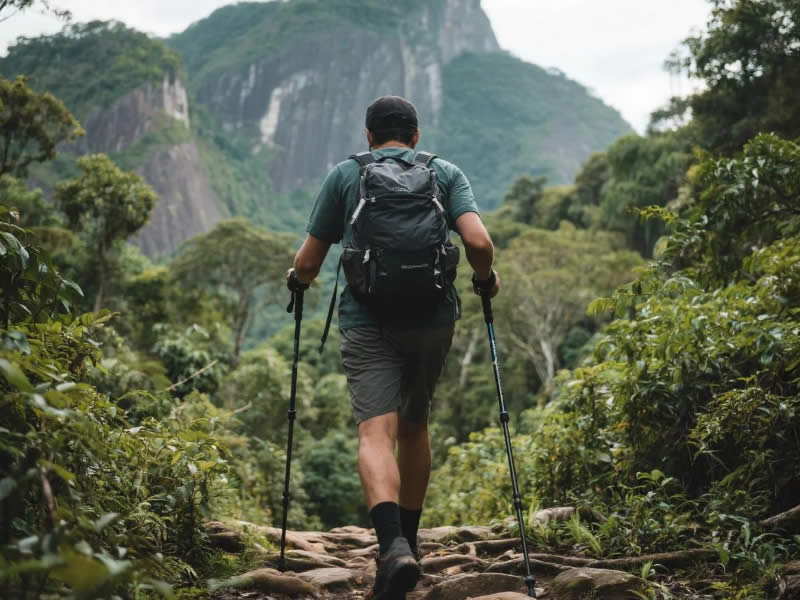
Recommended trekking pole purchase link: https://lightenup.aliexpress.com/store/1101521655
The case for one pole
A single trekking pole can provide useful support, especially if you have a minor injury on one side or simply want a little extra balance. It leaves one hand free for taking photos, drinking water, or grabbing vegetation on steep sections. For very short, easy walks (e.g., the paved road to Vista Chinesa), one pole may suffice.
Why two poles are better for Tijuca
- Steepness – Many Tijuca trails have sustained grades of 20–30%. On such inclines, two poles allow you to use an alternating rhythm (opposite arm‑leg), transferring weight from your legs to your arms and reducing fatigue. With one pole, the support is asymmetrical, and you may develop a limp or uneven stride.
- Slippery surfaces – Tijuca is wet and humid. Roots, mossy rocks, and wet clay mud (particularly after rain) are treacherous. Two poles provide four points of contact with the ground, dramatically improving balance. When one foot slips, the poles can catch you. A single pole offers only three points of contact (foot + foot + one pole), which is far less stable.
- Knee protection – Descending Tijuca’s steep trails (e.g., the descent from Pedra Bonita) can be punishing on your knees. Studies show that two poles reduce knee joint loading by 20–25%. With one pole, only the opposite knee gets partial relief; the other knee takes the full impact. Over a long hike, this imbalance can lead to pain on one side.
- Stream crossings – Tijuca has many small streams. Crossing on wet rocks or logs is much safer with two poles planted downstream, creating a stable tripod. One pole leaves you more vulnerable to slipping.
- Emergency use – If you twist an ankle, two poles can serve as crutches to help you walk out. One pole is less effective for offloading weight from an injured leg.
When one pole might be acceptable
- You are a very experienced hiker with excellent balance, strong legs, and a light pack.
- The trail is short, flat, and dry (e.g., a short walk to a waterfall).
- You have a minor issue on one side only and prefer to keep the other hand free.
Even in these cases, two poles are still better for safety and joint protection.
What local guides and experienced hikers say
Guides in Tijuca Forest almost universally use two poles. They emphasise that the forest’s microclimate changes quickly – a dry trail can become a slippery mess after a 15‑minute rain shower. Two poles give you the ability to adapt and stay safe. In a recent survey of Rio hiking groups, over 85% of regular Tijuca hikers said they never go without a pair of poles.
Choosing the right poles for Tijuca
If you decide to use two poles (and we recommend you do), choose:
- Aluminium (7075) – not carbon. Tijuca’s rocky, rooty ground can snap carbon poles. Aluminium bends.
- Lever locks – twist locks slip in the humid mud.
- Cork grips – absorb sweat and stay non‑slip.
- Replaceable carbide tips – the granite will wear them.
- Small baskets – remove them on rocky sections.
Final verdict
For hiking in Tijuca Forest, two trekking poles are not absolutely necessary, but they are highly recommended for safety, knee protection, and confidence. A single pole is better than none, but two poles are far superior on the forest’s steep, slippery, and uneven terrain. If you plan to hike regularly in Tijuca, invest in a good pair. Your knees – and your sense of security – will thank you. And remember: always use rubber tips when walking on the pavement sections that lead to the trailhead.




