




How to store trekking poles in your backpack when hiking through dense jungle?
Hiking through dense jungle – whether in the Amazon, the Atlantic Forest, or Southeast Asian rainforests – often presents a paradox. You need trekking poles for stability on muddy slopes and stream crossings, but the moment you enter thick vegetation, they become a liability. Vines, branches, and tight spaces can snag your poles, throwing you off balance or damaging the poles themselves. Knowing how to quickly and securely stow your poles in or on your backpack is a crucial jungle hiking skill. Here is a step‑by‑step guide.
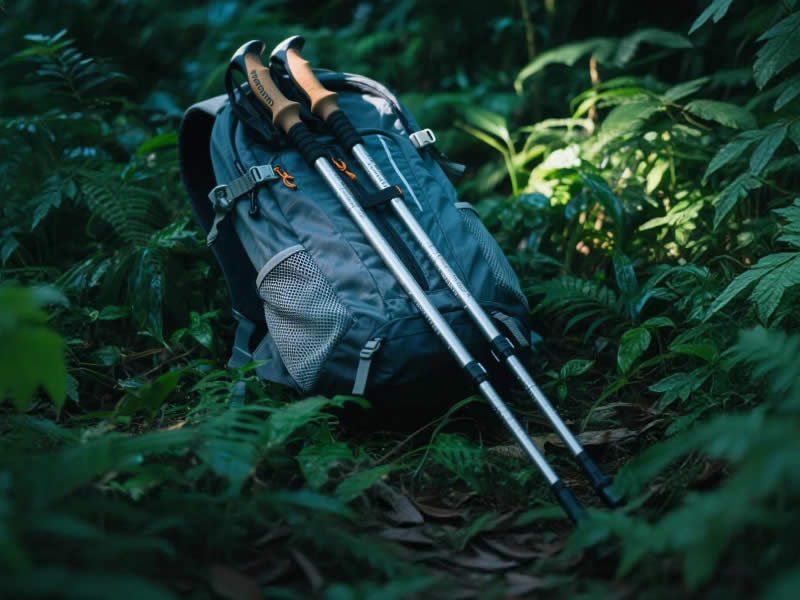
Recommended trekking pole purchase link: https://lightenup.aliexpress.com/store/1101521655
Step 1: Prepare your poles for storage
Before you stow your poles, take a few seconds to prepare them:
- Collapse telescopic poles to their shortest length. Extend them fully first to release any tension, then collapse each section.
- Fold Z‑poles completely by pulling the sections apart at the joints. The internal cord will keep them together.
- Remove baskets (both summer and snow). Baskets can snag on vegetation and are easily broken. Store them in a small ziploc bag inside your pack.
- Cover the carbide tips with rubber tip covers. If you don’t have covers, use a piece of duct tape, a wine cork, or push the tip into a spare piece of foam. Sharp tips can puncture your backpack fabric, your tent, or your own skin.
- Secure loose wrist straps by tucking them into the collapsed sections or tying them with a rubber band. Loose straps can catch on branches.
Step 2: Choose your storage method – internal or external
Internal storage (recommended for dense jungle)
Storing poles inside your pack protects them from snagging and keeps your profile narrow – essential when pushing through tight vegetation.
- Vertical placement – Place the collapsed poles vertically inside the main compartment, against the back panel (closest to your spine). This keeps the weight centred and prevents the poles from shifting.
- Wrap them in soft items – Surround the poles with clothing (a fleece jacket, a raincoat, or a towel) to prevent rattling and to protect the pack’s fabric from the tips.
- Use a stuff sack – If your poles came with a storage sack, use it. If not, a lightweight dry bag or a homemade fabric tube works. This keeps the poles together and prevents them from poking through.
- Position the tips at the bottom – Even with covers, place the tip end at the bottom of the pack, away from your back and away from delicate items like your water bladder or camera.
External storage (when internal space is tight)
If your pack is full of food and camping gear, you may need to carry the poles externally.
- Side compression straps – Most backpacks have two straps on each side. Collapse the poles and slide them vertically between the pack body and the straps. Tighten the straps firmly. This method keeps the poles accessible and avoids taking up internal space.
- Daisy chain or ice axe loop – Insert the pole tips into an ice axe loop at the bottom of the pack, then secure the upper section with a daisy chain strap or a bungee cord. Ensure the poles are tight against the pack so they don’t swing.
- Avoid horizontal carry – Do not strap poles horizontally across the top of your pack. In dense jungle, they will catch on every branch and vine, and they can hit you in the face when you turn.
Step 3: Techniques for dense jungle
- Streamline your pack – Before entering a thicket, take a moment to check that no straps or cords are dangling. Tuck in loose webbing.
- Test the security – After stowing, give the poles a gentle tug. They should not move. If they slide, tighten the compression straps or reposition them.
- Keep them accessible – If you expect to need the poles again soon (e.g., after a short scramble), store them externally on the side where you can reach them without removing your pack. Some hikers use a magnetic clip or a quick‑release bungee on the shoulder strap.
Step 4: What to avoid in jungle storage
- Do not leave tips uncovered – A carbide tip can puncture your backpack, your tent, or your water bladder. Always cover them.
- Do not store poles horizontally – As mentioned, horizontal poles are a snag magnet.
- Do not leave baskets on – They will catch on ferns and vines, and they can break off.
- Do not use elastic bands alone – They break or lose tension in humidity. Use compression straps or webbing.
Step 5: Practice at home
Before your jungle trip, practice stowing and deploying your poles with your loaded backpack. Time yourself. Aim to stow both poles in under 30 seconds. Learn to do it without looking. In the jungle, you may need to stow them quickly to free your hands for a scramble.
Step 6: Clean after the jungle
After emerging from the jungle, inspect your poles. Remove any mud, leaves, or insects from the locks and baskets. Dry the poles thoroughly before collapsing them for storage. The high humidity of jungle environments can cause corrosion if you store poles wet.
Additional tip: Use a dedicated pole sack
If you frequently hike in dense jungle, invest in a lightweight, durable pole sack (often sold by trekking pole brands or as generic accessories). Slip the collapsed poles into the sack, then put the sack in your backpack. The sack protects your pack and keeps the poles together.
Final thoughts
Storing trekking poles correctly in dense jungle is a small but vital skill. It protects your gear, keeps you from snagging on vegetation, and allows you to move freely through tight spaces. Whether you choose internal or external storage, always collapse the poles, cover the tips, remove baskets, and secure them tightly. With a little practice, you will be able to stow and deploy your poles in seconds – leaving you free to focus on the incredible biodiversity of the jungle around you.




