




How to use trekking poles for balance on sandy trails near Brazilian beaches?
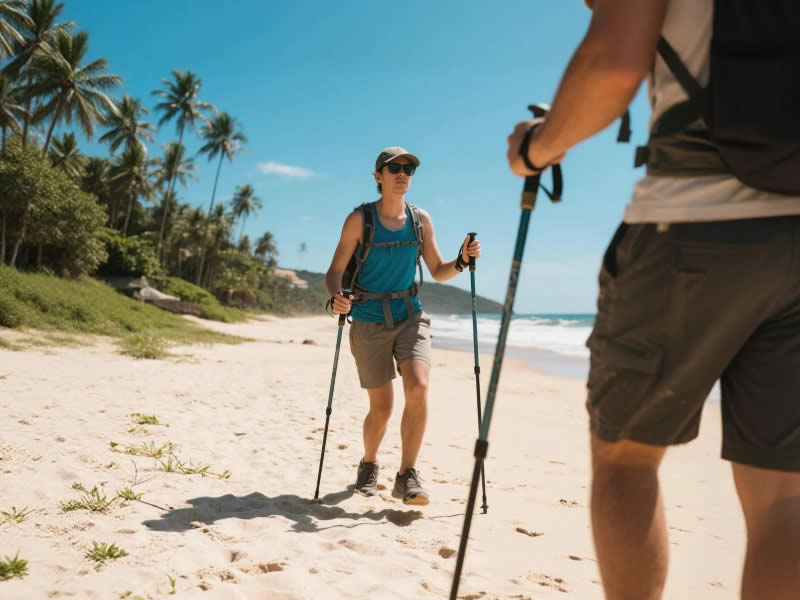
Walking on sandy trails near Brazil’s stunning coastline – from the dunes of Lençóis Maranhenses to the beach paths of Ilha Grande or the sandy tracks of Jericoacoara – presents a unique challenge. Sand is soft, unstable, and energy‑sapping. Your feet sink, and without support, each step can feel like a struggle. Trekking poles, used correctly, transform walking on sand into a stable, efficient, and even enjoyable experience. Here’s how to master sandy trails with your poles.
Recommended trekking pole purchase link: https://lightenup.aliexpress.com/store/1101521655
The problem with sand
Unlike hard ground, sand shifts under your weight. When you step, your foot sinks, and the sand flows around it, creating a sucking effect. Your natural balance is compromised, and your muscles work harder to stabilise. Poles provide four points of contact, reducing the sinking effect and improving stability.
Essential equipment for sandy trails
- Sand baskets (larger than summer baskets) – These are essential. Standard small baskets (4–5 cm) will sink; sand baskets (6–8 cm) have a larger surface area, preventing the pole from plunging deep. Some trekking pole brands sell dedicated sand baskets; alternatively, use mud baskets or small snow baskets. If you don’t have them, you can still use poles, but they will sink more.
- Carbide tips – The sharp point helps penetrate the sand to find a firmer layer below. Rubber tips are useless on sand.
- Lightweight aluminium poles – Carbon is fine, but aluminium is more durable for the abrasive sand.
- Two poles, always – One pole is not enough to provide four‑point stability.
Technique for walking on sandy trails
- Lengthen your poles slightly – Add 2–3 cm to your normal flat‑ground length. A slightly longer pole allows you to plant ahead without leaning too far forward.
- Plant vertically – On sand, an angled plant will cause the pole to slide sideways. Push the tip straight down until the basket contacts the surface. The basket should sit on top of the sand, preventing further sinking.
- Use an alternating rhythm – Opposite pole to forward foot (right foot forward, left pole down). This natural gait works well on sand.
- Take shorter steps – Long strides cause your foot to sink deeper. Keep your feet under your body. Short, shuffling steps are more stable.
- Push down lightly, then lift – Don’t push hard; you’ll just bury the pole deeper. A gentle plant is enough to get the basket to float.
- Keep your weight centred – Avoid leaning forward or back. Your torso should be upright, with knees slightly bent.
What about steep sand dunes (e.g., Lençóis Maranhenses)?
On steep dune slopes, the technique changes:
- Uphill: Shorten poles by 5–10 cm, use double planting (both poles together), and pull yourself up. The baskets will prevent sinking, and your arms will help your legs.
- Downhill: Lengthen poles by 5–10 cm, plant both poles ahead, and push down to brake. This controls your descent and prevents you from sliding.
Walking on wet, compacted sand (near the waterline)
At the beach waterline, sand is firm and wet. You can use standard small baskets or no baskets at all. The technique is similar to walking on hard ground: use alternate planting, elbows at 90°. However, be prepared for occasional soft patches – keep your baskets handy.
Common mistakes on sandy trails
- Using small baskets – Your poles will sink, and you’ll tire quickly. Always fit sand baskets for dry, loose sand.
- Planting at an angle – The pole will skid, and you may lose balance.
- Long strides – Sink deeper and waste energy.
- Gripping too tightly – Let the wrist strap work; relax your fingers.
- Using only one pole – Unbalanced and inefficient.
Adapting to mixed terrain (sand to rock to sand)
Brazil’s coastal trails often alternate between sand, rock, and forest. Be ready to change your setup:
- Carry sand baskets in your pocket and swap them on when you hit deep sand.
- For short sandy sections, you can keep your small baskets and accept a little sinking – it’s not ideal but manageable.
- On rocky sections, remove baskets to avoid catching.
Maintenance after sandy hikes
Sand is abrasive and can get into your locking mechanisms. After a beach walk:
- Rinse poles with fresh water – Pay attention to the locks and baskets.
- Dry thoroughly – Extend poles and leave them in a ventilated area.
- Lubricate lever lock pivots – A drop of oil prevents sand‑induced wear.
- Check baskets – Sand can wear down plastic edges; replace cracked baskets.
Recommended poles for sandy Brazilian trails
- Leki Makalu – Durable 7075 aluminium, SpeedLock lever, cork grip. Add Leki’s “Sand baskets” (available as an accessory).
- Decathlon Forclaz MT500 – Budget aluminium, lever lock, cork/foam grip. Decathlon sells universal sand baskets.
- Black Diamond Trail Pro – Robust, FlickLock lever, foam grip. Add BD’s “Mud/Sand baskets”.
Final thoughts
Walking on sandy trails near Brazilian beaches doesn’t have to be a struggle. With the right equipment (sand baskets, two poles) and proper technique (vertical plant, short steps, centred weight), you’ll glide over the sand with stability and ease. Enjoy the stunning coastal landscapes of Brazil – from the white dunes of Maranhão to the golden beaches of Bahia – without the frustration of sinking footsteps. Your trekking poles will be your best friends on the sand.




