




How to use trekking poles to clear spider webs on narrow forest paths?
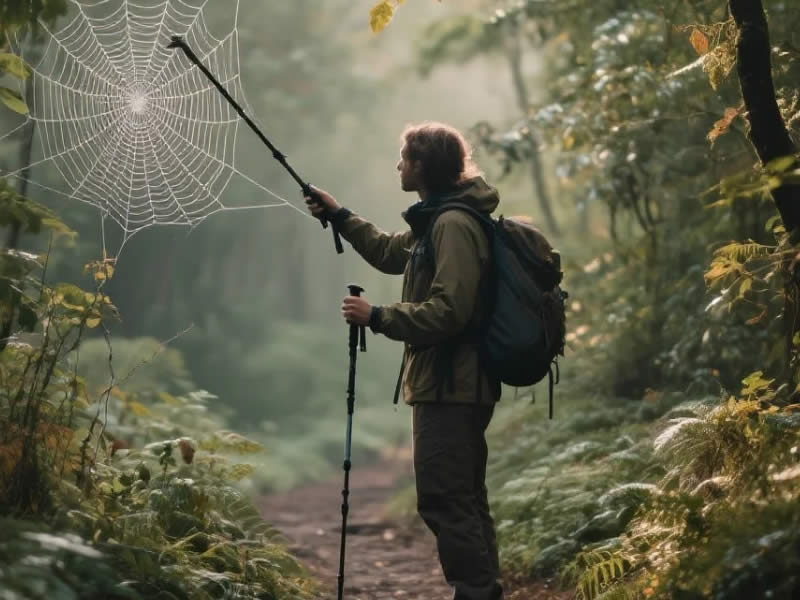
If you have ever hiked early in the morning on a narrow forest path – whether in the Brazilian Atlantic Forest, the Appalachian woods, or any temperate or tropical woodland – you know the sudden, startling sensation of walking face‑first into a spider web. The sticky silk clings to your skin, and the unseen weaver may drop onto your shoulder. Your trekking poles are not just for balance and knee protection; they are the perfect tool to clear webs ahead of you, keeping your hike comfortable and arachnid‑free. Here is a complete guide to using your poles as a web‑clearing wand.
Recommended trekking pole purchase link: https://lightenup.aliexpress.com/store/1101521655
Why use trekking poles to clear webs?
- Avoids direct contact – No more sticky silk on your face or neck. The pole takes the web.
- Protects the spider – By gently moving the web rather than destroying it, you allow the spider to rebuild elsewhere.
- Keeps your hands free – You don’t need to wave your arms or carry a separate stick.
- Extends your reach – A pole can clear webs at face height or even above your head.
The basic technique: horizontal sweep
- Hold one pole horizontally in front of your face, at about eye or nose level. Grip it near the centre for balance.
- Sweep gently from side to side as you walk, keeping the pole just ahead of your leading foot. Use a smooth, continuous motion – not a rapid flick.
- The goal is to break the web’s anchor threads without snapping the pole or damaging nearby vegetation. A light touch is sufficient; most webs are fragile.
- For very low webs (across the trail at ankle or knee height), lower the pole to that level and sweep.
Two‑pole technique for dense webs
On trails where webs are frequent (e.g., after a rainy night, or in early morning), use both poles:
- Hold one pole in each hand, forming a horizontal bar about 1.5 m wide. Walk with the poles held steady at face height. This creates a “web plow” that clears a wider path.
- Alternatively, hold both poles together in one hand and sweep in front of you as a single wide bar. This frees your other hand for balance.
Dealing with different web types
- Orb webs (classic circular webs) – A horizontal sweep catches the central threads, and the whole web collapses.
- Sheet webs (flat, tangled masses) – A vertical or diagonal sweep is more effective. Raise the pole above your head and bring it down in a chopping motion? No, a gentle downward sweep works.
- Funnel webs – Use the pole to push aside the funnel opening; the spider will retreat, and you can step over.
- Single anchor threads – A simple touch with the pole tip breaks the thread.
Vertical sweep for overhead webs
If a web is strung across the trail at head height or higher:
- Hold the pole vertically with the tip pointing up.
- Extend your arm and push the pole upward through the web. The tip will gather the silk, and you can lower it to the side.
- Alternatively, raise both poles like goalposts and walk through – the webs will gather on the poles.
How to avoid harming spiders
- Do not swing aggressively. A gentle touch allows the spider to fall to the ground or retreat to a leaf.
- Avoid smashing the web into a ball – that destroys it completely. Instead, break the anchor points so the web collapses naturally.
- After clearing, shake the pole to release any spider that may have clung to it. Do not flick it violently; just a gentle tap.
- Remember that spiders are beneficial – they control insect populations. Clear webs, but don’t go on a crusade.
Cleaning your poles after a web‑filled hike
Spider silk is sticky but water‑soluble. After your hike:
- Rinse the poles with fresh water – the silk will wash off easily.
- Dry with a cloth. Sticky residue can attract dirt; a quick wash prevents buildup.
- Check your grips – silk on cork or foam can be removed with a damp cloth.
When not to use poles to clear webs
- On very narrow, overgrown trails where you need both hands for balance – stow your poles and use your arms.
- If you are hiking in a group – the person in front should clear webs; those behind follow. If you sweep aggressively, you may hit the person behind.
- If you are afraid of spiders – using a pole may cause the spider to fall onto you. Consider having a friend go first, or use a long stick rather than a pole close to your body.
Alternative: use a dedicated “web wand”
Some hikers carry a lightweight, telescopic carbon rod specifically for web clearing. But your trekking poles are already in your hands – why carry extra weight? With a little practice, the pole technique becomes automatic.
Eco‑awareness tip
In pristine areas, consider avoiding the trail after heavy rain or early morning when webs are most abundant. Spiders rebuild every evening; by walking early, you are guaranteed to hit webs. If you must go, use your poles gently and try not to kill the spider. Many spiders will drop to the ground if they feel the vibration of the pole – give them a chance to crawl away.
Practice on a quiet path
Before your big hike, practice the horizontal sweep on a local path. Get comfortable with the motion. You’ll soon learn to clear webs without even slowing down.
Final thoughts
Using trekking poles to clear spider webs is a simple skill that transforms a frustrating, sticky morning into a pleasant walk. Hold one pole horizontally, sweep gently from side to side, and watch the webs part before you. With a two‑pole plow, you can clear a wider path. Always be kind to the spider – a gentle touch is enough. Your poles earn their keep not just on steep descents, but on every silken thread that stretches across the trail. Happy (web‑free) hiking!




