




Can trekking poles be used as tent stakes in emergency camping situations?
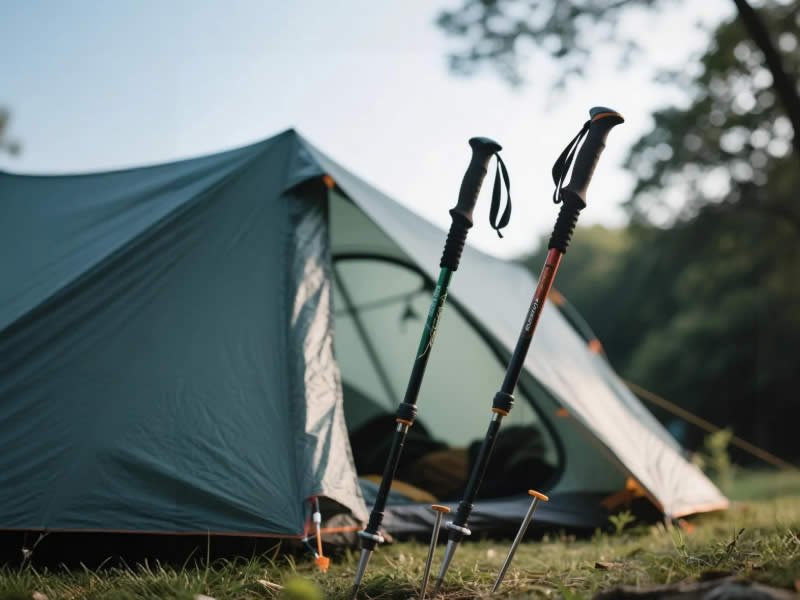
Yes – in an emergency, your trekking poles can serve as makeshift tent stakes. While they are not designed for this purpose, and you should never rely on them as a primary solution, they can save the night when you have lost your pegs, the ground is too hard for regular stakes, or you forgot your stake bag. Here is a practical guide to using trekking poles as emergency tent stakes, including techniques, limitations, and better alternatives.
Recommended trekking pole purchase link: https://lightenup.aliexpress.com/store/1101521655
When would you need to use poles as stakes?
- You lost or forgot your tent stakes (a common beginner error).
- The ground is too rocky or frozen for standard pegs – your poles can be pounded into crevices or wedged.
- You are using a trekking‑pole tent (e.g., a tarp or pyramid) and need additional anchor points.
- You are in a survival situation and have no other anchoring options.
Technique 1: The vertical stake
This works best on soft ground – dirt, sand, or muddy campsites.
- Collapse your poles completely to their shortest length (telescopic) or fold Z‑poles.
- Push the carbide tip vertically into the ground at the desired stake point. The sharp tip will penetrate most soils easily.
- Push the pole down until the basket (if attached) sits on the surface, or until the pole is about 5–10 cm deep.
- Tie your guy line around the pole just above the tip or around the basket. A clove hitch or a simple loop works.
- Angle the pole slightly away from the tent – the tension will pull it, so you want it to resist.
Limitations: On very soft ground, the pole may pull out under tension. On hard or rocky ground, you cannot push it in.
Technique 2: The angled deadman
This is better for windy conditions or softer soils.
- Dig a small trench or scrape a shallow depression in the ground, about 10–15 cm long.
- Lay the collapsed pole horizontally in the trench, perpendicular to the direction of the guy line.
- Tie the guy line to the middle of the pole or to the basket.
- Cover the pole with soil, rocks, or sand – the weight of the covering will anchor it. The pole acts like a deadman anchor.
Advantages: Very secure, works in sand and loose soil. Disadvantage: You need to dig.
Technique 3: Using the pole as a rock anchor
If you are on rocky ground (e.g., granite slabs in Serra dos Órgãos), you cannot drive stakes. Instead:
- Collapse the pole to its shortest length.
- Find a heavy rock (5–10 kg) with a crevice or a shape that can trap the pole.
- Place the pole under the rock with the tip pointing outward, or thread the guy line through the basket and then place the rock on top of the pole.
- Pull the guy line taut – the rock’s weight holds the line.
Alternative: Use the pole as a lever to lift a rock, then slide the guy line under the rock. But the pole itself can be the anchor.
Technique 4: Ice and snow anchoring
If camping on snow or ice (rare in Brazil, but possible in the highest peaks of the Mantiqueira), your poles can serve as snow stakes.
- Insert the pole vertically into the snow at an angle (about 45° leaning away from the tent).
- Push it down until the basket is buried. The large snow basket provides flotation and resistance.
- Tie the guy line to the grip or just above the basket.
- Tamp down the snow around the pole to solidify it.
Important: Do not use your poles as stakes for high winds
Your trekking poles are valuable, and using them as stakes can bend them (especially aluminium) or snap them (carbon). If the wind is strong and the pole is pulled sideways, it may fail. Only use this technique in calm conditions or as a last resort.
What about using the poles as part of the tent structure?
Many tents (e.g., trekking‑pole tents) already use your poles as the main supports. In that case, you still need stakes for the corners. You can use your second set of poles (if you carry two pairs) or a single pole as a stake. But typically, you have only one pair.
Better alternatives for emergency stakes
- Carry spare stakes – A few extra lightweight pegs (e.g., titanium shepherds hooks) weigh almost nothing. Keep them in your repair kit.
- Use natural materials – Wooden sticks, sharpened branches, or even large nails (if you have a multi‑tool).
- Use your ice axe – If you have one, it can serve as a stake (but it’s heavy).
- Use rocks and logs – You can often guy out a tent to a large rock or a tree root without any stakes.
How to minimise the need for stakes
- Choose a sheltered campsite with natural anchors (trees, large boulders).
- Use a tent that can be pitched with guylines only (e.g., some tarps and pyramids).
- Set up your tent so that the main tension is on the trekking poles themselves, not on the stakes.
Real‑world example
In Chapada Diamantina, on the rocky plateau of the Vale do Pati, finding a spot to drive stakes can be impossible. Hikers often use trekking poles as deadman anchors by burying them under rocks or using the rock‑anchor method. It works, but it’s time‑consuming.
After the emergency
- Inspect your poles – Check for bends, cracks, or damaged locks. If you used them as stakes on rocky ground, the tips may be dull.
- Clean the poles – Remove dirt from the locks and shafts.
- Replace any damaged parts – Tips, baskets, or the pole itself.
Final verdict
Yes, trekking poles can be used as emergency tent stakes in a pinch. They work as vertical stakes in soft ground, as deadman anchors in sand or soil, as rock anchors with heavy stones, or as snow stakes in winter. However, they are not designed for this purpose, and using them may damage the poles or cause them to fail in windy conditions. For peace of mind, always carry a few lightweight spare stakes. In an emergency, your poles can save the night – but treat them with care.




