




How to store trekking poles in a humid Brazilian house to prevent damage?
Living in Brazil means dealing with high humidity – especially in coastal cities like Rio de Janeiro, Salvador, or Recife, or in rainforest regions like the Amazon and the Atlantic Forest. This humidity can wreak havoc on trekking poles, causing corrosion, mould, and sticking mechanisms. Proper storage is just as important as cleaning after a hike. Here is a step‑by‑step guide to storing your trekking poles in a humid Brazilian house to keep them in top condition.
Recommended trekking pole purchase link: https://lightenup.aliexpress.com/store/1101521655
Why humidity damages trekking poles
- Corrosion: Aluminium shafts can develop white powdery oxide; steel components (screws, springs, tip ferrules) rust.
- Mould and mildew: Damp grips (cork or foam) can grow mould, becoming smelly and slippery.
- Frozen locks: Moisture inside twist‑lock mechanisms can cause them to seize or become impossible to turn.
- Baskets and tips: Plastic baskets can become brittle in high humidity? Actually, humidity doesn’t affect plastic much, but moisture trapped in the joints leads to corrosion.
The key is to store poles clean, dry, and extended.
Step 1: Clean before storing
Never store poles that are muddy or salty from sweat. Follow the post‑hike cleaning routine:
- Rinse with fresh water to remove mud, salt, and grit.
- Scrub locks and joints with a soft brush.
- Use mild soap if needed, then rinse thoroughly.
- Pay special attention to the inside of telescopic sections – extend poles fully and flush with water.
Step 2: Dry completely – this is critical
Humidity means that even if you wipe the poles, moisture remains in the locking mechanisms and between overlapping sections. You must:
- Extend poles fully – do not collapse them.
- Leave them extended for at least 24 hours in a well‑ventilated area. A room with a dehumidifier or an air‑conditioned room is ideal.
- Use a hair dryer on a cool setting to blow warm air into the locks (especially twist locks) to evaporate trapped moisture.
- Wipe all metal parts with a dry cloth.
Step 3: Apply a protective coating
Once completely dry, protect the metal surfaces:
- Aluminium shafts: Wipe with a cloth lightly dampened with silicone spray or light machine oil. This repels moisture and prevents oxidation. Avoid WD‑40 – it leaves a sticky residue.
- Steel components (screws, springs, tip ferrules): After cleaning, apply a tiny drop of light oil. For internal springs (anti‑shock poles), a light spray of dry silicone can help.
- Lever lock pivots: One drop of oil on the hinge.
- Twist‑lock threads: Apply silicone grease to the threads only (not the friction surfaces).
Step 4: Choose the right storage location
- Best: An air‑conditioned, dry room with low humidity (e.g., a bedroom or living room). Avoid bathrooms, kitchens, and laundry rooms.
- Acceptable: A closet in a well‑ventilated area, as long as it’s not damp.
- Avoid: Garages, basements, attics, sheds, or any space with poor airflow or high humidity.
- Do not store: In a car, on a balcony exposed to rain, or near a window where condensation forms.
Step 5: Store poles extended, not collapsed
This is the most common mistake: collapsing poles and putting them in a cupboard. The trapped moisture between sections leads to corrosion and makes sections stick.
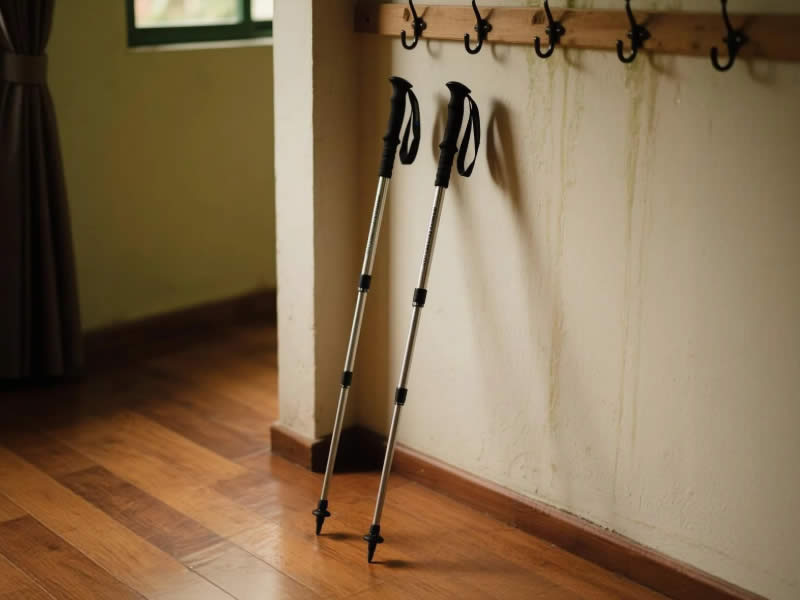
- Leave poles fully extended – lean them against a wall in a corner, or lay them flat on a shelf.
- If you lack space, collapse them but loosen all locks so air can circulate inside. However, extended is always better.
Step 6: Additional moisture‑control measures
- Silica gel packets: Place a few large silica gel packets inside the storage bag or near the poles. Replace them when they change colour.
- Dehumidifier: If your house is very humid, run a dehumidifier in the room where you store gear.
- Never store poles in a closed plastic bag – this traps moisture and promotes mould.
Special care for cork grips
Cork grips can absorb moisture and sweat, leading to mould. After cleaning, allow them to air dry completely. If they feel damp, you can gently warm them with a hair dryer on low heat. To prevent mould, wipe them occasionally with a diluted vinegar solution (1 part vinegar to 3 parts water), then rinse and dry.
What to do if you have already stored poles incorrectly
If you pull out your poles and find white powder (oxidation), rust, or sticky locks:
- Clean thoroughly with water and a brush.
- For oxidation, use white vinegar on a cloth to remove the white powder.
- For rust on steel, use steel wool or vinegar.
- Dry completely, then lubricate as described.
Seasonal storage (months without use)
If you are not hiking for several months (e.g., winter in the South of Brazil), follow the same steps: clean, dry, lubricate, and store extended. Check on the poles every month – if you see any white powder, wipe it off and re‑apply silicone spray.
Final checklist for humid Brazilian houses
- Poles cleaned and bone‑dry
- Fully extended (not collapsed)
- Metal parts lightly oiled or sprayed with silicone
- Stored in a dry, ventilated room (not garage)
- Avoid direct sunlight (UV degrades grips)
- No closed plastic bags
Conclusion
Storing trekking poles correctly in a humid Brazilian house is not difficult, but it requires discipline. The golden rules: clean, dry, extend, lubricate, and store in a dry place. A few minutes of care after each hike and proper long‑term storage will prevent corrosion, mould, and stuck locks, ensuring your poles remain reliable for years of adventures in Brazil’s beautiful mountains and forests. Don’t let humidity ruin your gear – store smart!




