




How to replace frayed wrist straps on trekking poles?
Wrist straps are among the most heavily used components of trekking poles. They endure sweat, friction, and constant tension. Over time, they fray, the stitching loosens, or the padding compresses. A worn‑out strap not only reduces comfort but can also be dangerous – a broken strap on a steep descent may cause you to lose your pole or fall. Fortunately, replacing wrist straps is a simple, low‑cost repair that you can do at home with basic tools. This guide covers the most common attachment systems and provides step‑by‑step instructions.
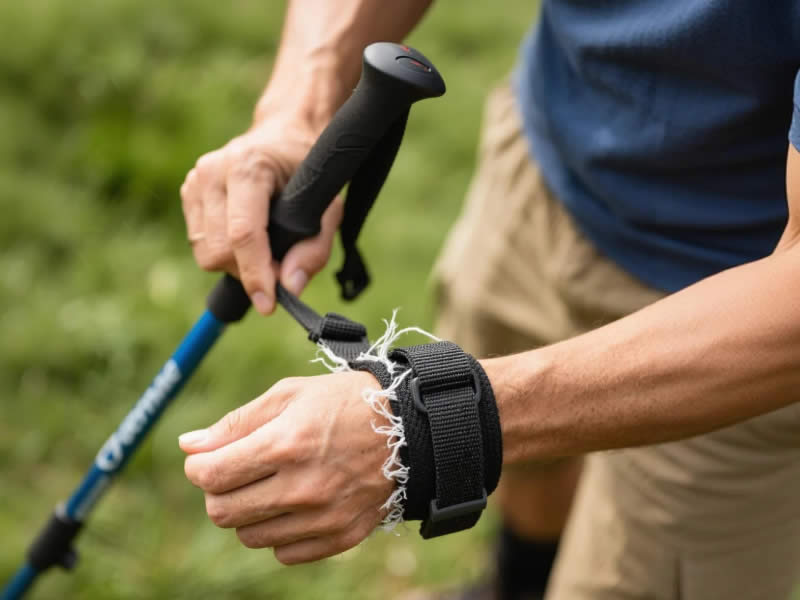
Why replace frayed straps promptly?
- Safety: A frayed strap can snap under load, especially when you are leaning heavily on the pole.
- Comfort: Worn straps have lost padding; they can dig into your skin and cause blisters or numbness.
- Hygiene: Old straps absorb sweat and harbour bacteria, leading to unpleasant odours.
- Efficiency: A properly adjusted strap transfers weight from your grip to your arm; a frayed strap cannot do that reliably.
Types of strap attachment systems
Most trekking poles use one of these methods:
- Retaining pin (most common) – A small metal or plastic pin passes through the top of the grip and a loop in the strap. Found on Leki, Black Diamond, Komperdell, Decathlon, and many others.
- Wrap‑around loop – The strap forms a loop that goes around the grip, secured by stitching or a buckle. Common on very budget poles.
- Screw‑mount – The strap attaches to the grip via a small screw (rare).
Identifying your system
Look at the top of the pole grip. If you see a small hole on each side with a pin going through, it’s a retaining pin system. If the strap wraps around the grip and is stitched to itself, it’s a wrap‑around. If you see a tiny screw head, it’s screw‑mount.
Step‑by‑step replacement for retaining pin systems (e.g., Leki, Black Diamond, Decathlon)
Tools needed: Small flathead screwdriver, pin punch, or a paperclip; optional: a small hammer or multi‑tool.
- Push out the retaining pin – Locate the pin that goes through the grip. It often has a smaller end and a larger end. Use a paperclip or a small screwdriver to push the pin from the smaller side. Tap gently with a light hammer if needed. The pin should slide out. If it’s stuck, apply a drop of penetrating oil (e.g., WD‑40) and wait a few minutes.
- Remove the old strap – Once the pin is out, pull the old strap out of the slot. Note the orientation: the padded side of the strap should face toward your wrist, and the adjustment slider should be accessible.
- Clean the slot – Use a toothbrush or a cloth to remove any dirt or old thread from the groove.
- Prepare the new strap – If you bought a brand‑specific replacement (e.g., Leki, Black Diamond), it will have a sewn loop or a reinforced hole. Ensure it’s the correct left/right version if your poles are handed.
- Insert the new strap – Slide the strap’s end into the slot. Align the hole or loop with the pin channel. The strap should be oriented so that the padded part will rest on the back of your hand when you use the pole correctly (hand up from below).
- Re‑insert the pin – Push the pin back through the grip and the strap. It should go in smoothly and sit flush on both sides. Tap gently if needed. The strap should pivot freely but not fall out.
- Adjust the length – Use the slider or buckle to set the strap to fit your hand. The correct fit: when you insert your hand from below, the strap should be snug enough that you can relax your fingers and the pole stays attached, but not so tight that it cuts off circulation.
Replacing wrap‑around loop straps
- Cut the old strap carefully with scissors, taking care not to damage the grip.
- Source a replacement: Universal replacement straps with velcro or buckle closures are available online (Amazon, Mercado Livre). Alternatively, sew your own using 15‑20 mm wide nylon webbing and a ladder lock buckle.
- Wrap the new strap around the grip, ensuring it cannot slip off when pulled. Secure via the buckle or by stitching.
- Test – Pull firmly; the strap should stay in place.
Replacing screw‑mount straps
- Unscrew the small screw (often a Phillips or hex head) that holds the strap.
- Remove the old strap and clean the screw and mount area.
- Attach the new strap (some brands sell replacement kits). Use a tiny drop of threadlocker on the screw to prevent loosening.
- Tighten snugly – do not overtighten, as you may crack the plastic grip.
Where to buy replacement straps in Brazil
- Decathlon – Sells universal replacement straps for their Forclaz poles, as well as some Leki‑compatible straps.
- Adventure Sport (adventuresport.com.br) – Authorised Leki importer; stocks genuine Leki wrist straps.
- Dancor (dancor.com.br) – Another source for Leki and Komperdell parts.
- Mercado Livre / Amazon Brasil – Search for “alça de pulso para bastão de trilha”. Check seller ratings and compatibility.
- Universal straps – Available from third‑party sellers; ensure the attachment method matches your pole.
Preventive maintenance for longer strap life
- Rinse straps after sweaty hikes – salt accelerates wear. Use fresh water and let them air dry.
- Avoid leaving poles in direct sunlight for weeks – UV degrades nylon and padding.
- Inspect stitching regularly – catch small frays before they become big tears.
- Adjust the strap to the correct tension – too tight puts stress on the stitching; too loose causes you to grip harder, which can wear the strap faster.
When to replace rather than repair
If the grip itself is cracked or the pin hole is enlarged, no new strap will hold securely. In that case, consider replacing the entire pole or the grip (if removable). Also, if your poles are very cheap (under 100 BRL), the cost of replacement straps may be close to the price of new poles – but it’s still worth repairing to reduce waste.
Conclusion
Replacing frayed wrist straps is a quick, inexpensive repair that restores the safety and comfort of your trekking poles. Most poles use a simple retaining pin system: push out the pin, swap the strap, reinsert the pin. Keep a spare pair of straps in your repair kit. With fresh straps, your poles will feel like new, and your hands will thank you on every descent.




