




Are trekking poles good for balance problems in older Brazilian adults?
Yes – and for many, they can be life‑changing. As we age, balance problems become increasingly common due to muscle weakness, joint stiffness, reduced proprioception, and side effects of medications. Falls are a leading cause of injury among older adults. In Brazil, where sidewalks are often uneven, streets have cobblestones, and parks may have sloping, root‑crossed paths, maintaining balance can be a daily challenge. Trekking poles – used in pairs – are an excellent, low‑cost tool to improve stability and prevent falls. Here’s why they work and how to use them correctly.
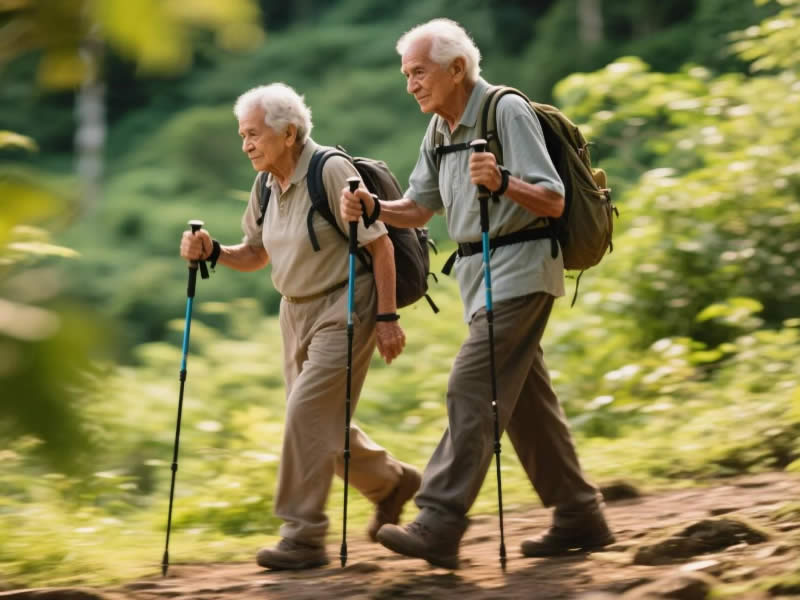
Recommended trekking pole purchase link: https://lightenup.aliexpress.com/store/1101521655
Why balance declines with age
Balance relies on a complex system: vision, vestibular (inner ear), and proprioception (sensing body position). Age‑related changes in any of these systems can cause unsteadiness. Additionally, muscle weakness (sarcopenia) makes it harder to correct a stumble. Many older adults also have arthritis, neuropathy, or orthostatic hypotension, further compromising balance.
How trekking poles help
- Widen the base of support – With two poles, you go from two points of contact (your feet) to four. This dramatically increases stability. When one foot slips, the poles can support your weight instantly, preventing a fall.
- Provide tactile feedback – The poles give you information about the ground ahead. You can test a step before committing your weight, feeling for loose tiles, curbs, or wet spots.
- Offload weight from legs – By pushing down on the poles, you transfer some body weight to your arms. This reduces the load on weak or arthritic hips and knees, allowing you to walk more securely.
- Encourage an upright posture – Poles naturally pull your shoulders back, opening your chest. This improves breathing and shifts your centre of gravity, reducing the forward lean that often leads to falls in older adults.
- Boost confidence – Fear of falling can limit activity, leading to further muscle weakness. Poles give a tangible sense of security, encouraging older adults to walk more often – which in turn strengthens balance.
What the research says
Studies have shown that using two walking poles (e.g., Nordic walking poles or trekking poles) significantly reduces postural sway and improves dynamic balance compared to walking unaided or with a single cane. A 2016 review in Gait & Posture concluded that pole walking is an effective intervention for improving balance and reducing fall risk in older adults.
Choosing the right poles for older Brazilian adults
- Two poles, always – One pole unbalances you. Always use a pair.
- Lightweight aluminium – Heavy poles cause arm fatigue. Look for under 260g per pole (520g per pair). Decathlon’s Forclaz MT500 (₿250‑300) is ideal.
- Lever locks, not twist locks – Twist locks require a twisting motion that can be difficult for arthritic hands. Lever locks are easy to operate with a simple push.
- Cork or soft foam grips – Comfortable and non‑slip. Cork also absorbs sweat.
- Rubber tips (paw covers) – For walking on pavement, tiles, or indoors, rubber tips provide excellent grip. Carbide tips are for dirt only and are dangerously slippery on hard surfaces.
- Adjustable height – The poles must be set to the correct length: when standing, your elbow should be at a 90° angle with the tip on the ground.
How to use trekking poles for balance
- Adjust the length – Standing upright, bend your elbow to 90°. Adjust the pole so the rubber tip touches the ground. Mark this setting.
- Use the wrist straps correctly – Insert your hand up through the strap from below, then grip lightly. The strap should sit between your thumb and index finger. Relax your fingers – the strap bears your weight.
- Walk with opposite arm‑leg rhythm – Right foot forward, left pole forward; left foot forward, right pole forward. This mimics natural walking and is most stable.
- Start on flat, dry ground – Practice indoors or on a smooth sidewalk. Gradually progress to uneven surfaces.
- Look ahead, not down – Your peripheral vision will guide the poles.
Safety tips for Brazilian conditions
- Always use rubber tips on pavement – Brazilian sidewalks often have smooth tiles, slippery when wet. Rubber tips grip well.
- Avoid using poles on steep, loose terrain – If you have significant balance problems, stick to flat or gently rolling paths until you gain confidence.
- Check your poles regularly – Ensure locks are tight and rubber tips are not worn out.
- Consult a physiotherapist – If you have severe balance issues, a professional can assess whether poles are suitable or if a walker is needed.
When trekking poles are not enough
For older adults with significant balance impairment (e.g., due to Parkinson’s disease, stroke, or vestibular disorders), a four‑wheeled walker (rollator) or a cane with a quad base may be safer. Always seek medical advice.
Where to buy in Brazil
- Decathlon – Affordable Forclaz MT500, with rubber tips included. Staff can help with fitting.
- Adventure Sport – For Leki Makalu, more expensive but very comfortable.
- Mercado Livre / Amazon Brasil – Search for “bastão de trilha para idosos” or “bengala ajustável dupla”.
Final verdict
Yes, trekking poles are highly effective for improving balance in older Brazilian adults. Used in pairs, with rubber tips and correct technique, they reduce fall risk, increase walking confidence, and encourage active lifestyles. They are not a cure for balance disorders, but for many, they are a simple, empowering tool that makes daily walks safer and more enjoyable. Encourage your older loved ones to try them – and consider joining them on a walk through Brazil’s beautiful parks, with poles in hand.




