




Can trekking poles be used as an emergency antenna for satellite devices?
In remote Brazilian backcountry—think deep Chapada Diamantina or the Amazon rainforest—satellite communication devices (like Garmin inReach, SPOT, or Zoleo) are lifelines. But what if your signal is weak? Could your trekking pole serve as an emergency antenna booster? The short answer is theoretically possible, but practically risky and rarely effective. Here’s what you need to know.
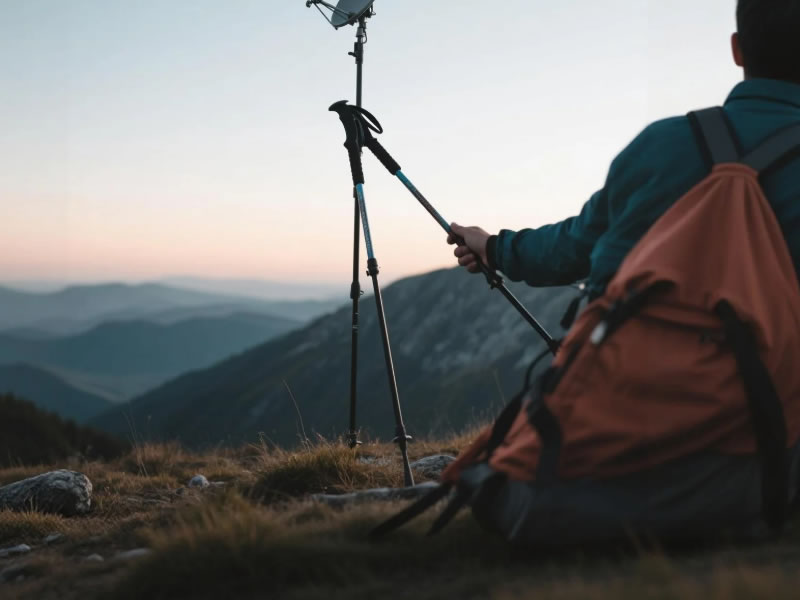
Recommended trekking pole purchase link: https://lightenup.aliexpress.com/store/1101521655
The theory behind using a pole as an antenna
Satellite devices use specific frequencies (around 1.6 GHz for Iridium/Globalstar). A metal conductor—like an aluminum trekking pole—can, in principle, act as a counterpoise or improvised dipole if connected correctly. Some survival manuals suggest attaching the device’s ground to a long metal object to increase the effective radiating area. In controlled tests, this has occasionally improved signal by 1–2 dB.
Why it usually fails in real emergencies
- Impedance mismatch – Satellite devices are designed for tiny internal antennas (often patch or helical). Connecting a long metal pole creates a severe mismatch, potentially reflecting power back into the device’s amplifier, which can damage it permanently.
- No proper connection – You’d need to expose the internal antenna connection point, voiding warranty and risking water/dust ingress. Using a clip on the outside rarely couples effectively.
- Pole length is wrong – For 1.6 GHz, a half‑wave dipole is about 9 cm. A 110 cm trekking pole is many wavelengths long, creating unpredictable radiation patterns (nulls and lobes) that may actually weaken signal in the satellite’s direction.
- Ground plane missing – A single pole without a proper ground counterpoise is inefficient.
What experts say
Backcountry emergency specialists (e.g., REI survival instructors) unanimously advise against this. “You’re more likely to fry your $400 device than get a message out,” says one. Instead, they recommend proven signal‑boosting methods.
Better emergency alternatives for weak satellite signal
- Elevate the device – Place it on a rock, tree stump, or your pack. Higher is better. If safe, climb a small rise.
- Clear line of sight – Move away from cliffs, dense canopy, or wet foliage. A few meters can make a huge difference.
- Use a dedicated external antenna – Some satellite messengers (e.g., Yellowbrick) have optional external antennas designed to be taped to a pole. These work perfectly. But for most consumer devices, no antenna port exists.
- Turn off and on – Reboot the device; it may re‑acquire satellites better.
- Send a shorter message – Less data requires less signal strength.
The only safe “pole as antenna” method
If you have a device with an external antenna jack (rare among personal messengers), and you carry a coaxial adapter and a wire, you could attach a wire to the pole and run it to the device. But that’s not an emergency hack—it’s pre‑planned engineering.
Final verdict
No, you should not use trekking poles as an emergency antenna for satellite devices. The risk of damaging your device far outweighs any minuscule potential gain. Instead, focus on proper device placement, clear sky views, and carrying a backup communication method (like a PLB). In the Brazilian backcountry, your trekking poles are for your knees, not your signal.




