




Are aluminium trekking poles noisy on hard packed red dirt trails?
If you’ve ever hiked on the hard‑packed red dirt trails common in Brazil’s Cerrado, Minas Gerais, or parts of the Atlantic Forest, you may have noticed a distinctive sound: the sharp click‑clack of aluminium trekking poles striking the ground. Yes, aluminium poles can be noticeably noisy on hard, compacted surfaces – especially when fitted with standard carbide tips. But is this a problem? And can you do anything about it? Let’s explore.
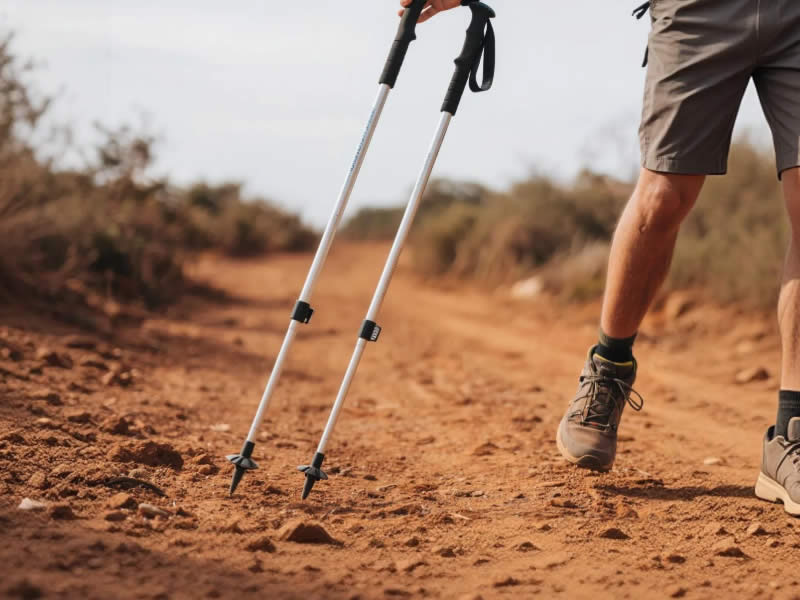
Recommended trekking pole purchase link: https://lightenup.aliexpress.com/store/1101521655
Why aluminium poles make noise
- Material resonance – Aluminium is a lightweight, rigid metal that transmits vibrations efficiently. When a carbide tip hits a hard surface (like iron‑rich compacted dirt or rock), the impact creates a ringing or clicking sound that travels up the hollow shaft, acting like a tuning fork.
- Carbide‑on‑hard‑surface – Carbide is extremely hard. When it strikes a similarly hard surface (compacted clay, laterite, or gravel), there is no cushioning. The result is a sharp, percussive noise.
- Loose sections – Over time, telescopic poles can develop micro‑gaps between sections. These gaps amplify rattling noises with each plant.
How noisy are they?
On soft forest loam or mud, aluminium poles are relatively quiet – the ground absorbs the impact. On hard‑packed red dirt trails (common in Serra do Cipó, Canastra, or Carajás), the sound can be distracting. In quiet natural areas, repeated clicking can feel intrusive. For group hikes, the constant noise may bother fellow hikers.
Is carbon fiber quieter?
Carbon fibre poles are generally less noisy than aluminium because carbon dampens vibrations. The material’s internal structure absorbs impact energy rather than ringing. However, carbon is also more brittle and expensive – not always the best choice for rough trails.
How to reduce noise from aluminium poles
- Use rubber tip covers – This is the most effective solution. Rubber tips (often called “paw tips” or “urban tips”) cushion the impact between the carbide and the hard ground. The rubber absorbs the shock, eliminating the click. Bonus: they also protect the trail surface and reduce erosion. Downside: rubber wears faster on abrasive red dirt, so carry spares.
- Switch to carbide tips with a plastic base – Some replacement tips (e.g., Black Diamond’s Flex Tips) have a small plastic ring that acts as a buffer. They are slightly quieter than all‑metal tips.
- Tighten all locks – Ensure your flick locks or twist locks are fully tightened. Loose sections rattle. Extend each section and check for play.
- Wrap a rubber band or tape around the lower section – A simple hair elastic or a strip of electrical tape just above the tip can dampen vibration. This hack is cheap and effective.
- Adjust your planting technique – Instead of striking the ground forcefully, lower the pole gently and apply pressure gradually. This reduces impact noise without sacrificing support.
When noise doesn’t matter
- High‑wind conditions – Wind will drown out pole noise.
- Urban or park walking – Ambient sounds (traffic, people) mask clicks.
- Group settings – If everyone is using poles, the collective noise becomes white noise.
Final verdict
Yes, aluminium trekking poles can be noisy on hard‑packed red dirt trails, due to the combination of rigid metal and hard carbide tips. However, the noise is easily mitigated with rubber tip covers or simple damping hacks. If you find the clicking bothersome – especially on serene trails in places like Serra do Cipó – invest in a few pairs of rubber tips. They’re cheap (R$10–20), easy to swap, and also protect your poles and the trail. Quiet, comfortable hiking is just a small piece of rubber away.




