




Are foldable trekking poles safe and easy for children to handle?
When equipping a child for a family hike in Brazil’s stunning mountains – from the granite peaks of Serra dos Órgãos to the muddy trails of Serra do Mar – many parents consider foldable (Z‑pole) trekking poles for their lightweight and compact design. But are these poles actually safe and easy for children to handle? The short answer is generally no – foldable poles present several challenges for young hikers. Telescopic poles with flick locks are usually a better choice. Here’s a detailed breakdown.
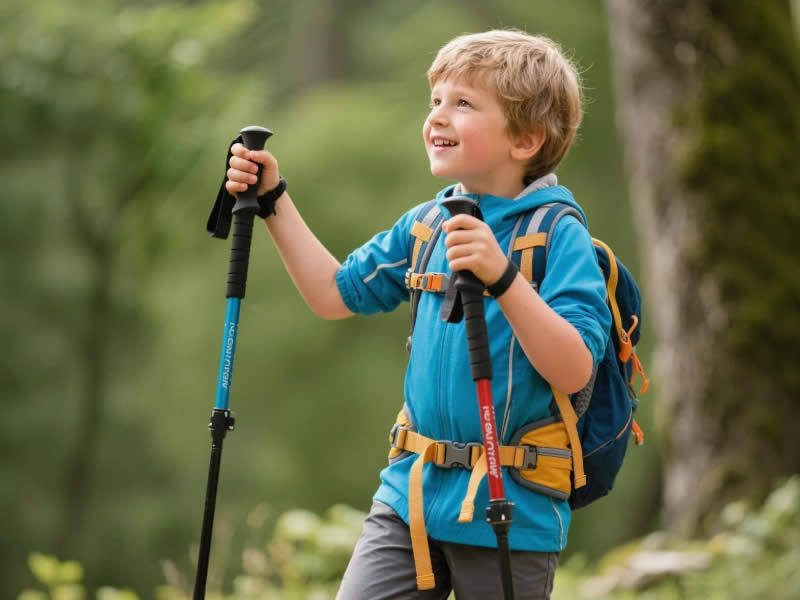
Recommended trekking pole purchase link: https://lightenup.aliexpress.com/store/1101521655
What are foldable trekking poles?
Foldable poles (also called Z‑poles) consist of three or four sections connected by an internal elastic cord (Dyneema or Kevlar). To assemble, you pull the sections apart until they snap into place at the joints. To collapse, you press small buttons or pull the cord to release the joints. They are popular among ultralight hikers and trail runners because they pack very small (33‑40 cm) and weigh little (280‑300 g per pair).
Why foldable poles are not ideal for children
- Difficulty in assembly and collapse – Most foldable poles require you to press a small button on each joint while pulling or pushing. This demands a precise combination of strength and dexterity. Children’s smaller hands and weaker fingers often struggle. They may pinch their skin between the sections or fail to lock the pole properly, leading to sudden collapse on the trail.
- Safety concerns with the locking mechanism – The buttons can be stiff. A child might use excessive force, causing the pole to snap shut on their fingers. Internal cords can also wear out or fray over time; if a cord breaks, the pole becomes unusable. Children are less likely to notice early warning signs (loose joints, clicking sounds) and may continue using a damaged pole, risking a fall.
- Lack of length adjustability – Many foldable poles have fixed lengths (e.g., 105 cm, 115 cm). Children grow quickly, and a fixed length may be too long or too short. Without the ability to adjust on steep uphill or downhill sections, children are forced to use an incorrect posture, increasing fatigue and injury risk.
- Higher chance of breakage – Foldable poles, especially carbon ones, are more brittle than telescopic aluminium poles. Children often forget to avoid wedging poles between rocks – a common cause of snapping. A broken pole on a remote trail can be a real problem.
The better alternative: telescopic poles with flick locks
For children, telescopic poles (slide‑and‑lock) with external flick locks are far safer and easier to handle.
- Easy adjustment – A child can turn the flick lock lever with their thumb, then slide the section up or down. No button pressing or cord pulling. Markings on the shaft help them return to the correct length.
- Greater durability – Aluminium telescopic poles bend rather than snap. If a section gets slightly bent, it can often be straightened.
- Infinite length range – They adjust from very short (65 cm) to long (135 cm). You can set the perfect length for your child’s current height and also adjust for uphill/downhill.
- Familiar operation – Many children already understand how to tighten a lever (like on a bike seat). Flick locks are intuitive.
When foldable poles might work for a child (with caveats)
- Older, stronger teenagers (14+) with good hand strength and coordination may handle foldable poles.
- Very lightweight children’s models (e.g., some specialty kids’ Z‑poles) that are designed with softer springs and larger buttons exist, but they are rare in Brazil.
- If you already own foldable poles and your child is careful, you can try them on short, easy trails under close supervision. Teach them exactly how to press the button and inspect the joint before each use.
What to look for in poles for children
Regardless of type, prioritize:
- Weight – Under 180 g per pole for ages 6‑10. Over 200 g is too heavy.
- Rubber tip covers – Essential for safety when not on soft ground.
- Replaceable tips – So the poles last as the child grows.
- Foam or small‑diameter cork grips – Fits small hands.
Recommended models for children in Brazil
- Best overall (telescopic): Decathlon Quechua MH500 Kids – adjustable from 65‑110 cm, flick locks, 160 g per pole, includes rubber covers. About R$150.
- If you must use foldable: Only consider models with large, easy‑press buttons (e.g., some Black Diamond Z‑poles for youth). Imported, expensive (R$500+), and hard to find.
Final verdict
Foldable trekking poles are not safe or easy for most children to handle. The combination of small, stiff buttons, lack of length adjustability, and higher fragility makes them a poor choice for young hikers. Instead, invest in telescopic poles with external flick locks – they are far more child‑friendly, durable, and adjustable. Decathlon’s Quechua MH500 Kids is the ideal solution in Brazil. Teach your child proper technique on flat ground first, always use rubber tip covers, and supervise on the trail. With the right poles, your child will hike safely and confidently for years to come.




