




What is the best trekking pole for a person with only one strong arm?
Hiking with only one strong arm – due to stroke, nerve damage, amputation, or a healed fracture – requires a different approach to balance and support than a traditional two‑pole setup. While most trekking advice assumes you have two fully functional arms, a person with unilateral weakness can still enjoy Brazil’s trails safely and comfortably. The key is choosing the right single trekking pole or adapting a standard pole with specific features. Here’s what you need to know.
Why a single pole is better than none
With one strong arm, using a single pole provides crucial benefits:
- Improved balance – A single extra point of contact helps compensate for asymmetrical strength.
- Reduced load on the weak side – By channeling weight through the strong arm, you spare the weaker leg and hip on the opposite side.
- Increased confidence – Knowing you have a support on one side reduces fear of falling on uneven terrain (roots, loose rocks, mud).
However, a standard single pole can also create imbalance if not chosen or used correctly. The goal is to make the pole an extension of your strong arm, not a source of new problems.
Key features for a person with one strong arm
- Single‑pole orientation – You need just one pole, but many are sold in pairs. Search for “single trekking pole” or buy a pair and keep one as a spare. Some brands offer individual poles (e.g., Decathlon sells single Forclaz poles in some markets; ask in store).
- Flick lock (external lever) adjustability – Twist locks require two‑handed twisting, which is difficult if your other hand is weak. Flick locks can be operated with one hand (thumb and forefinger). They also allow quick length changes on the trail without help.
- Lightweight material (aluminium or carbon) – A heavy pole will fatigue your single strong arm faster. Aim for under 250 g per pole. Carbon is lighter but more brittle; aluminium (7075) is a good compromise.
- Ergonomic, shock‑dampening grip – Cork or high‑density foam grips reduce hand fatigue and provide secure hold even when sweaty. Look for an extended grip (a long foam section under the handle) that allows you to “choke down” for steep descents without changing your grip.
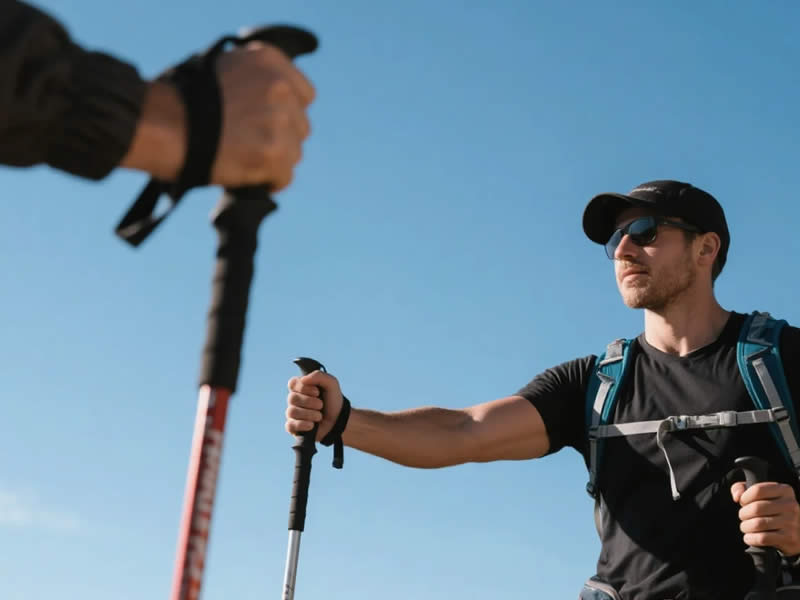
- Adjustable wrist strap – The strap is critical for a one‑arm user. It should be wide, padded, and easily adjustable with one hand. When correctly used (hand up through the loop, then down), the strap transfers weight from your hand to your forearm, allowing you to relax your grip on long descents.
- Forearm support (optional but recommended) – Some specialized walking aids (e.g., “forearm crutch” or “arm cane”) attach to the pole, providing a cuff that wraps around your forearm. This distributes weight over a larger area and prevents the pole from flying away if you lose grip. Brands like HurriCane or Trionic offer such attachments. They can be retrofitted to standard trekking poles.
- Rubber tip covers and baskets – Rubber covers for pavement and compacted trails reduce shock; mud baskets prevent sinking in soft ground. Both help maintain a smooth, predictable stride.
How to use a single pole with one strong arm
- Hold the pole on your strong side – If your right arm is strong, hold the pole in your right hand. It will support your left leg (opposite arm/leg coordination still applies).
- Set the correct height – Elbow at 90° when tip is on the ground. For descents, lengthen the pole 5‑10 cm; for ascents, shorten 5‑10 cm. Mark your neutral setting with tape.
- Use a “tripod” gait – Plant the pole simultaneously with the opposite foot (strong arm with weak leg). This creates a three‑point support (two feet + pole) that is very stable.
- Avoid leaning heavily on the pole – It should assist, not bear all your weight. Keep your spine straight.
Potential pitfalls and solutions
- Pole sliding sideways – On slippery surfaces (wet roots, polished rock), the carbide tip may skate. Use a wide mud basket or a “rock tip” (blunter carbide) for better purchase.
- One arm fatigue – Take frequent breaks and switch the pole to the other side? You can’t. Instead, use the pole intermittently: on steep sections or rough ground, plant it; on flat, firm sections, carry it collapsed.
- Difficulty adjusting length – Practice one‑handed flick lock operation at home. Some levers are stiff; choose a model with an easy‑action lever (e.g., Black Diamond FlickLock, LEKI SpeedLock).
Recommended poles for one‑arm use in Brazil
- Black Diamond Trail Ergo Cork (single pole available separately through some dealers). Lightweight aluminium, flick lock, cork grip, padded strap.
- LEKI Makalu Lite (sold individually). Excellent flick lock, foam/cork grip, compatible with forearm cuff attachments.
- Decathlon Forclaz Trek 500 (buy a pair, use one). Most affordable option (R$199 per pair). Flick locks, cork grip. Slightly heavier but durable.
- Forearm support add‑on – Look for “Trekking pole arm support” on Mercado Livre or Amazon Brasil. Brands like Pacerpole are rare, but you can use a universal cuff from a rollator (walking frame) adapted to fit your pole.
Adapting a standard pole with a forearm cuff
If you have basic DIY skills, you can attach a forearm crutch cuff (available at medical supply stores) to your trekking pole. Remove the grip, slide the cuff onto the shaft, and replace the grip. The cuff allows you to relax your hand while still controlling the pole. Test it thoroughly on flat ground before hitting the trails.
Final advice for Brazilian conditions
- On steep, rocky trails (Serra Fina, Pedra da Gávea), shorten the pole and use a carbide tip. The cuff is especially helpful here.
- On muddy Atlantic Forest trails, use a wide basket to prevent sinking, and rely on the wrist strap more than grip strength.
- On beach or dune trails (Lençóis Maranhenses), consider no pole – soft sand makes poles difficult. If needed, use a powder basket.
Final verdict
The best trekking pole for a person with only one strong arm is a lightweight, flick‑lock single pole with an ergonomic cork grip and a padded wrist strap. For maximum stability and reduced fatigue, add a forearm support cuff. The Black Diamond Trail Ergo Cork (sold individually) or Decathlon Forclaz Trek 500 (pair, use one) are excellent choices in Brazil. Practice proper technique on easy trails first, and always listen to your body. With the right pole, you can confidently explore Brazil’s diverse winter landscapes – from the coastal forests to the highland peaks.




