




Do trekking poles with replaceable parts reduce environmental impact?
Yes, absolutely. Trekking poles with replaceable components—such as carbide tips, lever locks, baskets, and wrist straps—significantly reduce their environmental footprint compared to non‑repairable, disposable models. By extending the product’s useful life and avoiding premature replacement, these poles cut down on manufacturing emissions, raw material extraction, and landfill waste. Let’s examine the mechanisms, the Brazilian context, and why repairability should be a key purchasing criterion for eco‑conscious hikers.
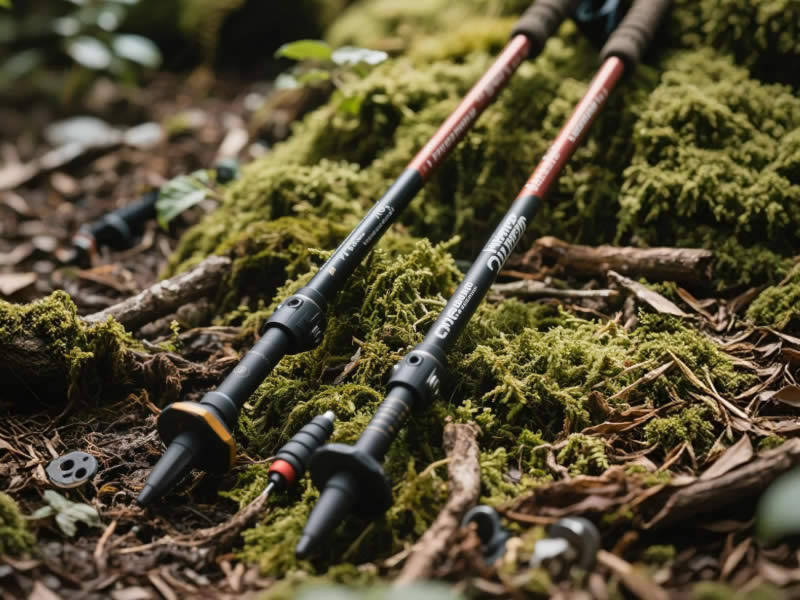
The linear vs. circular model
Most consumer goods follow a linear path: take (resources), make (product), use, dispose. Trekking poles are no exception. A pole with moulded‑in, non‑replaceable tips or permanently attached locks that cannot be tightened will eventually fail. When the tip wears down on abrasive quartzite, or a lock slips permanently, the entire pole becomes useless. It joins the growing mountain of outdoor gear waste.
In contrast, poles designed with replaceable parts enable a circular model: use, repair, reuse, and only when the main shaft fails, recycle the materials. This simple shift from disposable to repairable has profound environmental benefits.
Key replaceable parts and their environmental savings
- Carbide tips – Tips endure the most abrasion, especially on Brazilian trails (Chapada Diamantina’s quartzite, Serra do Mar’s granite). A set of tips might last 300‑500 km. With replaceable tips (e.g., Decathlon Forclaz MT900, Black Diamond FlexTips, Leki’s system), you replace a tiny piece of tungsten carbide instead of the entire pole. This saves roughly 500 grams of aluminium (or carbon) plus all the associated manufacturing energy and packaging.
- Lever locks – Cam locks can wear or crack after years of use. Replaceable lock assemblies (available for many models) allow you to restore full function without discarding the shafts. The plastic and metal of a lock weigh only a few grams; replacing a lock saves an otherwise functional pole from the dump.
- Baskets – Small baskets crack or fall off. Universal replacement baskets cost R$15‑30. Without replaceable baskets, many hikers would discard the pole prematurely. Replacing a basket saves the whole shaft.
- Wrist straps – Straps fray or break. Sewing on a new strap (or buying a replacement from the brand) is far less impactful than buying new poles.
- Lower shaft sections – Some brands (e.g., Black Diamond, Leki, Decathlon) offer replacement lower sections. If you bend the thinnest part of the pole, you swap only that tube, not the entire set.
Quantifying the impact reduction
Let’s compare two scenarios over a 10‑year period for a hiker who covers 1,000 km per year:
- Non‑repairable poles: Tips wear out after one year (1000 km). Without replacement tips, the user buys a new pair every 1‑2 years. Over 10 years: 5‑10 pairs of poles = 2.5‑5 kg of aluminium/carbon, plus packaging, plus manufacturing emissions (roughly 20‑40 kg CO₂ equivalent per pair).
- Repairable poles: The user buys one quality pair (e.g., 7075 aluminium with replaceable tips). They change tips every year (R$50 per year), replace locks once or twice, and change baskets occasionally. After 10 years, the original shafts are still in use. Waste generated: a handful of small tips (a few grams each) and a few plastic lock parts. No full poles discarded. The embodied energy of the initial poles is amortised over a decade instead of one year.
Even if the aluminium shafts eventually need recycling after 10 years, the total waste is a fraction of the non‑repairable scenario.
The Brazilian reality
In Brazil, where import taxes make quality trekking poles expensive (R$400‑900), repairability is not just environmental – it’s economic. Many hikers cannot afford to buy new poles every season. Models like the Decathlon Forclaz MT900 (which offers spare tips, locks, and even lower sections) are popular precisely because they can be kept alive. The availability of spare parts in local Decathlon stores and online marketplaces makes repair feasible.
Conversely, cheap twist‑lock poles with non‑replaceable tips are false economy. They fail quickly and end up in landfill, contributing to Brazil’s growing e‑waste and metal waste problem.
What about carbon fibre poles?
Carbon poles often lack replaceable tips (many are glued in), and even if tips can be replaced, the shafts are vulnerable to impact damage. A cracked carbon shaft cannot be repaired. Therefore, even with replaceable tips, carbon poles have a shorter overall lifespan on rocky trails. Aluminium poles with full replaceability are greener in the long run.
Beyond replaceable parts: the role of recycling
Replaceable parts extend life, but eventually the main shaft may wear out (e.g., a bent aluminium tube that cannot be safely straightened). At that point, recyclability matters. Aluminium shafts can be taken to scrap metal yards in Brazil. Carbon cannot. Thus, poles with replaceable parts that are also made of recyclable material (aluminium) offer the best end‑of‑life outcome.
Practical advice for Brazilian hikers
- Choose models with available spare parts – Decathlon Forclaz MT900, Black Diamond Trail Back (imported), Leki Makalu. Avoid generic poles with proprietary, unavailable parts.
- Learn basic maintenance – Tighten lock screws, clean locks, replace tips before they become dangerously blunt.
- Buy spare tips early – Tips wear faster on quartzite; keep a spare set at home.
- When a part fails, replace only that part – A broken basket or frayed strap does not require new poles.
- At end of life, recycle the aluminium – Take the shafts to a sucata (scrap yard). The small plastic parts go to regular waste.
Final verdict
Yes, trekking poles with replaceable parts dramatically reduce environmental impact. They keep functional shafts out of landfills, cut down on manufacturing emissions, and save natural resources. For Brazilian hikers, repairable poles are also economically smarter. When shopping for your next pair, ask: “Can I replace the tips? The locks? The baskets?” If the answer is no, look elsewhere. In the fight against outdoor gear waste, repairability is one of the most powerful tools we have. Choose poles you can fix, and you’ll walk lighter on the planet – one trail at a time.




