




What is the “climbing mode” adjustment for trekking poles?
If you have ever struggled up a steep, rocky ascent—like the paredões of Chapada Diamantina or the stair‑like trails of Petrópolis—you may have noticed that your normal pole length suddenly feels awkward. Your elbows are too high, your poles reach too far ahead, and you are not getting any pushing power. This is where climbing mode comes in. In simple terms, climbing mode means temporarily shortening your trekking poles for uphill sections. But doing it correctly can transform a gruelling climb into a much more efficient, leg‑saving effort.
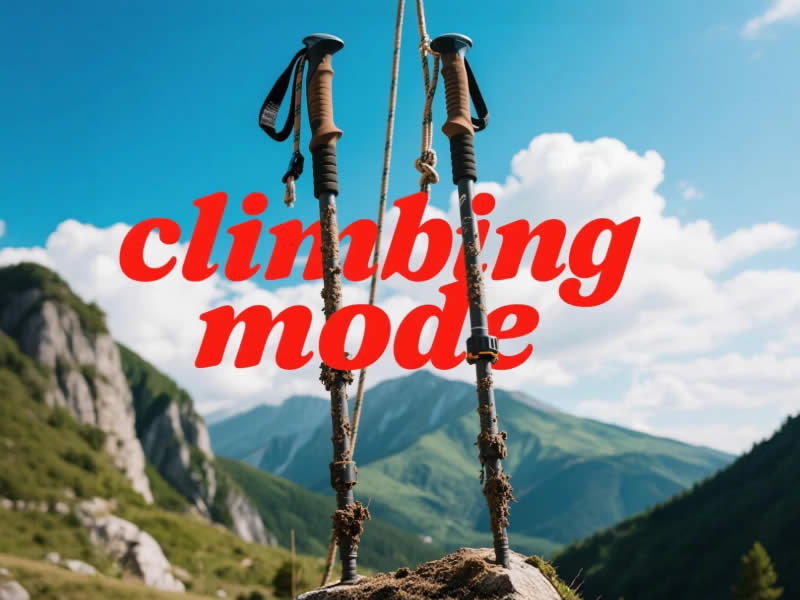
Let’s break down what climbing mode is, how to set it up, and how to use it on Brazil’s varied mountain terrain.
What is climbing mode?
Climbing mode is an adjustment technique, not a special feature. When you are walking on flat ground, your poles are set so that your elbows form a roughly 90‑degree angle when the tips touch the ground. That length is your “flat” setting. As the trail tilts upward, that same length becomes too long. Your hands rise relative to the slope, forcing you to lift your arms or lean back to plant the poles. Both actions waste energy and reduce stability.
In climbing mode, you shorten each pole by 5 to 15 centimetres (2 to 6 inches) compared to your flat setting. The exact amount depends on the steepness of the slope. On a gentle 10‑15% incline, a 5 cm reduction suffices. On a very steep 30‑40% gradient or on tall stone steps, you may shorten by 15 cm or even more. The goal is to keep your hands low (around hip or lower thigh level) so that each pole plant gives you a powerful upward push, not a forward reach.
Why shortening helps: the biomechanics
Imagine climbing a ladder. You would never hold the rungs at shoulder height; you reach up, pull, and step. Trekking poles on a steep slope work similarly. When poles are too long, you plant them far ahead, then pull your body toward them. This creates a forward‑leaning posture that strains your lower back and reduces leg drive.
When you shorten the poles, you can plant them close to your feet – often just one step ahead or even directly beside your front foot. Your elbows remain bent, your shoulders stay relaxed, and you can push down vertically through the straps. This vertical push transfers force directly into lifting your body up the slope, offloading your quadriceps and glutes.
Studies on Nordic walking and uphill trekking show that shortening poles by 10 cm can reduce heart rate by 5‑8 beats per minute on a 20% grade for the same speed, because the upper body contributes more effectively to propulsion.
How to find your climbing mode length
- Start with your flat setting – On a level patch, set poles so your elbows are 90°.
- Move to a steep section – Stand facing uphill. Without changing length, plant both poles naturally. Observe that your elbows are now >90° (too straight) and your hands are high.
- Shorten incrementally – Reduce length by 2‑3 cm at a time and test. Plant the poles, then step up. When you feel a solid, low‑handed push that lifts you without straining your shoulders, you have found your climbing length.
- Mark the shaft – Once dialled, use a permanent marker or a piece of tape on the lower section as a visual reference. On the trail, you can quickly extend to that line.
Practical technique for climbing mode
- Plant both poles together – On very steep slopes, use a double plant: place both tips on the step ahead or on the same level, then push down simultaneously as you step up.
- Keep the poles close – The tips should land within 30‑40 cm of your front foot. Reaching too far ahead pulls you off balance.
- Push through the straps – Your hands should be relaxed; the wrist strap bears the weight. When you push down, your arm straightens, and the strap transfers force to your triceps and lats.
- Shorten more for steps – On human‑made stone steps (common in Petrópolis, Ouro Preto), reduce length even further – sometimes to 100‑105 cm for a 170 cm hiker. This allows you to plant on the next step up and push directly under your shoulder.
When to switch back
Climbing mode is for ascents only. Once the trail flattens or starts descending, return to your normal (longer) length. Descending with shortened poles forces you to hunch forward and reduces your braking ability. Many adjustable poles have a quick‑release lever (speed lock) that makes on‑trail changes easy – practice doing it one‑handed while walking.
Brazil‑specific considerations
- Quartzite and granite steps – In Chapada Diamantina and Serra do Cipó, natural rock steps are often polished and irregular. A shortened pole with a sharp carbide tip bites better than a long one, which tends to skid.
- Muddy ascents – On wet Atlantic Forest climbs, shortening poles lowers your centre of gravity, improving stability. The poles will not sink as deeply because you plant them more vertically.
- Heavy backpacks – If you are carrying a multi‑day load (e.g., Travessia do Vale do Pati), you may need to shorten poles an extra 2‑3 cm to compensate for the backward pull of the pack.
Common mistakes
- Not shortening enough – Many hikers shorten only 2‑3 cm on a steep slope, which does little. Be bold: try 10‑12 cm reduction and feel the difference.
- Leaving poles in climbing mode on descents – This is dangerous. The poles become too short to brake properly, increasing knee impact. Always readjust at the top.
- Using twist locks on muddy climbs – Twist locks can slip under the added force of a shortened pole. Lever locks are far more reliable.
Final verdict
Climbing mode is simply shortening your trekking poles for uphill sections – typically by 5‑15 cm. This low‑hand position gives you better leverage, reduces shoulder strain, and offloads your leg muscles. For Brazilian hikers facing steep quartzite steps, muddy forest climbs, or long mountain ascents, mastering this adjustment is essential. Always mark your lengths, practice the double‑plant push, and switch back to normal length on flat or downhill terrain. With climbing mode, those steep paredões become less intimidating – and your knees and quads will thank you at the summit.




