




What is the Brazilian technique for using poles in dense jungle?
Brazil’s dense jungles—from the Amazon rainforest to the Atlantic Forest (Mata Atlântica)—present unique challenges for trekkers. Trails are often narrow, overgrown, muddy, and littered with exposed roots, fallen logs, and hidden animal burrows. Standard trekking pole techniques developed for open mountain trails fail here. Over years of local experience, Brazilian jungle hikers have refined a specific set of techniques that transform poles from a balance aid into an essential tool for navigation, safety, and pest control. Let’s unpack the “Brazilian technique” for dense jungle.
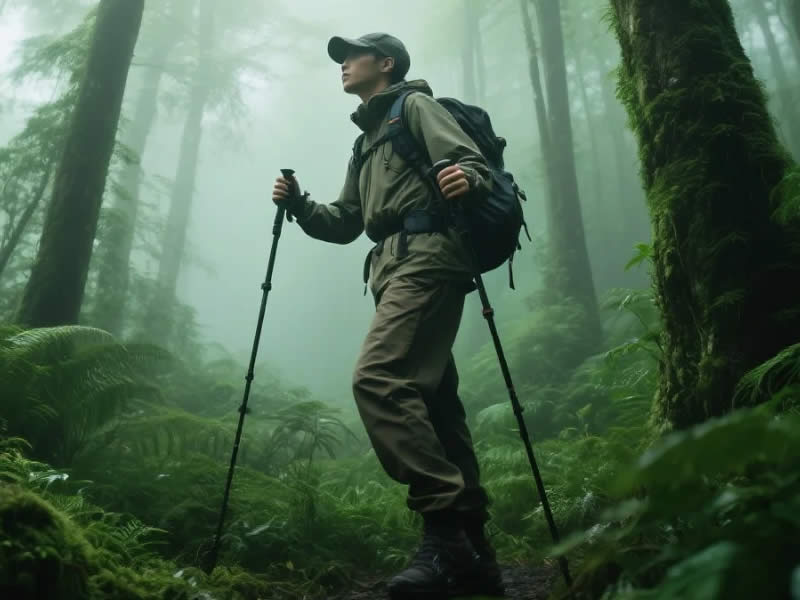
The core philosophy: poles as extensions of your senses
In the jungle, you often cannot see the ground beneath your feet. Fallen leaves hide slippery mud, shallow streams disguise deep holes, and roots crisscross unpredictably. The Brazilian technique treats trekking poles as tactile probes—you use them to “read” the terrain before committing your weight.
1. Shorten your poles drastically
On open trails, poles are set so elbows form a 90° angle. In dense jungle, shorten them by 10‑20 cm (to about 100‑110 cm for an average hiker). Why? A shorter pole keeps your hands low, allowing you to:
- Swing the pole through thick undergrowth without catching on overhead vines.
- Plant the tip directly in front of your foot, not far ahead, so you can test the ground immediately before stepping.
- Push aside low branches and spiky palm fronds (e.g., juçara or tucum) without lifting your arms above head height.
2. Use the “tap and feel” method
Before each step, extend the pole forward and tap the ground in a small arc. Listen and feel:
- A dull thud – Solid ground or packed mud. Safe to step.
- A soft, deep push – Mud or leaf litter over a hole. Probe deeper to gauge depth.
- A hollow sound – Possibly a root cavity or animal burrow. Avoid or test with more pressure.
- Sudden slip – Wet clay or moss on rock. Adjust footing.
Experienced Brazilian jungle guides tap the pole three times rapidly: once to clear debris, once to feel firmness, once to confirm. This becomes a rhythmic, almost subconscious action.
3. Clear spider webs and branches
The jungle is full of orb‑weaver spiders (e.g., Nephila), whose webs can stretch across the trail. Swinging a pole in a figure‑eight pattern ahead of your face clears webs without touching them. For low‑hanging branches, raise the pole horizontally and push them up and away before you pass. This technique also alerts snakes (like the jararaca or coral snake) that may be resting on branches, giving them time to retreat.
4. Test water depth in flooded sections
During the rainy season, many Brazilian jungle trails flood. Before stepping into murky water, extend a fully lengthened pole (back to 120‑130 cm) and plunge it straight down. Feel for bottom. If the pole sinks more than 100 cm without hitting solid ground, find an alternate route. Also, wiggle the pole side to side to detect submerged logs or rocks that could trip you.
5. Root navigation – the “three‑point” rule
Jungle trails are crisscrossed with tree roots that become slippery when wet. Instead of stepping over them blindly, plant both poles on the far side of the root, then use them to support your weight as you swing your legs over. This creates a stable three‑point contact (two poles + one foot) while the other foot clears the root. Never step onto a root with the tip of your boot – always place the whole foot flat to avoid sliding.
6. Mud management
In deep mud (common in the Amazon várzea), standard pole baskets help prevent sinking too far. However, many Brazilian hikers remove baskets entirely because they catch on roots. Instead, they use the pole tip to probe for firmer ground beneath the mud layer. If the mud is ankle‑deep, plant the pole vertically and push down until it hits a hard layer – then step exactly there.
7. Snake and animal avoidance
The Brazilian technique uses poles to announce your presence. Tap the ground rhythmically ahead of you. The vibrations alert snakes (which sense vibration through their jawbones) and encourage them to slither away before you arrive. For larger animals like peccaries or capybaras, clacking the poles together makes a sharp noise that warns them of your approach. Never poke at an animal – only use the pole as a noisemaker.
8. Single pole vs. two poles
In very dense vegetation where both hands are needed to part branches, many Brazilian hikers switch to a single pole, holding it in the dominant hand. The other hand is free to push aside foliage. If you use two poles, keep them together in one hand like a bundle while using the free hand to clear the path.
Gear adaptations for the jungle
- Tips – Carbide tips are fine, but many locals add a small, sharpened steel pin (a “jungle spike”) for better grip on wet wood. Rubber tips are useless.
- Locks – Lever locks (cam locks) are essential because mud and humidity cause twist locks to slip. Rinse locks after each day.
- Straps – Some hikers remove wrist straps to avoid snagging on branches. Others keep them loose.
- Material – Aluminium is preferred over carbon because carbon shafts can splinter when wedged between roots.
The “caiçara” technique from Atlantic Forest
Along Brazil’s coast, traditional caiçara communities use a single wooden pole (vara de caminhar) about 1.5 m long. The technique involves holding the pole vertically, then swinging it in a low arc to clear snakes and test ground. Modern trekking poles mimic this motion. Some Brazilian hikers extend one pole to maximum length and use it as a vara, while keeping the other collapsed on their pack.
Practice and adaptation
The Brazilian jungle technique takes time to master. Start on well‑marked trails (e.g., in Ilha Grande or Serra do Mar) before attempting dense Amazon undergrowth. Focus on rhythm: tap, clear, plant, step. Within a few hours, it becomes automatic. You will notice less tripping, fewer spider webs in your face, and a calmer, more confident stride.
Final takeaway
The Brazilian technique for using poles in dense jungle is not about efficiency or speed – it’s about safety and sensory expansion. By shortening your poles, tapping ahead, clearing webs, testing mud, and announcing your presence, you turn your poles into protective extensions of your body. This local wisdom, honed by generations of Amazonian and Atlantic Forest hikers, allows you to move through the world’s most challenging vegetation with less fear and more connection to the ground beneath. So next time you enter a Brazilian jungle trail, shorten those poles, start tapping, and walk like a local.




