




How to flick trekking poles to remove mud without stopping?
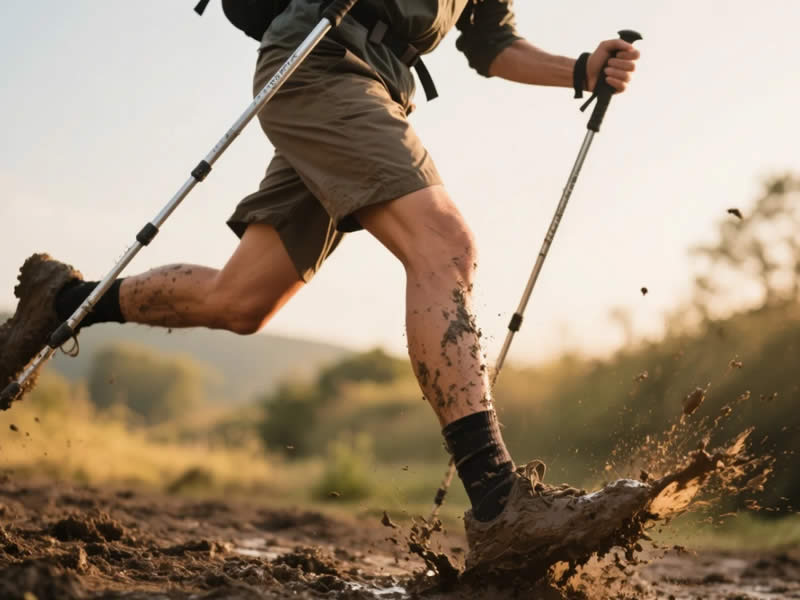
Mud is a constant companion on many Brazilian trails—from the sticky red clay of the Atlantic Forest to the black sludge of the Amazon’s floodplains. It clings to your trekking pole tips and baskets, adding weight, reducing grip, and forcing you to stop and scrape. But experienced hikers know a simple, hands‑free technique: the wrist flick. With a quick, sharp snap, you can send mud flying without breaking stride. Here’s how to master it.
Why mud is a problem
When mud builds up on your pole tip, several issues arise:
- Increased weight – A thick coating can add 50–100 g per pole, causing arm fatigue.
- Loss of traction – Mud smooths the carbide tip, making it slide on rocks or roots.
- Lock damage – Dried mud inside the joints can jam twist or lever locks.
- Mess – Mud falls onto your hands, clothing, or pack.
Stopping to scrape against a tree or rock takes 10–15 seconds per pole. Over a 6‑hour trek, that can add up to 30 minutes of lost time. The flick eliminates those stops.
The technique – step by step
- Normal plant – Walk with your usual alternating rhythm.
- Lift and backswing – After the plant, lift the pole and swing it backward, tip pointing behind you.
- Wrist snap – Just as the pole reaches its rearmost point, snap your wrist downward and slightly outward, like cracking a whip.
- Centrifugal force – The sudden acceleration flings mud radially off the tip and basket.
- Recover – Immediately bring the pole forward for the next plant. The entire motion adds less than 0.2 seconds.
Key tips for success
- Snap, don’t swing – The power comes from a quick wrist rotation, not a big arm movement.
- Flick backward – Aim mud behind you to avoid hitting your legs or hiking partner.
- Adjust force – Wet, sticky clay needs a harder snap; dry mud requires less.
- Practice – Try on a short muddy section until the flick becomes automatic.
Common mistakes
- Flicking sideways – This sprays mud onto your pants or the trail edge. Always flick backward.
- Flicking too late – If you snap as the pole moves forward, you may hit your own shin. Keep the flick in the backswing.
- Stiff wrist – A rigid arm reduces the centrifugal effect. Keep your wrist loose and relaxed.
- Over‑flicking – Excessive force can bend a carbon pole or loosen a tip. Use only necessary effort.
When to flick
- After every plant in deep, heavy mud.
- When you feel extra weight – a muddy pole feels noticeably heavier.
- Before collapsing poles – Always flick clean before shortening or folding to prevent lock contamination.
Gear considerations
- Remove baskets – Small baskets act like mud scoops. For wet trails, take them off.
- Use carbide tips – Rubber tips collect mud and offer no grip. Carbide sheds mud better.
- Aluminium poles – These handle the sudden stress of flicking better than carbon.
- Lever locks – Twist locks are more prone to jamming from dried mud.
Environmental courtesy
When you flick, aim the mud to the side of the trail, not directly behind you. The next hiker will appreciate a clean face. Also, avoid flicking onto sensitive vegetation – mud is natural, but excessive buildup can smother small plants.
Why this is a must‑know for Brazilian hikers
Brazil’s trails are uniquely muddy: high humidity, frequent rain, and iron‑rich soils create a sticky, persistent muck. Guides in Serra do Mar and Chapada Diamantina rely on the flick to maintain pace. Watching a local guide, you’ll see them flicking almost invisibly with every stride – poles stay clean, rhythm never falters, and they leave others behind who are constantly stopping to scrape.
Practice drill
Find a short, muddy path (or simulate by dipping your pole tip in wet soil). Walk 20 meters, flicking after each plant. Then walk back without flicking – you’ll immediately feel the difference. After 10 minutes of practice, the motion becomes second nature.
Conclusion
The flick transforms mud from a nuisance into a non‑issue. With a sharp wrist snap, you remove mud without stopping, preserving your energy, protecting your gear, and maintaining a smooth walking rhythm. Whether you’re hiking the red clay of Petrópolis or the swampy trails of the Pantanal, mastering this simple technique will keep you moving faster, cleaner, and safer. So next time you feel that heavy, muddy tip, don’t stop – just flick and go.




