




Are aluminium trekking poles more durable than carbon for scrambling?
Yes – aluminium trekking poles are significantly more durable than carbon for scrambling. On rocky, uneven terrain where side impacts are common, aluminium bends but rarely breaks, and can often be straightened in the field. Carbon is strong under vertical load but brittle under lateral forces – a single knock against a rock can cause splintering, rendering the pole useless. For scrambling in the UK's mountains (Snowdonia, the Lake District, Scotland), 7075 aluminium poles are the safer, more reliable choice. This article explains the material differences, real‑world durability, and why aluminium is the preferred choice for technical terrain.
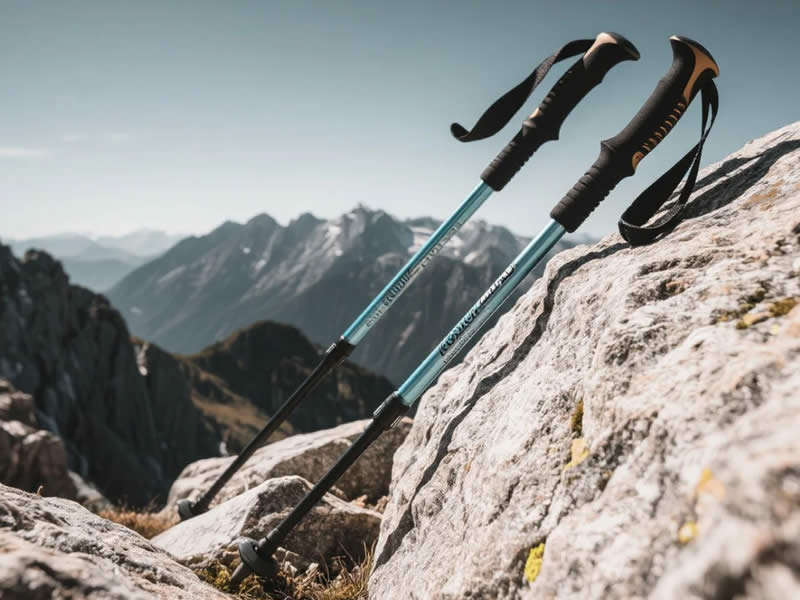
1. Understanding the forces on scrambling terrain
Scrambling is a blend of walking and climbing. You are on rocky ground, often placing poles between boulders, wedging them in cracks, or using them for balance on steep, uneven slopes. The forces applied to poles during scrambling are not just vertical (compression) – they include significant lateral (sideways) forces when you plant the pole at an angle or use it to brace against a rock.
- Vertical load – Both aluminium and carbon handle vertical compression well. A pole can support your weight without bending under normal use.
- Lateral load – This is where the materials diverge. A sideways knock, a jam between rocks, or a twist while the tip is caught can subject the shaft to bending forces.
2. Why aluminium is more durable for scrambling
a. Ductility – bends but does not break – Aluminium is a ductile metal. When subjected to a side impact or bending force, it will deform plastically – it bends. While a bent pole is not ideal, it is rarely catastrophic. In many cases, you can straighten a bent aluminium section in the field (by rolling it on a flat rock or using your hands). The pole may be weakened, but it remains functional.
b. Impact absorption – Aluminium's ductility allows it to absorb the energy of an impact by deforming, rather than fracturing. This makes it forgiving of the bumps and knocks that are inevitable on scrambling ground.
c. Repairability – If a lower section of an aluminium pole is bent, you can often straighten it. If the bend is severe, you can replace the lower section (for models like Leki Makalu, Black Diamond Trail Back, or Decathlon Forclaz MT900) – a cheap and straightforward fix. Cracked carbon, by contrast, is terminal.
d. Proven on UK scrambles – Aluminium poles are the standard choice of mountain guides and scramblers on routes like Crib Goch, the Aonach Eagach, and the Cuillin Ridge. Their track record speaks for itself.
3. Why carbon fails on scrambling terrain
a. Brittleness – splinters on impact – Carbon fibre is a composite material: carbon fibres embedded in a resin matrix. It is extremely strong under tension and compression, but it is brittle under impact. A side impact on a sharp rock can cause the carbon to splinter – the fibres delaminate, and the shaft fractures. This is a catastrophic failure; the pole is no longer usable.
b. No repair – A splintered carbon pole cannot be straightened or repaired. You need to replace the entire section or pole. If you are on a remote ridge, you are left with a useless pole.
c. Push‑button joints (on folding carbon poles) – Many carbon poles are folding (Z‑pole) designs with push‑button joints. These joints can jam with grit or become damaged on rocky ground. They are also more fragile than the simple, robust joints of telescoping aluminium poles.
d. Cold brittleness – Carbon becomes more brittle in cold temperatures – a factor on Scottish winter scrambles. Aluminium's performance is not affected by cold.
4. Real‑world comparison – what scramblers use
- Leki Makalu – The pole of choice for many UK mountain guides. 7075 aluminium, steel lower section, SpeedLock Plus. Built to survive side impacts and abrasion.
- Black Diamond Trail Back – Similar to the Makalu, with 7075 aluminium and FlickLock. Also favoured by scramblers.
- Decathlon Forclaz MT900 – A budget alternative with 7075 aluminium and reliable lever locks. While it lacks a steel lower section, it is still far more durable on scrambling terrain than carbon.
- Carbon poles – Rarely seen on serious scrambles. Trail runners and ultralight hikers may use them on well‑maintained paths, but they are not trusted on technical ground.
5. When carbon might be acceptable
Carbon poles can be used on scrambling if:
- You are a very confident scrambler who never places poles between rocks.
- You are on a well‑maintained, non‑technical route (e.g., the Llanberis Path on Snowdon, not Crib Goch).
- You accept the risk of breakage and are prepared to carry a backup (e.g., a spare pole or a repair kit).
For the majority of scramblers, the risk is not worth the weight saving.
6. Weight vs. durability – the trade‑off
Carbon poles are lighter (e.g., Leki Micro Vario Carbon at ~220 g per pole vs. Makalu at ~270 g). On a scrambling route, you are using your upper body heavily, and weight saving might seem attractive. However, the potential for failure on a remote ridge outweighs the benefit of saving 50–100 g per pole. Aluminium's reliability is a more important factor.
7. Maintenance tips for aluminium scrambling poles
- Inspect for bends – After a trip, roll each section on a flat surface to check for bends. Minor bends can be straightened.
- Tighten lever locks – The vibration of scrambling can loosen lever locks. Carry a hex key and tighten them periodically.
- Replace worn tips – The abrasive rock on scrambles will wear down tips quickly. Carry spare tips and replace as needed.
- Clean after muddy scrambles – Grit can damage locks and shafts. Rinse with fresh water and dry thoroughly.
8. Final verdict
For scrambling, aluminium trekking poles are significantly more durable than carbon. They bend under impact, can be straightened in the field, and are repairable with readily available parts. Carbon poles, while lighter, are brittle and prone to catastrophic failure on rocky terrain. For any route involving exposed rock, uneven footing, or side impacts, choose 7075 aluminium poles with lever locks. Reserve carbon for well‑maintained trails where side impacts are unlikely. Your safety and peace of mind on the mountain are worth the extra weight of aluminium.




