




Do anti-shock trekking poles really reduce knee pain on descents?
Partially, but not for the reason most walkers think. The internal spring mechanism absorbs some high‑frequency vibration and impact shock, which can make descents feel slightly more comfortable on hard surfaces. However, the primary knee‑saving benefit of trekking poles comes from load transfer – using your wrist straps and correct planting technique to offload weight from your legs to your upper body – rather than the shock absorber itself. Anti‑shock systems can reduce joint discomfort, but they are not a substitute for proper technique, correct pole length, and using your wrist straps effectively. For steep descents, a well‑timed push‑off and correct arm position reduce far more knee stress than any spring. This article explains how anti‑shock mechanisms work, what they can and cannot do, and how to protect your knees on descents.
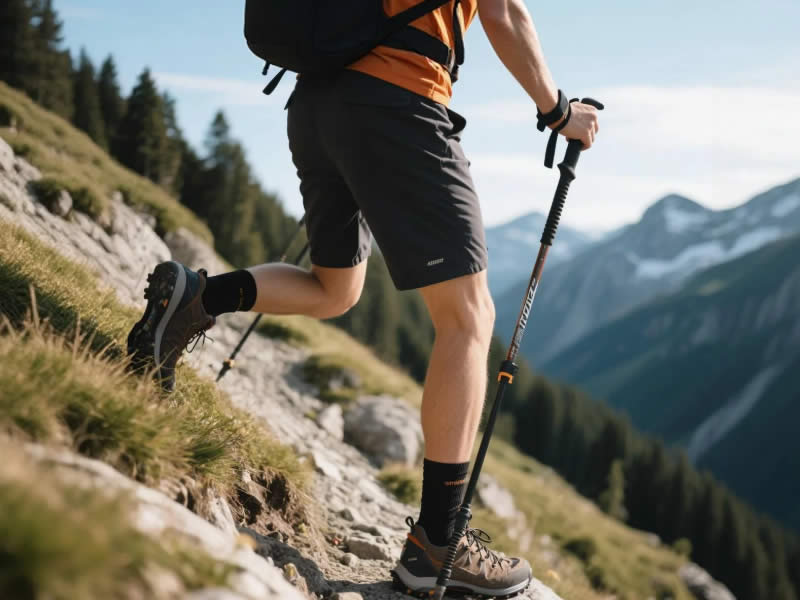
1. How anti‑shock systems work
Most anti‑shock trekking poles contain a coiled spring or elastomer insert inside the lower section. When you plant the pole and apply downward force, the spring compresses, absorbing a fraction of the impact energy. The theory is that this reduces the jarring force transmitted up the shaft to your hands, arms, and shoulders.
On flat or gentle terrain, the spring may compress slightly with each step, but the effect is subtle. On descents, where you plant the pole more heavily, the spring is more active. However, the amount of shock absorbed is relatively small – typically a few millimetres of travel – and is most noticeable on hard, unyielding surfaces like rock or compacted gravel.
2. The real knee‑saver: load transfer, not shock absorption
The primary mechanism by which trekking poles protect your knees is not shock absorption, but load transfer. When you plant a pole correctly and push down through the wrist strap, you transfer a portion of your body weight from your legs to your arms and upper body. On a descent, this can reduce the impact force on your knees by up to 20–25%.
- Wrist straps – The strap should sit across the base of your palm, transferring force directly to your skeletal structure. Your grip should be relaxed; the strap does the work. Without proper strap use, anti‑shock mechanisms are ineffective.
- Planting technique – Plant the pole slightly ahead of your foot, then push down and back as you step. This creates a braking effect that slows your descent and reduces the load on your quads and knees.
- Pole length – On descents, lengthen your poles by 5–10 cm (compared to flat ground length). This allows you to reach further ahead, creating a more effective braking angle.
3. What anti‑shock actually helps with
Anti‑shock systems do have some benefits, though they are secondary:
- Reduced hand and arm fatigue – On long, rocky descents, the spring absorbs high‑frequency vibrations that can cause numbness or tingling in your hands. This makes the descent more comfortable and reduces the need to constantly adjust your grip.
- Comfort on hard surfaces – On compacted gravel, tarmac, or chalk, the spring softens the impact slightly, making each plant feel gentler.
- Psychological confidence – Some walkers find the cushioned feel gives them more confidence to plant the pole firmly, which in turn improves their technique.
4. What anti‑shock does NOT do
- Prevent knee injury – Anti‑shock mechanisms do not reduce the overall load on your knees. They only smooth out the peak impact. The total downward force is still transmitted through the pole, just over a slightly longer time period.
- Replace good technique – If you do not use your wrist straps correctly, or if your poles are too short, anti‑shock will not save your knees. The spring cannot compensate for poor form.
- Work effectively on soft ground – On mud, grass, or peat, the spring has little effect because the ground itself absorbs most of the impact. Anti‑shock is most useful on hard surfaces.
5. Evidence from research
Studies on walking poles and joint loading show that the primary benefit is load transfer. A 2018 study in the Journal of Sports Sciences found that trekking poles reduced knee joint forces by up to 25% on descents, but the reduction was largely independent of the shock‑absorbing mechanism. The spring accounted for only a small fraction of the effect; the rest came from the spreading of load to the upper body.
6. Do you need anti‑shock?
- For most UK walkers – Not essential. On the typical muddy, grassy, or moorland terrain of UK hills, the ground itself is soft enough that anti‑shock adds little. On harder surfaces (coastal paths, chalk downs, or paved sections), it can add comfort.
- For walkers with joint issues – It can reduce the jarring sensation, making descents feel less harsh. If you have arthritis or sensitive joints, the cushioning may be beneficial.
- For frequent walkers on rocky terrain – It helps reduce hand fatigue, but the weight penalty (anti‑shock mechanisms add 30–50 g per pole) and the risk of mechanical failure (springs can wear out) may outweigh the benefit.
7. Proper technique – more important than anti‑shock
To protect your knees on descents, prioritise:
- Pole length – Extend poles 5–10 cm longer than your flat‑ground setting.
- Wrist strap use – Push up through the strap so it sits across the base of your palm. Your grip should be relaxed.
- Planting position – Plant the pole ahead of your foot, then push down and back as you step. This creates a braking effect.
- Body position – Lean slightly forward, but keep your back straight. Avoid over‑reaching.
8. Final verdict
Anti‑shock trekking poles do reduce knee pain on descents, but the benefit is often overestimated. The spring mechanism primarily reduces hand and arm fatigue by absorbing high‑frequency vibration, while the main knee‑saving effect comes from correct load transfer through wrist straps and proper technique. For most UK walkers on soft, muddy trails, anti‑shock adds little benefit – you are better off investing in a good pair of poles with reliable lever locks, comfortable grips, and replaceable tips. If you walk regularly on hard, rocky terrain or have sensitive joints, anti‑shock can provide extra comfort. But remember: no spring can replace good technique. Master your strap use and planting rhythm, and your knees will thank you far more than any shock absorber can.




