




What is the difference between Nordic walking poles and standard trekking poles?
Nordic walking poles and standard trekking poles may look similar at a glance, but they are fundamentally different tools, designed for distinct activities, techniques, and terrains. The key differences lie in their grip design, locking mechanisms, tip construction, and intended walking technique. While trekking poles are fully adjustable, rugged, and designed for balance and support on uneven off‑road terrain, Nordic walking poles are typically fixed‑length, feature angled grips with quick‑release straps (gloves), and use asymmetrical rubber "paws" to promote a specific fitness‑walking technique on flat, firm surfaces. Using the wrong type compromises performance and can even lead to injury. This article breaks down the essential differences to help you choose the right pole for your activity.
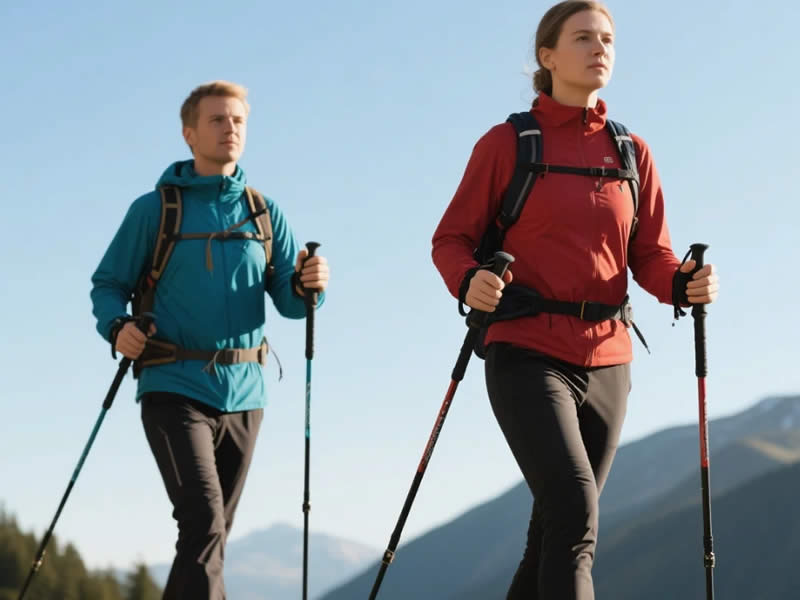
1. Grip and Strap Design
- Nordic Walking Poles: These feature angled or ergonomic grips that encourage a natural handshake position, promoting an upright posture. Crucially, they come with a special quick‑release strap system (glove) that fits over your hand like a fingerless glove. This allows you to fully release the pole on the backswing without dropping it, enabling the classic "rolling" push‑off motion essential for the Nordic walking technique.
- Standard Trekking Poles: They have straight grips (often cork or foam) with a simple adjustable loop strap that goes around your wrist. You grip the handle tightly, and the strap primarily bears the downward load on ascents or descents. The design prioritises grip security and weight transfer for balance, not a rhythmic release.
2. Length and Adjustability
- Nordic Walking Poles: These are generally fixed‑length or have very limited adjustability. Correct length is critical for the biomechanics of Nordic walking—usually calculated as 0.68 x your height. Once set, you do not change the length during a walk because the terrain is typically flat or gently undulating.
- Standard Trekking Poles: They are almost always fully adjustable telescoping poles (using twist or lever locks). This allows you to shorten them for steep ascents and lengthen them for descents, adapting to varied gradients and rocky, uneven terrain where your hand position relative to the ground changes constantly.
3. Tips and Footwear (The "Paws")
- Nordic Walking Poles: Instead of sharp metal tips, they are equipped with asymmetrical rubber "paws" or ferrules. These are angled and have a textured surface designed to grip the pavement or hard ground and provide a push-off point. The asymmetrical shape ensures the pole drags smoothly behind you without catching. The carbide tip is usually hidden or interchangeable with the paw.
- Standard Trekking Poles: They use a permanent, exposed tungsten carbide tip (often with a removable rubber tip cover for road sections). The carbide tip is essential for biting into mud, grass, scree, and rocky surfaces to provide reliable traction and prevent slipping on unpredictable off‑road terrain.
4. Technique and Purpose
- Nordic Walking Poles: The primary goal is fitness and cardio. The technique involves a long, rhythmic stride, planting the pole diagonally behind you at a specific angle, and using the pole to propel you forward, engaging your core, shoulders, and back. It is a low‑impact, high‑energy workout designed for flat, smooth surfaces like park paths, promenades, and pavements.
- Standard Trekking Poles: The primary goal is stability, support, and safety. The technique focuses on alternating planting to reduce knee impact on descents, provide leverage on steep climbs, and maintain balance on slippery, uneven, or technical trails (bogs, rocky fells, river crossings).
5. The UK Context: Which one do you need?
If you are walking on well‑maintained, flat paths (e.g., a towpath, a coastal promenade, or a park) specifically to get a workout, Nordic walking poles are ideal. However, you must buy the correct length and learn the specific technique, often with a qualified instructor.
If you are walking on the Lake District fells, the mud of the Pennines, the Scottish Highlands, or any uneven terrain where you need balance, knee protection, and flexibility to adjust for ups and downs, standard adjustable trekking poles are what you need. These are the poles stocked by Decathlon, Cotswold Outdoor, and Go Outdoors for hillwalking and backpacking.
Final Verdict
They are not interchangeable. Nordic walking poles are specialised fitness equipment for flat, hard surfaces, featuring fixed lengths, angled grips, glove‑straps, and rubber paws for a push‑off action. Standard trekking poles are adaptable, rugged support tools for off‑road terrain, with adjustable lengths, wrist straps, and carbide tips for gripping mud and rock. Choosing the wrong pole compromises technique, reduces safety, and limits effectiveness. If you are tackling British hills, choose adjustable trekking poles. If you are power‑walking the park, choose Nordic poles.




