




Do trekking poles work well on slippery chalk downland?
Yes – trekking poles work very well on slippery chalk downland (e.g., the South Downs, North Downs, and Ridgeway), but with important caveats. The sharp carbide tip bites into the chalk surface, providing grip far better than rubber. On wet, greasy chalk, the tip can still find micro‑cracks for traction. However, chalk is highly abrasive and will wear down carbide tips faster than on soil or mud – keep your tips sharp or carry spares. Plant deliberately, at a slight angle for maximum bite. Rubber tips should be removed – they slide dangerously on wet chalk. Lever‑lock poles are preferred over twist‑locks in gritty, wet conditions. Overall, poles improve stability on slippery downland when used with sharp carbide tips and good technique. This article explains the science, practical tips, and why chalk downland is a unique challenge for walkers.
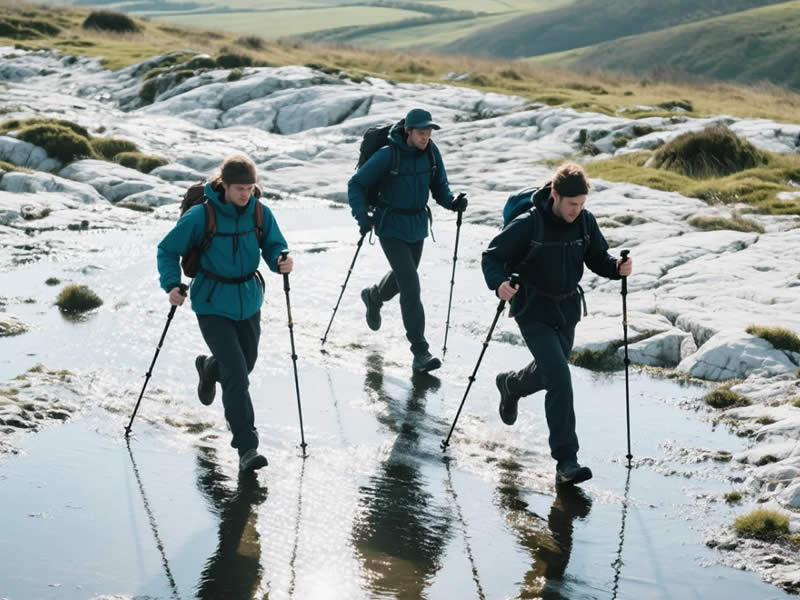
1. Why chalk downland is slippery
Chalk is a soft, porous limestone that becomes extremely slippery when wet. Rainwater combines with the fine chalk dust on the surface, creating a greasy, soap‑like film. This is particularly hazardous on steep slopes (common on the South Downs and Chilterns) where footing is already challenging. The surface is often uneven, with embedded flints and loose stones, further complicating balance.
2. How trekking poles help
- Carbide tip grip – The sharp carbide tip penetrates the chalk surface, finding micro‑cracks and irregularities to grip. This provides a secure planting point that your foot cannot achieve on the slick surface.
- Stability – Four points of contact (two feet + two poles) improve balance, especially on greasy slopes where a single misstep could lead to a fall.
- Testing the ground – You can probe ahead with the pole to test the firmness of the chalk before committing your weight. Hidden flints or loose stones can be detected.
3. Why rubber tips are dangerous
Rubber tips (ferrules) are designed for pavement and indoor use. On wet chalk, rubber has almost no traction – it skids across the surface, offering no support. If you are walking on chalk downland, remove any rubber tips. They are a hazard.
4. The abrasion problem
Chalk is surprisingly abrasive. The fine particles act like sandpaper, wearing down carbide tips much faster than mud or grass. You may notice your tips becoming blunt after a few days of walking on chalk. For long‑distance walks (e.g., the South Downs Way or the Ridgeway), carry spare tips and replace them as needed.
5. Tip angle and planting technique
- Plant at a slight angle – On steep descents, plant the pole slightly ahead of you, at a slight angle. This increases the surface area of the tip in contact with the chalk, reducing the chance of skidding.
- Push down firmly – Apply downward pressure to seat the tip into the chalk. A light plant may slide.
- Avoid jabbing – A sharp jab can cause the tip to glance off a flint. Plant deliberately, with a controlled motion.
6. Pole locks – lever vs. twist
Chalk dust and mud can enter locking mechanisms. Twist‑locks are particularly vulnerable – the fine chalk dust can get into the threads, causing them to slip or seize. Lever‑locks (cam locks) are more resilient; they can be rinsed and adjusted easily. For chalk downland, choose a pole with lever locks.
7. Additional tips for chalk downland walking
- Shorten poles on ascents – Chalk hills can be steep; shorten your poles by 5–10 cm for better leverage.
- Lengthen on descents – Lengthen for braking on slippery descents.
- Use mud baskets – In wet conditions, a small basket can prevent the pole from sinking too deep into soft chalk mud.
- Check tips daily – Inspect your tips after each walk; replace if blunt.
8. What about Nordic walking poles on chalk?
Nordic walking poles use angled rubber paws, which are not suitable for wet chalk – they slide. If you are Nordic walking on chalk paths, switch to standard carbide‑tipped poles for the downland sections.
9. Final verdict
Trekking poles work very well on slippery chalk downland when used correctly – with sharp carbide tips, removed rubber ferrules, and deliberate planting. They significantly improve stability and reduce the risk of falls on the greasy, uneven slopes. However, the abrasive nature of chalk will wear down tips faster than on other terrains, so carry spares and inspect regularly. For the South Downs, North Downs, and Ridgeway, a pair of lever‑lock poles with sharp carbide tips is an essential piece of safety equipment, not just a comfort accessory.




