




What is the best trekking pole for use with a trekking pole tent like the Lanshan?
For a Lanshan tent (or similar trekking‑pole shelters like the Zpacks Duplex, Six Moon Designs, or Gossamer Gear tents), the ideal pole is an adjustable aluminium trekking pole with lever locks, reaching at least 135 cm. The Lanshan 1 requires a centre height of 115–125 cm; the Lanshan 2 needs 120–130 cm – fixed‑length poles cannot achieve this precise adjustability, especially on uneven ground. Aluminium is safer than carbon – tent support creates lateral tension that can snap brittle carbon poles; 7075 aluminium bends rather than breaks under the constant tension of a pitched shelter. Lever locks (cam locks) are essential – twist locks slip under the sustained load of a guyed‑out tent, potentially collapsing your shelter. Top picks: Leki Makalu (£90), Black Diamond Trail Back (£75), or budget Decathlon Forclaz MT500 (£35). Avoid carbon, twist locks, or fixed Z‑poles for tent support. This article explains the technical requirements, compares the best options, and provides practical tips for pitching your Lanshan with trekking poles.
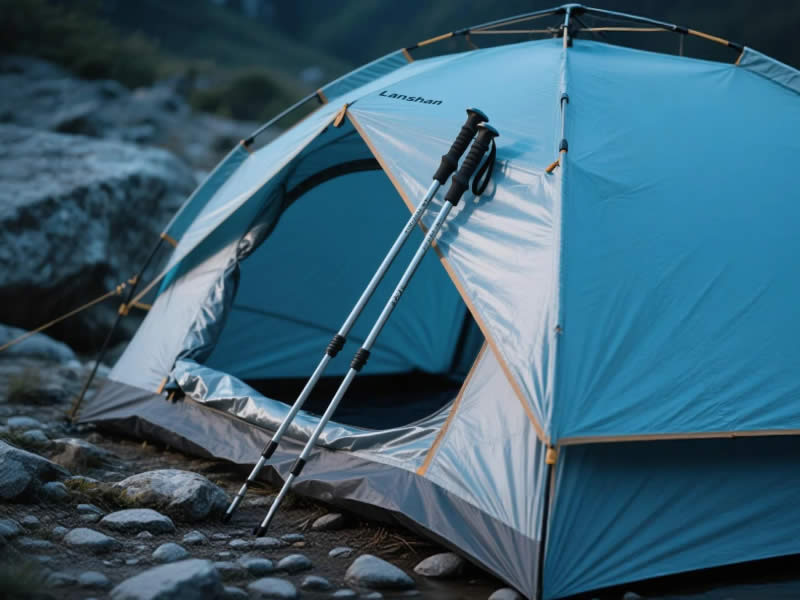
1. Why a trekking pole tent needs specific pole features
Trekking‑pole tents are designed to be supported by your walking poles, saving the weight of dedicated tent poles. The Lanshan, like many similar shelters, uses a central apex design where the pole tip sits in a reinforced grommet or webbing pocket at the peak. The pole must hold the tent taut against wind, rain, and guyline tension. This creates specific demands that not all trekking poles can meet.
2. The three critical requirements
a. Adjustable length – The Lanshan 1 requires a pole height of 115–125 cm; the Lanshan 2 needs 120–130 cm. The exact height depends on the ground slope, how taut you pitch the fly, and your personal preference. Fixed‑length poles (e.g., Black Diamond Distance Z) cannot achieve this precision, making them unsuitable for a reliable pitch.
b. Lateral strength – When the tent is guyed out, the pole is subjected to lateral (sideways) forces as the fabric tensions. Carbon fibre poles, while strong under vertical compression, can splinter under these lateral forces. 7075 aluminium is far more forgiving and can withstand the constant tension without failing.
c. Locking reliability – The pole must hold its length under continuous load. Twist locks (friction‑based) are notorious for slipping, especially if grit or moisture enters the mechanism. Lever locks (cam locks) create a mechanical clamp that holds securely regardless of load or weather.
3. Why carbon poles are risky for tent support
Carbon poles are designed for lightweight walking, not for holding a tent taut. The lateral forces generated by a guyed‑out shelter can exceed the carbon's strength, especially at the joint areas. A splintered carbon pole on a remote trail leaves you with a sagging shelter and a broken pole. Aluminium bends under excessive force – it may bend, but it rarely breaks catastrophically, and you can often straighten it enough to pitch your tent.
4. Why twist locks fail
Twist locks work by expanding an internal mechanism against the inner wall. Under the constant tension of a pitched tent, the friction can be overcome, causing the pole to slowly collapse. This is especially problematic in damp or gritty conditions. Lever locks have no such weakness – they clamp mechanically and hold until you release them.
5. Top recommendations for the Lanshan
| Model | Price | Material | Locking | Max length | Best for |
|---|---|---|---|---|---|
| Leki Makalu | £90–100 | 7075 aluminium | SpeedLock Plus (lever) | 145 cm | Premium durability, steel lower section |
| Black Diamond Trail Back | £75–85 | 7075 aluminium | FlickLock (lever) | 140 cm | Reliable, lightweight |
| Decathlon Forclaz MT500 | ~£35 | 6061 aluminium | Cam lock (lever) | 140 cm | Budget, occasional use |
| Decathlon Forclaz MT900 | £55 | 7075 aluminium | Cam lock (lever) | 140 cm | Best value, proven on UK trails |
6. Practical tips for pitching with your poles
- Set the pole height – For the Lanshan 1, start at 120 cm; for the Lanshan 2, start at 125 cm. Adjust up or down depending on the ground slope and how taut you want the pitch.
- Protect the tip – Place a small rubber tip cover over the carbide tip to prevent it from abrading the tent's grommet or fabric.
- Angle the pole – For a storm pitch, angle the pole slightly into the prevailing wind to improve wind resistance.
- Check the lock – After pitching, push down on the peak to ensure the pole is locked firmly. If it slips, tighten the lever lock screw.
- Carry a spare – If you are on a multi‑day trek, carry a spare pole section or an emergency pole. A broken pole on a remote trail can be a serious problem.
7. What about folding Z‑poles?
Folding Z‑poles are not recommended for tent support. Their push‑button joints are not designed to hold lateral tension and can fail. The sections also have minimal overlap, reducing their strength under load. Stick with telescoping poles.
8. Final verdict
For a Lanshan or similar trekking‑pole tent, the best choice is an adjustable aluminium telescoping pole with lever locks – such as the Leki Makalu, Black Diamond Trail Back, or Decathlon Forclaz MT900. These poles offer the adjustability, lateral strength, and locking reliability needed for a secure, storm‑worthy pitch. Avoid carbon, twist locks, and folding Z‑poles – they are not up to the task. Invest in a quality pair of poles that can serve you on the trail and as a reliable tent support, and you'll be well‑equipped for your wild camping adventures.




