




How to use trekking poles on flat vs rolling terrain?
The key difference in technique between flat and rolling terrain is rhythm versus adjustment. On flat terrain, you use a steady, alternating diagonal stride to maintain efficiency and reduce fatigue. On rolling terrain, you constantly adjust your pole length and planting technique to match the changing gradient. Mastering both will save energy and protect your joints on any trail.
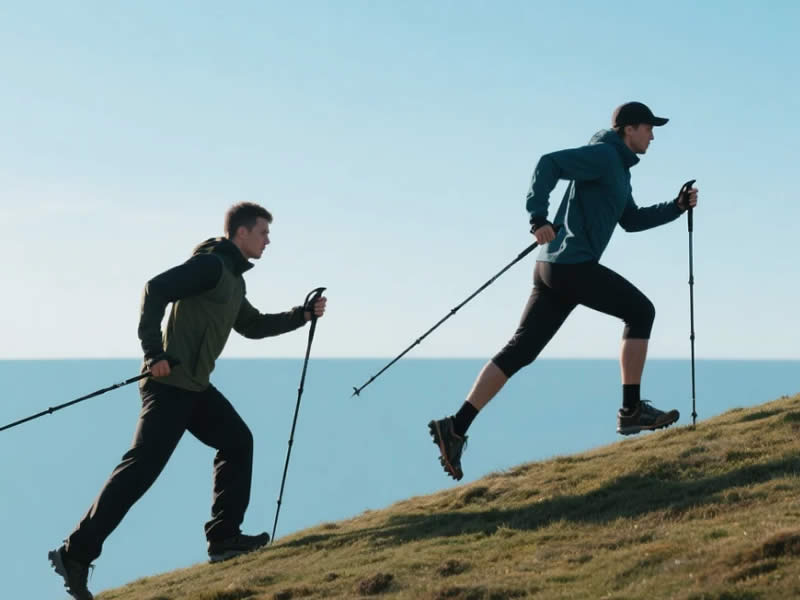
1. Flat terrain – rhythm and efficiency
On flat ground, the goal is to maintain a steady, efficient rhythm that uses your upper body to assist your legs. The technique is simple but requires practice to perfect.
a. The alternating diagonal stride
- Plant left pole as your right foot steps forward.
- Plant right pole as your left foot steps forward.
- This mimics your natural arm swing and spreads the workload across your body.
b. Pole length
- Set your poles so your elbows are at 90° when the tip is on the ground.
- This is your baseline flat-ground length. For most walkers, this is around 120–125 cm.
c. Rhythm
- Aim for a consistent cadence: around 60–70 plants per minute per pole.
- Count "left, right, left, right" to find a steady rhythm.
- A consistent rhythm reduces mental effort and helps you maintain a steady pace over long distances.
d. Planting position
- Plant the pole close to your body – level with your heel or slightly ahead.
- Avoid reaching too far forward, which wastes energy and disrupts your rhythm.
e. Energy transfer
- Push down through the wrist strap, not your grip.
- Your hand should be relaxed; the strap transfers the load to your arms and shoulders.
f. When to use rubber tips
- On tarmac or hard paths (common on trails like the Thames Path), fit rubber tip protectors to save your carbide tips and reduce noise.
2. Rolling terrain – frequent adjustments
Rolling terrain – a series of short, steep ascents and descents – is common on trails like the South Downs Way, the North Downs Way, and many sections of the Coast to Coast. The key is to adjust your pole length frequently to match the gradient.
a. Ascents – shorten for leverage
- Shorten poles by 5–10 cm (compared to flat-ground length) on steep ascents.
- A shorter pole lowers your hands, giving you better leverage to push up the slope.
- Use a double plant on very steep steps: plant both poles together ahead of you and push down as you step up.
b. Descents – lengthen for braking
- Lengthen poles by 5–10 cm on steep descents.
- A longer pole allows you to plant ahead of your feet, creating a braking effect that reduces knee impact.
- Plant the pole slightly ahead and push down to slow your momentum.
c. Adjusting on the go
- Lever locks (cam locks) allow quick, tool-free adjustments.
- Practice adjusting your poles without stopping – it takes seconds and saves energy over a rolling trail.
- Carry a hex key to tighten lever locks if they loosen with use.
d. The double plant on steep rollers
- On very steep, short slopes (common on the South Downs), use a double plant – both poles together – on the ascent to push up, and again on the descent to brake.
- This gives you maximum power and stability on the steepest sections.
e. When to stow poles
- On long, flat sections between rollers, you may prefer to stow your poles and walk freely. This saves arm fatigue and lets you rest your upper body.
- On very steep, technical descents, you may want to stow poles and use your hands for balance.
3. Comparison table – flat vs rolling terrain
| Aspect | Flat Terrain | Rolling Terrain |
|---|---|---|
| Pole length | Fixed (90° elbow) | Adjust frequently (shorten/lengthen) |
| Rhythm | Alternating diagonal stride | Adapt to slope – double plant on steep sections |
| Planting position | Close to body | Ahead on descents, close on ascents |
| Energy use | Steady, rhythmic | More variable – bursts on ascents |
| Adjustments | Minimal | Frequent – carry a hex key |
4. Common mistakes
- Not adjusting length on rolling terrain – Walking with the same length on a steep descent reduces braking and increases knee impact.
- Over-adjusting – You don't need to adjust for every tiny slope. Only adjust for significant changes in gradient.
- Losing rhythm – On rolling terrain, it's easy to lose your rhythm. Focus on a consistent cadence, adjusting your planting to match the slope.
5. Practice
- Flat terrain – Practice the alternating stride on a flat, straight path. Focus on rhythm and the wrist strap.
- Rolling terrain – Find a trail with short, steep sections. Practice shortening and lengthening your poles on the go. It takes a few walks to become automatic.
6. Final verdict
The correct technique for flat terrain is a steady, alternating rhythm with fixed pole length. For rolling terrain, you need to constantly adjust your pole length and planting technique to match the gradient. The key difference is rhythm versus adjustment. Master both, and you will walk more efficiently, protect your joints, and enjoy the trail, whether it's a flat towpath or a rolling chalk ridge.




