




What is the correct way to hold the grips without straining fingers?
The correct way to hold trekking pole grips is to let your wrist strap do the work, not your fingers. Many walkers instinctively grip the handle tightly, which leads to finger fatigue, blisters, and even tingling in the hands. The secret is to adjust the strap so it sits across the base of your palm, enabling the load to be transferred through the strap rather than your grip. Your fingers should simply guide the pole, not clamp it. This article explains the correct technique, how to adjust your straps, and how to avoid common mistakes that cause finger strain.
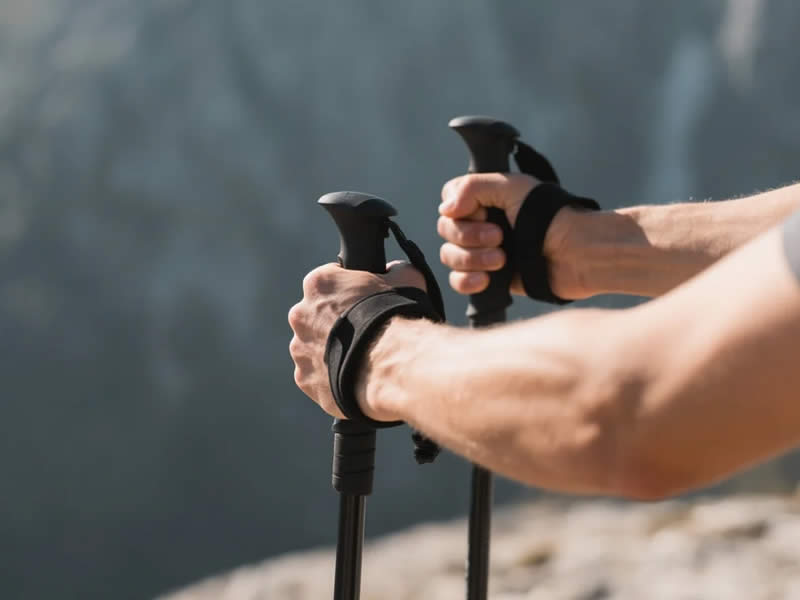
1. The principle: The strap bears the load, not your fingers
When you plant a trekking pole, the downward force of your body weight needs to be transferred to the ground. Many people try to achieve this by gripping the handle tightly. This is inefficient and causes fatigue. The correct method is to use the wrist strap as the load‑bearing point:
- The strap should sit across the base of your palm (the fleshy area between your thumb and wrist).
- When you push down on the pole, the force goes through the strap, not through your fingers.
- Your fingers remain relaxed, simply guiding the pole—they are not supporting your weight.
2. The "underhand" technique
The correct way to put your hand through the strap:
- Slide your hand up through the strap from underneath. Your palm should be facing the grip.
- Bring your hand down onto the grip. The strap should now sit diagonally across the back of your hand, between your thumb and index finger—not across your wrist.
- Relax your fingers – They should be loosely curled around the grip, like you are holding a butterfly or a raw egg. If you are gripping tightly, you are doing it wrong.
3. Adjusting traditional straps
Most poles have a simple webbing loop strap.
- Loosen the strap so you can comfortably slide your hand through using the underhand method.
- Tighten the strap until it is snug, but not tight—you should be able to slide one finger between the strap and the back of your hand.
- Test the load transfer – Plant the pole and push down. You should feel the force through the strap, not your fingers. If your fingers are doing the work, the strap is too loose.
4. Adjusting trigger straps (Leki system)
The Leki trigger strap system is designed for fast adjustments:
- The clip should be centred on the back of your hand when you hold the grip.
- Adjust the width using the slider on the strap. It should cradle your hand without pinching.
- Snap in – The trigger should clip in smoothly. Your hand should be able to relax, with the strap taking the load.
5. Common mistakes
- Gripping too tightly – This is the most common cause of finger strain. Your fingers should be relaxed; the strap does the work.
- Strap across the wrist – The strap should sit across your palm, not your wrist. This transfers load to your skeletal structure, not your grip.
- Strap too loose – If the strap is loose, your grip has to do the work, leading to fatigue.
- Strap too tight – A tight strap can restrict blood flow, causing numbness or tingling. You should be able to slide one finger between the strap and your hand.
- Fingers curled too far around the grip – Some people curl their fingers all the way around, which puts pressure on the flexor tendons. Keep your fingers relaxed, with a light hold.
6. The feeling of a correct grip
When you hold the grip correctly:
- Your fingers feel relaxed.
- When you push down on the pole, you feel the load through the strap, not your fingers.
- You can almost let go of the grip completely and still push down firmly.
- Your hand does not ache after a long walk.
- You do not get blisters on your fingers.
7. Preventing finger strain – additional tips
- Wear gloves – Lightweight trekking gloves (fingerless) can reduce friction and provide cushioning.
- Take breaks – Shake out your hands periodically to improve circulation.
- Stretch – Gentle finger and wrist stretches before and after walking can help reduce tension.
- Use foam grips – Some walkers find foam grips more comfortable than cork, though cork is better in wet conditions.
8. How to practice
- Without poles – Stand with your arms relaxed by your sides. Feel the weight of your arms; your hands are relaxed.
- With poles – Pick up the poles using the underhand method. Walk a short section, focusing on relaxing your grip. If you feel tension, pause, shake out your hands, and start again.
- Plant and relax – Plant the pole, push down, and feel the load transfer through the strap. Your fingers should not be working hard.
9. Final verdict
The correct way to hold trekking pole grips without straining your fingers is to let your wrist strap do the work. Slide your hand up through the strap, tighten it so it sits across the base of your palm, and hold the grip loosely—like holding a butterfly. The force of your weight should be transferred through the strap, not your fingers. If your fingers ache or tingle, your grip is too tight or your strap is incorrectly adjusted. With the right technique, you can walk for hours without finger strain, allowing you to enjoy the trail without discomfort. Practice the relaxed grip until it becomes automatic, and your hands will thank you.




