




Do professional mountain guides use trekking poles?
Yes – most professional mountain guides use trekking poles, but their choice depends on terrain and season. On rocky, steep, or muddy terrain, guides rely on poles for stability, knee protection, and fatigue reduction. On technical scrambles or glacier travel, they may use an ice axe instead. Guides typically choose 7075 aluminium poles with lever locks and steel lower sections (e.g., Leki Makalu) for durability and repairability, avoiding carbon fibre which is too brittle for the demands of guiding. This article provides a detailed look at when, why, and how professional guides use trekking poles.
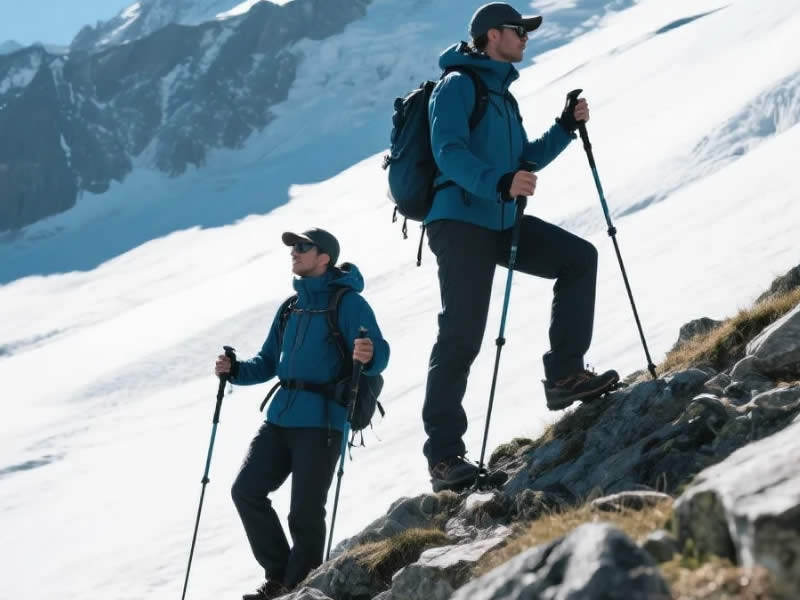
1. When guides use trekking poles
a. Approaches and descents – The most common use. Guides use poles to protect their knees on long, steep sections, especially when carrying a heavy pack. Poles offload 20–25% of the weight from the knees.
b. Muddy or uneven ground – On wet, muddy, or boggy terrain, poles provide stability and allow the guide to test the ground ahead. This is particularly important on routes like the Pennine Way or Dartmoor.
c. Long, flat sections – On long, flat stretches, poles help maintain a steady rhythm and reduce leg fatigue, allowing the guide to cover more ground.
d. Winter walking – In winter, guides use poles with snow baskets and carbide tips for traction on snow and ice. The poles provide stability and can be used to test the depth of snow.
2. When guides don't use poles
a. Technical scrambles (Grade 2+) – On scrambles where hands are needed for balance and support, guides will stow their poles. They use their hands for stability and safety.
b. Glacier travel – On glacier terrain, an ice axe is essential for self‑arrest. Guides carry an ice axe and may not use poles.
c. Very steep snow – On steep snow slopes, an ice axe is safer for arrest. Poles are less effective on steep, hard snow.
3. What guides look for in a pole
a. 7075 aluminium – Guides prioritise durability over weight. Carbon fibre is lighter, but a side impact can cause it to splinter. Aluminium bends but rarely breaks, and can often be straightened in the field.
b. Steel lower section – The lower section of the pole is subject to constant abrasion from rocks and ice. A steel ferrule (found on the Leki Makalu) resists this wear, extending the pole's life.
c. Lever locks (cam locks) – Lever locks are more reliable than twist locks, especially in cold, wet conditions. They are easier to operate with gloves and can be adjusted with a hex key.
d. Cork grips – Cork grips are comfortable in wet, cold conditions. They become tacky when damp, providing a secure hold even with gloves.
e. Replaceable tips – Guides use poles frequently, so replaceable tips are essential. They can replace worn tips rather than buying new poles.
f. Field‑repairable – Guides need poles that can be repaired on the trail. They carry spare tips, hex keys, and sometimes spare sections.
4. Popular models among guides
- Leki Makalu – The gold standard. 7075 aluminium, steel lower section, SpeedLock Plus, cork grips. Used by many guides in the UK, Alps, and elsewhere.
- Black Diamond Trail Pro – A close alternative. 7075 aluminium, FlickLock, comfortable foam/cork grip.
- Black Diamond Trail Back – Similar to Trail Pro, slightly lighter.
- Decathlon Forclaz MT900 – A budget option. Some guides use it for summer work, but it lacks the steel lower section.
5. The guide's philosophy – reliability over weight
Guides choose reliability over weight. A broken pole on a remote mountain is not just an inconvenience – it can be a safety issue. Guides prioritise poles that are durable, repairable, and field‑adjustable. The weight saving of a carbon pole is not worth the risk of it snapping on a side impact.
6. Guides and the ice axe
In winter and on glacier terrain, guides often use an ice axe instead of poles. The ice axe is used for balance, self‑arrest, and cutting steps. Some guides carry both an ice axe and a single pole, using the pole for support on the approach and the axe on the technical sections.
7. Final verdict
Professional mountain guides use trekking poles extensively, but their choice is terrain‑dependent. On approaches, descents, and muddy ground, poles are essential. On technical scrambles and glacier terrain, they may switch to an ice axe. When choosing poles, guides prioritise durability and reliability – hence the preference for 7075 aluminium, lever locks, and steel lower sections. Carbon poles are rarely used due to their brittleness. The Leki Makalu is the most common choice among guides in the UK and Europe. For guiding, reliability is paramount – and that means aluminium.




