




Are trekking poles with twist‑lock or lever‑lock more reliable in heavy rain?
Lever locks are significantly more reliable than twist locks in heavy rain. Twist locks rely on friction between an internal expander and the inner shaft. Water and mud reduce friction, causing the lock to slip. Lever locks (cam locks) are mechanical clamps that hold securely regardless of moisture or dirt. They are field-adjustable with a hex key and easy to clean. In heavy rain, lever locks are the only reliable choice—twist locks will slip when you need them most.
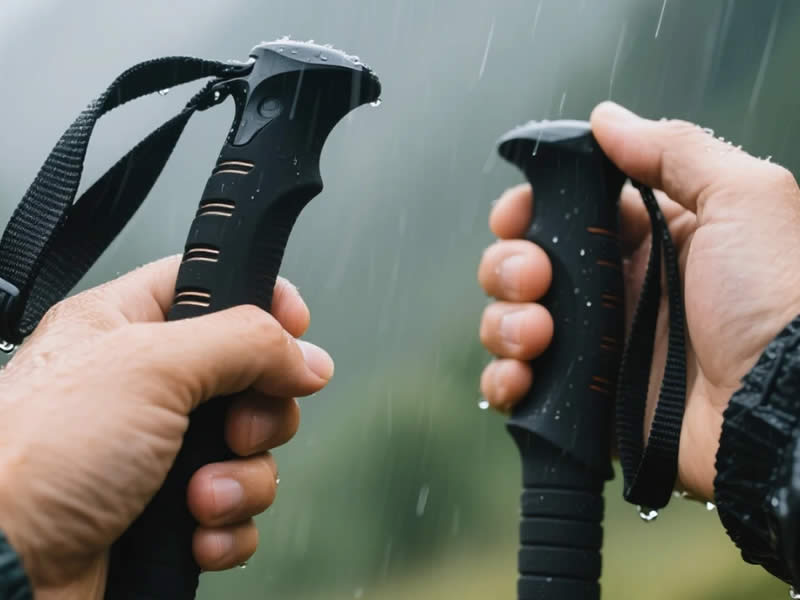
1. How twist locks work – and why they fail in rain
Twist locks consist of an internal expander (usually a plastic or metal cone) that presses against the inner wall of the outer shaft when you twist the lower section. The lock holds by friction. When the pole is dry and clean, this works adequately. However:
- Water reduces friction – Water acts as a lubricant, reducing the grip between the expander and the inner wall.
- Mud and grit – Mud and sand get into the threads, preventing the lock from tightening fully.
- Corrosion – Over time, moisture can cause the threads to corrode, making the lock stiff or impossible to adjust.
- Sudden slip – In heavy rain, a twist lock can slip suddenly under load, causing you to lose balance or fall.
2. How lever locks work – and why they are reliable
Lever locks (cam locks) use a mechanical clamp that tightens around the outer shaft. When you close the lever, it compresses a metal band around the shaft, locking the sections together. The grip is mechanical, not friction-based.
- Unaffected by water – The clamp holds securely regardless of moisture.
- Field-adjustable – If the lock loosens over time, you can tighten it with a hex key (usually 2.5 or 3 mm).
- Easy to clean – Mud and grit can be rinsed out of the mechanism.
- Works with gloves – Lever locks are easy to operate with wet or cold hands.
3. Real-world experience in heavy rain
In conditions like the UK's wet hills, the Brazilian Atlantic Forest, or tropical downpours, twist locks are a common point of failure. Walkers report slipping locks on steep descents, leading to loss of balance or falls. Lever locks, on the other hand, are trusted by mountain guides and experienced walkers for wet-weather reliability.
4. The maintenance factor
- Twist locks – If a twist lock slips in the rain, you have few options. You can try to dry the inner shaft and tighten it, but this is often impractical on the trail. Over time, the threads can become corroded, requiring disassembly and replacement of the expander.
- Lever locks – If a lever lock slips, you can tighten the adjusting screw with a hex key. You can also rinse the mechanism to remove mud and grit.
5. What about push-button locks (folding poles)?
Push-button locks on folding (Z-pole) poles are generally reliable in wet conditions, but they can jam with grit. They are less affected by rain than twist locks, but they are not as field-repairable as lever locks. For heavy rain, lever locks are still the best choice.
6. Recommendations for wet conditions
- Choose lever locks – Look for Leki SpeedLock Plus, Black Diamond FlickLock, or Decathlon cam locks.
- Avoid twist locks – If you hike in wet conditions, twist locks are a false economy.
- Clean lever locks – In heavy rain, periodically open the lever and flush out any grit.
- Carry a hex key – For adjusting lever locks if they loosen.
- Dry your poles – After a wet walk, extend the poles and dry the locks thoroughly to prevent corrosion.
7. The cost factor
Lever lock poles are generally more expensive than twist lock poles. However, the extra cost is justified by the reliability. A twist lock pole that slips on a steep descent is a safety hazard. In wet conditions, lever locks are worth the investment.
8. Final verdict
Lever locks are more reliable than twist locks in heavy rain. Their mechanical grip holds securely regardless of moisture or dirt. Twist locks rely on friction and slip when wet. For hiking in rainy conditions—whether in the UK, Brazil, or anywhere else—choose lever locks. They are safer, more reliable, and easier to maintain. If you have twist lock poles and hike in wet conditions, consider upgrading—your knees and safety will thank you.




