




What is the best trekking pole tip for slippery moss‑covered rocks?
A sharp tungsten carbide tip is the best choice for slippery moss-covered rocks. It bites through the moss into the rock surface, providing reliable traction. Rubber tips are dangerous—they slide without grip on moss or wet rock. For very smooth, polished rock, some walkers use studded rubber "crampon" caps, but they are less effective on moss.
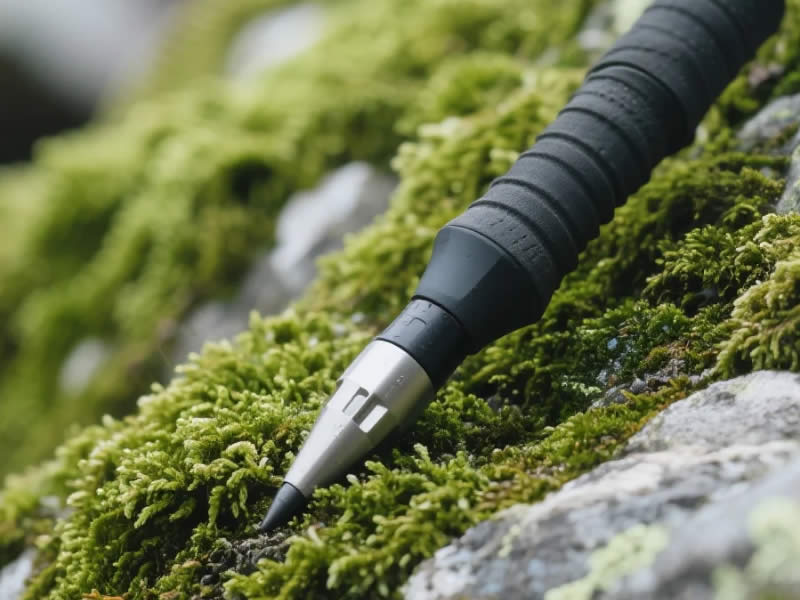
Why tungsten carbide works on moss:
- Bites through moss – The sharp point penetrates the moss layer into the hard rock beneath.
- Grips on wet rock – Carbide finds micro‑cracks and irregularities.
- Wear‑resistant – Holds its sharp edge longer than steel.
Technique tips:
- Plant vertically – A straight‑down push gives the carbide tip maximum bite.
- Avoid rubber tips – Remove them before entering mossy or wet sections.
- Replace worn tips – A blunt tip will skid; replace when rounded.
- Test each plant – Tap the ground before committing your weight.
What about studded rubber caps? Some walkers use studded rubber "crampon" caps on very smooth, polished rock. They can help on wet, hard surfaces, but they are less effective on moss. Carbide is the reliable choice for mossy rocks.
Verdict: For moss‑covered rocks, use sharp carbide tips. Plant vertically and avoid rubber tips. For Brazilian or UK trails with mossy sections, carbide is the best option. On very smooth, polished rock, studded caps are an alternative but not a replacement for good technique. Stay safe on wet, slippery trails.
1. Why moss is dangerous
Moss is a natural, soft layer that grows on rocks in wet, humid conditions. When wet, it becomes extremely slippery—like walking on a greased surface. The combination of moss, moisture, and uneven rock can make trails treacherous. Many Brazilian and UK trails, especially in the Atlantic Forest and the Lake District, have mossy sections.
2. Why tungsten carbide is the best choice
a. Bites through moss – The sharp point penetrates the moss layer into the hard rock beneath. This gives you a secure plant.
b. Grips on wet rock – Carbide is hard enough to find micro‑cracks and irregularities in the rock surface, providing traction even when the rock is wet.
c. Wear‑resistant – Carbide holds its sharp edge longer than steel, so it remains effective on abrasive surfaces.
3. Why rubber tips are dangerous
Rubber tips are designed for pavement and hard, dry surfaces. On wet moss, rubber has almost no traction—it skids across the surface, offering no support. If you are walking on mossy terrain, remove rubber tips. They are a hazard.
4. The role of studded rubber caps
Some walkers use studded rubber "crampon" caps on very smooth, wet rock. These have small metal studs that bite into the rock. They can help on polished surfaces, but they are less effective on moss because the studs are too small to penetrate the moss layer. For mossy rocks, carbide is the better choice.
5. Technique tips for mossy rocks
- Plant vertically – A straight‑down push gives the carbide tip maximum bite. Angled plants are more likely to skid.
- Remove rubber tips – Always remove rubber tips before entering mossy sections.
- Replace worn tips – A blunt tip will skid; replace when rounded.
- Test each plant – Tap the ground before committing your weight. If the tip skids, find a more secure plant.
- Test the ground – Use the pole to test the moss before stepping.
6. Additional advice for wet conditions
- Good footwear – Poles are not a substitute for boots with good grip.
- Slow down – On mossy rocks, speed is your enemy.
- Use two poles – Two poles give you four points of contact, improving stability.
7. Maintenance
- Check tips regularly – Mossy terrain can wear down tips. Replace when blunt.
- Clean after walks – Moss and mud can accumulate on the tip; rinse and dry.
8. Final verdict
For slippery moss‑covered rocks, a sharp tungsten carbide tip is the best choice. It bites through moss into the rock, providing reliable traction. Rubber tips are dangerous. Studded rubber caps are better for polished rock, not moss. For Brazilian and UK trails with mossy sections, carbide is the best option. Happy hiking.




