




Do trekking poles help with upper body workout during long Brazilian treks?
Yes – but only if you use them actively, not passively. When you push down through the straps and engage your arms, shoulders, back, and core, trekking poles turn walking into a full‑body workout. Studies show that active pole use can increase energy expenditure by 20–40% compared to walking without poles. The key is to use the straps to transfer load, not just rest your hands on the grips.
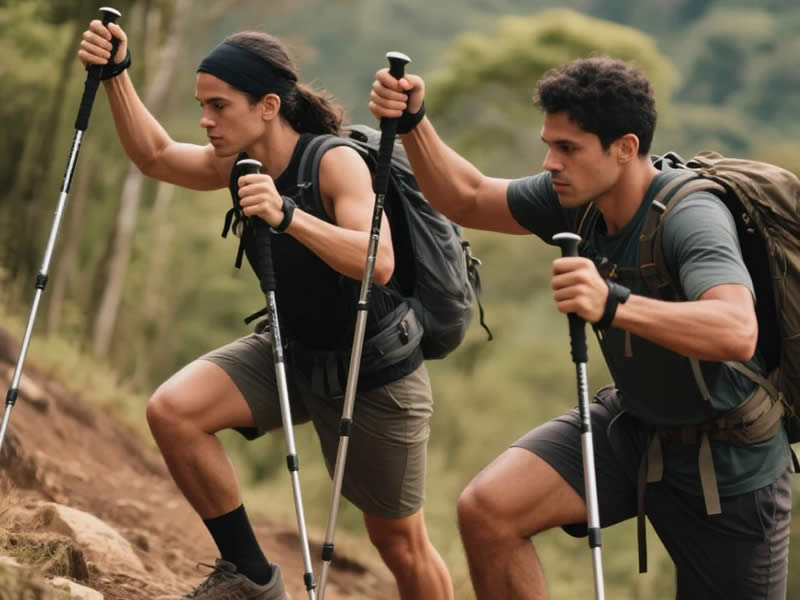
1. Passive vs. active pole use – the difference
Many walkers use poles as a crutch – they rest their hands on the grips and let the poles support some weight. This is passive use. It provides little upper body benefit. Active use is different. You push down through the straps with each plant, engaging your arms, shoulders, back, and core. This is what turns walking into a workout.
- Passive use – Poles support weight; upper body is mostly inactive.
- Active use – You push down and back, engaging muscles across your upper body.
2. Which muscles get worked?
When you use trekking poles actively, you engage several muscle groups:
- Arms – The push‑off engages your triceps (as you straighten your arm) and your biceps (as you pull the pole back).
- Shoulders – The swing and push‑off engage your deltoids and rotator cuff muscles.
- Back – The pulling motion engages your latissimus dorsi (lats) and trapezius (traps).
- Core – The alternating rhythm stabilises your torso, engaging your abdominal and oblique muscles.
- Chest – The push‑off also engages your pectorals (chest) slightly.
3. The research – what studies show
A study published in the Journal of Sports Sciences found that using trekking poles increased energy expenditure by 20–30% compared to walking without poles at the same speed. On hilly terrain, the increase can be up to 40%. This is because the upper body is actively working, turning walking into a low‑intensity whole‑body workout. Other studies have shown that pole walking improves cardiovascular fitness and upper body strength.
4. How to get the workout benefit on Brazilian treks
To get the upper body workout benefit, you need to use the correct technique:
- Push through the straps – On each plant, push down through the wrist strap, not your grip. Your hand should be relaxed.
- Use the diagonal stride – Plant the left pole with your right foot, and the right pole with your left foot. This engages your core.
- Maintain a steady rhythm – A consistent rhythm keeps your upper body engaged.
- Adjust length for terrain – Shorten for ascents (better leverage), lengthen for descents (braking). This changes the muscle engagement.
5. The Brazilian terrain advantage
Brazil's long treks—whether in Chapada Diamantina, Serra do Mar, or the Serra da Mantiqueira—are ideal for pole walking. The terrain is varied, with long ascents and descents. This variety keeps your upper body engaged differently on different sections:
- Ascents – The push‑off engages your triceps and lats.
- Descents – The braking action engages your shoulders and core.
- Flat sections – A steady rhythm keeps your arms and core active.
6. Calorie burn – the numbers
| Activity (30 minutes, 70kg person) | Calories burned |
|---|---|
| Walking without poles (3.5 mph) | ~120–150 |
| Walking with poles (passive) | ~130–160 |
| Walking with poles (active) | ~150–190 |
| Nordic walking (active pole use) | ~180–220 |
| Walking with poles on hills | ~200–250 |
These figures are approximate and vary with speed, terrain, and technique.
7. Equipment for active pole use
- 7075 aluminium poles – Light enough for active use, durable enough for Brazilian trails.
- Lever locks – Reliable in mud and dust; twist locks slip.
- Cork grips – Comfortable in the heat; become tacky when damp.
- Replaceable tips – Essential for the abrasive rock of Brazilian trails.
- Light weight – Under 500g per pair reduces arm fatigue.
8. Common mistakes that reduce the workout
- Gripping too tightly – A tight grip fatigues your forearms and reduces the workout benefit. Use the straps.
- Planting too far ahead – This turns your pole into a brake, not a propellant. Keep the plant close to your body.
- Ignoring the straps – If you are not using the straps, you are missing the main benefit.
- Rushing – A steady rhythm is more efficient than stop‑start.
9. Pro tips for Brazilian treks
- Start slow – If you are new to active pole use, start on flat terrain and build up to hills.
- Take breaks – On long treks, use your poles for support when resting.
- Stay hydrated – The Brazilian heat is intense; drink water regularly.
- Use rubber tips on road sections – To save your carbide tips.
10. Final verdict
Yes – trekking poles can provide a significant upper body workout during long Brazilian treks, but only if you use them actively. Push through the straps, use the diagonal stride, and maintain a steady rhythm. The variety of Brazilian terrain—ascents, descents, and flat sections—provides a full‑body workout that burns more calories and builds strength. With the right technique and equipment, your poles can turn a long walk into a full‑body fitness session. Happy hiking!




