




Can trekking poles help with walking after knee surgery in Brazil?
Recovering from knee surgery—whether it’s a total replacement, arthroscopy, or ligament reconstruction—is a challenging journey. Walking again without pain or instability is the ultimate goal, but the path often feels long and uncertain. In Brazil, where urban sidewalks are notoriously uneven, public transport requires climbing steps, and the natural beauty beckons with trails and beaches, regaining confident mobility is especially critical. One question frequently arises in physiotherapy clinics from São Paulo to Porto Alegre: can trekking poles (or hiking poles) be used as rehabilitation tools? The answer is a qualified yes—but only with the right guidance, timing, and technique. This article explores the evidence, the Brazilian context, and practical steps for integrating poles into your post‑surgery walking programme.
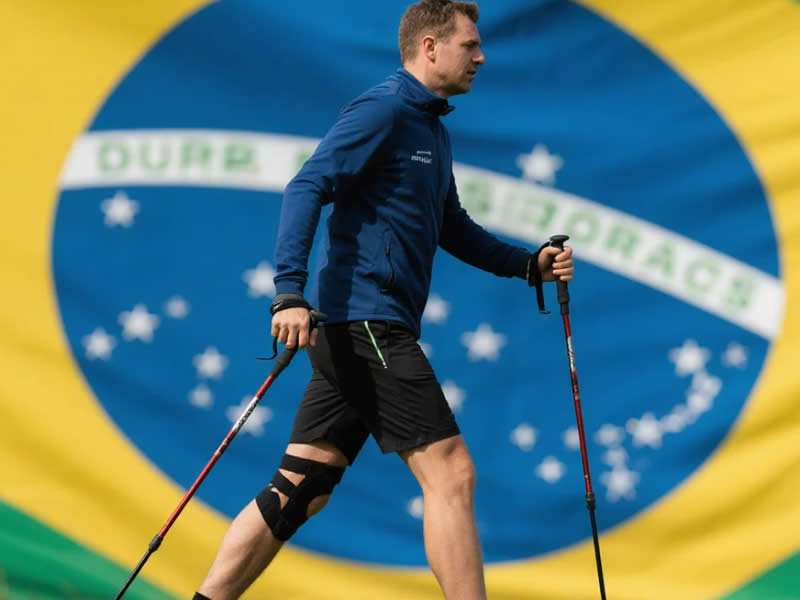
How trekking poles assist recovery after knee surgery
After knee surgery, the quadriceps muscles weaken, proprioception (the sense of joint position) diminishes, and the joint often swells. Walking without support can feel terrifying and may lead to a limp that creates secondary problems in the hips and back. Trekking poles act as external stabilisers that:
- Unload the operated knee – By transferring up to 30% of your body weight to your upper body, poles reduce the compressive force through the tibiofemoral joint, allowing pain‑free weight‑bearing earlier in recovery.
- Improve balance – Two extra ground contacts provide a wider base of support, crucial when navigating Brazil’s cracked pavements or cobblestone streets.
- Promote a normal gait pattern – Poles encourage a natural heel‑to‑toe stride and prevent the protective limp that often persists after surgery.
- Build confidence – Knowing you have support reduces the fear of falling, which is one of the biggest barriers to early mobilisation.
Several clinical studies have confirmed that using poles during the rehabilitation phase results in quicker return to unassisted walking and better patient‑reported outcomes compared to using a single cane or no aid.
Brazil‑specific factors to consider
Brazil presents unique challenges and opportunities for post‑surgery walkers:
- Urban terrain – Sidewalks often have slopes, potholes, and missing slabs. Poles give you tactile feedback about the ground before your foot lands, significantly reducing trip hazards.
- Heat and humidity – Sweaty hands can slip on standard handles; choose poles with cork or rubber grips that stay comfortable.
- Access to physiotherapy – Brazil has an excellent network of public (SUS) and private physiotherapists, but not all are familiar with trekking poles. You may need to bring research or ask specifically for “bastões nórdicos” (Nordic walking poles) as they are increasingly used in rehabilitation.
- Cost and availability – Quality trekking poles are available at Decathlon and specialty shops, with prices ranging from R$150 to R$600. For some, a pair of adjustable aluminium poles is a worthwhile investment compared to the cost of a walker or crutches.
When can you start using trekking poles?
Timing is critical. Using poles too early—before your surgeon approves weight‑bearing—can cause improper loading and damage the surgical repair. In general:
- For total knee replacement, patients usually begin with a walker for the first 2‑3 weeks, then progress to two crutches, and around week 4‑6, may transition to trekking poles if muscle strength and balance are adequate.
- For arthroscopy (meniscus trim or minor cartilage cleanup), poles may be introduced as early as day 3‑5 for outdoor ambulation.
- For ACL reconstruction, poles are often used during the initial 2‑4 weeks when the graft needs protection, then tapered as neuromuscular control improves.
Always obtain written clearance from your orthopaedic surgeon and a personalised plan from your physiotherapist before purchasing or using trekking poles.
How to choose and adjust trekking poles for rehabilitation
Not all poles are equal for rehab purposes. Follow these selection criteria:
- Adjustable length – You’ll need to fine‑tune height as your walking pattern changes and as you wear different footwear.
- Flick‑lock or twist‑lock – Lever‑locks (flick‑lock) are easier to adjust and more secure; twist‑locks may be harder to operate with weak hands.
- Weight – Lightweight aluminium (under 250g per pole) reduces arm fatigue.
- Wrist straps – Essential for transferring load; choose padded straps that are easy to adjust.
Correct pole height
While standing upright, hold the pole with the tip on the ground beside your foot. Your elbow should be at about 90 degrees. For downhill walking (if you progress to trails), extend the poles by 5‑10 cm to increase braking leverage.
Technique: walking with poles after knee surgery
The classic “two‑pole” technique used by hikers is also ideal for rehab. Here’s the sequence:
- Plant the poles – Step forward with your operated leg; simultaneously plant the opposite pole (or both poles) ahead of you.
- Push down – As you shift weight onto the operated leg, push down firmly on the poles to offload the knee.
- Step through – Swing your non‑operated leg forward and repeat.
- Keep the poles close – Avoid planting them too wide; they should stay within shoulder width to maintain a natural gait.
Your physiotherapist can coach you, but many Brazilian clinics now incorporate “pole walking” as part of their rehab curricula—ask if they offer it.
Limitations and precautions
While poles are beneficial, they are not a panacea:
- They don't replace strengthening – Poles are an assistance tool; you must still perform prescribed exercises to rebuild the quads and glutes.
- Risk of upper‑body strain – If you grip too hard, you may develop wrist, elbow, or shoulder pain. Use the straps correctly and relax your grip.
- Not for steep stairs initially – On staircases, use handrails and one pole, or no poles, until you’re stable.
- Avoid wet, slippery surfaces – Carbide tips can skid on smooth tiles; use rubber ferrules (tips) when walking indoors or on pavement.
Success stories from Brazilian patients
Maria, 62, from Curitiba, had a total knee replacement. She started using trekking poles at week 6 on her physiotherapist’s suggestion. “I was terrified of walking on our uneven streets,” she recalls. “The poles gave me courage. Within a month, I was walking 3 km daily without pain.” Similarly, João, 54, from Rio, used poles after ACL surgery and credits them for his early return to his weekend hikes in the Tijuca Forest. These stories are not rare—many rehabilitation centres now prescribe poles as standard.
Where to buy and get professional advice in Brazil
- Decathlon – Offers affordable, quality poles and staff who can help with sizing.
- Specialty outdoor shops (Mundo Outdoor, Adventure Sports) – Higher‑end models and expert advice.
- Online – Mercado Livre and Amazon Brasil have a wide selection; read reviews carefully.
- Physiotherapy clinics – Some clinics rent poles or include them in their rehab packages.
The verdict
Yes, trekking poles can substantially help with walking after knee surgery in Brazil—provided you have medical clearance, proper training, and suitable poles. They are more versatile than crutches, more stable than a single cane, and they prepare you to eventually return to the trails that make Brazil such a paradise for nature lovers. Remember: poles are a bridge, not a destination. Use them with discipline, wean off gradually, and combine them with strengthening and stretching. With patience and the right tools, you’ll be walking—and eventually hiking—again.




