




Do trekking poles help with carrying water supplies in Brazilian backcountry?
Yes – trekking poles help by reducing fatigue and improving stability, not by literally carrying the water. When you're carrying extra weight (like 2–3 litres of water), poles transfer some of that load from your legs to your arms, reducing knee strain and improving balance on uneven ground. Studies show poles reduce knee impact by 20–25% on descents – valuable when carrying heavy water supplies in Brazil's dry backcountry (Serra da Canastra, Chapada dos Veadeiros). They also help you test river depth before refilling. For weight distribution, use the wrist straps correctly – the strap should take the load, not your grip. For Brazilian backcountry, choose lightweight aluminium poles with lever locks and cork grips.
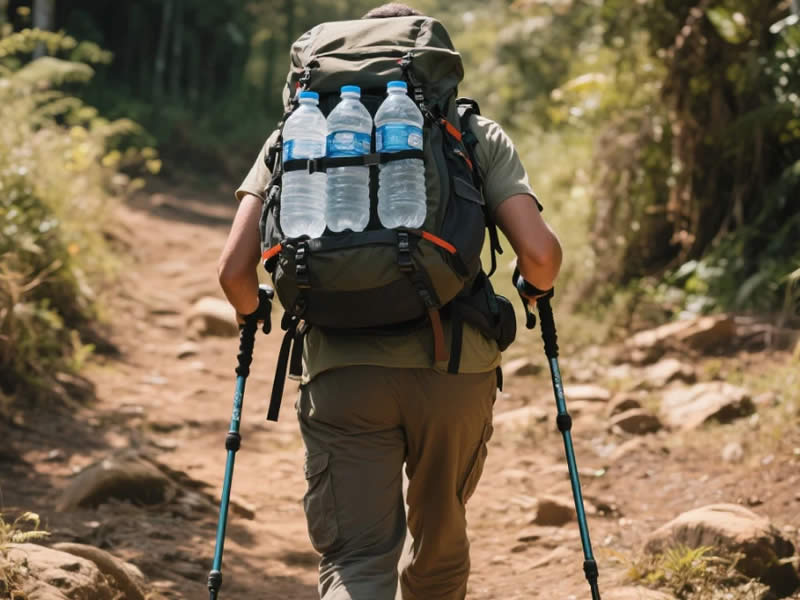
1. The challenge of carrying water in the Brazilian backcountry
In Brazil's dry backcountry – Serra da Canastra, Chapada dos Veadeiros, the Sertão – water sources can be scarce. You may need to carry 2–3 litres of water (or more) for multi‑day treks. This extra weight (2–3 kg) adds significantly to your pack load. It increases the strain on your knees, especially on descents, and can affect your balance on uneven ground. The cumulative effect over a day's walking is significant. Trekking poles can help manage this additional load.
2. How trekking poles help with heavy water supplies
a. Load transfer – When you plant a pole and push down through the wrist strap, a portion of your body weight (and pack weight) is transferred from your legs to your arms. This reduces the load on your knees and lower back. Studies show that using trekking poles can reduce knee joint forces by 20–25% on descents. This is particularly valuable when carrying extra water weight.
b. Reduced fatigue – By engaging your upper body, poles reduce leg fatigue. On long, dry sections where you are carrying extra water, this is a significant advantage. You can walk further with less fatigue.
c. Improved stability – Extra weight can affect your balance. Two poles provide four points of contact, improving stability on uneven ground – a common feature of Brazilian backcountry trails.
d. Testing river depth – Before refilling your water supply, you may need to cross a river or stream. Poles help you test the depth and stability of the streambed before stepping. This is essential in areas where water sources are scarce.
3. Technique for carrying heavy loads
a. Use the wrist straps – The strap should sit across the base of your palm (not your wrist). Push down through the strap, not your grip. This transfers the load to your arms and shoulders, reducing the strain on your back and legs.
b. Shorten for ascents – On steep climbs, shorten your poles by 5–10 cm. This gives you better leverage and reduces the work on your legs.
c. Lengthen for descents – On steep descents, lengthen your poles by 5–10 cm. This allows you to plant the pole ahead of your feet, creating a braking effect that reduces knee impact.
d. Maintain a steady rhythm – A steady, alternating rhythm (left pole with right foot) distributes the effort evenly and reduces fatigue.
e. Take breaks – Use your poles for support when resting. This allows you to relax your back and shoulders.
4. Equipment considerations for heavy loads
- 7075 aluminium poles – Stronger than carbon for heavy loads. Carbon is lighter but more brittle.
- Lever locks – Hold tension reliably under weight. Twist locks slip.
- Steel lower section – Resists abrasion on rocky terrain (e.g., Leki Makalu).
- Replaceable carbide tips – Heavy loads wear them faster; carry spares.
- Cork grips – Comfortable in the heat; become tacky when damp.
5. Pro tips for Brazilian backcountry
- Carry spare tips – The abrasive rock and heavy loads wear them down.
- Use rubber tips on road sections – To protect carbide tips.
- Adjust length for terrain – Shorten for ascents, lengthen for descents.
- Take breaks – Use poles for support when resting.
- Stay hydrated – Carry enough water for the day; refill at reliable sources.
- Check your poles before the walk – Test locks, tips, and baskets.
6. The water‑carrying strategy
- Carry 2–3 litres – For a typical day hike in the backcountry.
- Know your water sources – Check the trail map for reliable sources.
- Refill strategically – Refill at rivers or streams, not at dry springs.
- Use a water filter – In the backcountry, treat water before drinking.
7. Real‑world example
Imagine you are hiking in the Serra da Canastra, carrying 3 litres of water (3 kg) on a hot, dry day. The extra weight is significant. On a steep descent, the impact on your knees is magnified. By using trekking poles with the correct technique, you transfer some of that load to your arms, reducing the strain on your knees and allowing you to walk further and more comfortably.
8. Final verdict
Trekking poles help with carrying water supplies in the Brazilian backcountry by reducing fatigue, improving stability, and protecting your knees. They transfer some of the load from your legs to your arms, allowing you to walk further with less strain. For best results, choose aluminium poles with lever locks, cork grips, and spare tips. Use the wrist straps correctly, adjust the length for the terrain, and maintain a steady rhythm. With the right equipment and technique, you can carry water supplies safely and comfortably in Brazil's dry backcountry. Happy (and hydrated) hiking!




