




How to keep trekking pole adjustment threads clean from acidic peat soil?
If you've ever hiked across the peat bogs of the Peak District, the Flow Country of Scotland, or the blanket bogs of Ireland, you know the struggle is real. That dark, spongy, acidic soil gets everywhere—into your boot laces, your gaiters, and most critically, into the adjustment threads of your trekking poles. Peat is not just mud; it's a highly acidic, fine‑particulate sludge that can corrode metal, clog threads, and cause locking mechanisms to seize or slip. Left unchecked, it can destroy your poles within a single wet season. This guide will give you a systematic approach to keeping your pole threads clean and functional, ensuring they remain reliable for years.
Why peat soil is so destructive
Peat is formed from partially decayed vegetation in waterlogged conditions. It has a pH typically between 3.5 and 5.0—about as acidic as vinegar. This acidity attacks the oxide layer on aluminium and corrodes steel components like screws and springs. In addition, peat contains fine, abrasive particles that act like grinding paste when they get into the threads of twist‑locks or the cam surfaces of flick‑locks. Once the threads are clogged with compacted peat, the pole becomes difficult to adjust—or worse, it slips under load, compromising your safety.
The key to preserving your poles is to prevent peat from drying in the threads and to neutralise the acid before it can cause corrosion.
Immediate after‑hike care: the 5‑minute routine
The moment you finish a boggy hike, don't just collapse your poles and toss them in the boot of the car. The peat is wet and at its most dangerous. Take 5 minutes to do this:
1. Rinse with fresh water
If you have access to a tap, a stream, or even your water bottle, rinse the threads thoroughly with fresh water. For twist‑locks, fully unscrew the collar and let water run through the threads of both the collar and the expander (the internal cone). For flick‑locks, open the lever and flush the cam area and the screw threads. The goal is to wash away the peat particles before they dry and become cemented.
2. Scrub with a small brush
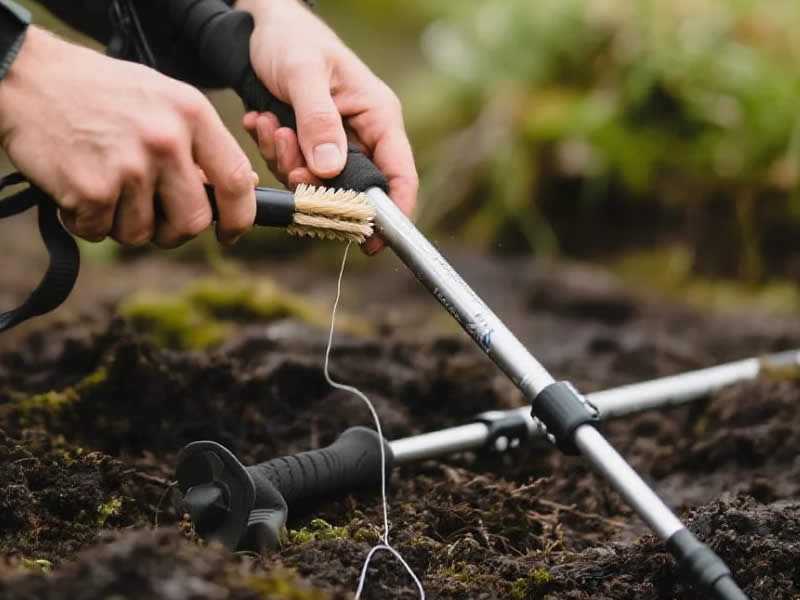
Use a dedicated brush—an old toothbrush is perfect—to scrub the threads of any remaining peat. Pay special attention to the internal threads of the collar (on twist‑locks) and the screw threads of flick‑locks. The abrasive particles are more damaging than the acidity, so mechanical cleaning is essential.
3. Neutralise the acid
While rinsing with water dilutes the acid, you can neutralise it more effectively by adding a teaspoon of baking soda to your rinse water (creating a mild alkaline solution). This neutralises the acid and prevents it from attacking the metal. Rinse the threads with this solution, then give them a final rinse with plain water.
4. Dry thoroughly
This is non‑negotiable. Dry the threads completely before you adjust or store the poles. Use a cloth to wipe them, then leave the locks open and the poles extended to air‑dry for at least 30 minutes. Moisture left in the threads will cause corrosion.
Deep‑cleaning routine for twist‑locks
Twist‑locks are particularly vulnerable because the threads are internal and hard to access. If you walk on peat regularly, you should perform a deep clean every few weeks:
- Fully unscrew the collar from the inner pole section.
- Remove the expander (the plastic or metal cone) from the inner tube.
- Wash the threads on the collar, the expander, and the inside of the outer tube with soapy water and a toothbrush.
- Soak the components in a mild baking soda solution for 10‑15 minutes to neutralise any residual acid.
- Rinse and dry thoroughly—use a hair dryer on a cool setting if necessary.
- Apply a dry lubricant (graphite powder) to the threads—not to the expander's gripping surface. This prevents galling and makes future cleaning easier.
Deep‑cleaning routine for flick‑locks (lever‑locks)
Flick‑locks have fewer internal threads, but the cam and lever screw are still vulnerable to peat and acid. Clean them as follows:
- Remove the lever screw using the appropriate hex key (usually 3 mm or 4 mm).
- Take out the cam and the lever.
- Scrub the screw threads with a toothbrush and soapy water.
- Clean the cam surfaces where they contact the pole shaft—peat often packs in here.
- Neutralise with baking soda solution, rinse, and dry.
- Apply a tiny dab of silicone grease to the screw threads (for smooth adjustment) and a light coating of dry graphite to the cam surfaces. Reassemble and tighten to the correct tension.
Lubrication: dry, not wet
Never use oil or wet grease on adjustment threads that are exposed to peat. Oil attracts peat particles, creating a grinding paste that will wear down the threads rapidly. Instead, use:
- Dry graphite powder: Dust it onto the threads and work it in. It reduces friction without sticking.
- PTFE (Teflon) dry spray: Spray onto a cloth and wipe the threads; it dries to a non‑sticky film.
- Anti‑seize compound (copper‑based): For steel‑on‑aluminium threads, this prevents galling and is resistant to acid. Apply sparingly.
Storage: disassembled and clean
After a peat‑heavy walk, store your poles disassembled (separate the sections) with the locks open. This allows any residual moisture to evaporate and prevents peat from being trapped in the joints. Never store poles collapsed and locked after a boggy hike—you're sealing in the corrosive peat.
Monthly inspection
If you walk on peat regularly, inspect your pole threads monthly:
- Check for rust on steel screws and springs. If you see any, remove the rust with a fine wire brush and apply anti‑seize.
- Check for wear on aluminium threads. If the threads are becoming rounded or galled, consider replacing the component (collars and expanders are often sold as spare parts).
- Check for pitting on the pole shafts near the adjustment area. This can indicate acid damage to the anodised layer.
What to avoid
- Don't use WD‑40: It's a solvent, not a lubricant, and it will wash away any protective grease while leaving a sticky residue that attracts grit.
- Don't use acid‑based cleaners: Some "rust removers" are acidic and will damage aluminium. Stick to mild soap and baking soda.
- Don't delay cleaning: The longer peat sits on the threads, the harder it is to remove and the more damage it does.
The verdict
Keeping trekking pole adjustment threads clean from acidic peat soil is a simple but essential routine. The golden rule: rinse and scrub immediately after each boggy hike, neutralise the acid, dry thoroughly, and lubricate with dry graphite or anti‑seize. Regular deep‑cleaning of the locks and storage of poles disassembled will prevent long‑term corrosion and wear. With these habits, your poles will survive the most acidic bogs and remain reliable for many years of walking. Happy hiking—and may your threads stay clean!




