




Do trekking poles with titanium tips offer better corrosion resistance in coastal walks?
Coastal walking is one of the most rewarding ways to experience the outdoors—but it's also one of the harshest environments for your gear. Saltwater spray, fine sand, and persistent moisture combine to attack every metal component of your trekking poles. In recent years, some manufacturers have introduced titanium tips as a premium option, often touting their corrosion resistance. But do they actually offer better protection than traditional carbide tips on coastal walks? The short answer is yes, titanium is more corrosion‑resistant than steel, but this advantage is largely theoretical for trekking poles. In practice, carbide remains the superior choice for coastal conditions. This article unpacks the science, the practical considerations, and the real‑world implications for your coastal walking gear.
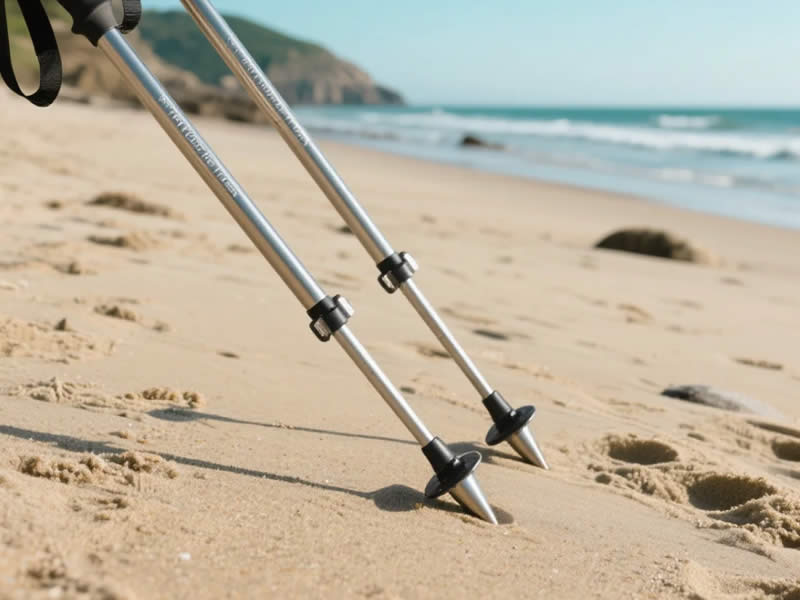
Understanding corrosion in coastal environments
Corrosion is an electrochemical process. When a metal is exposed to saltwater, the salt acts as an electrolyte, facilitating the transfer of ions and accelerating oxidation. For steel components, this leads to rust (iron oxide). For aluminium, it leads to pitting corrosion, where the protective oxide layer is breached and localized pits form. For titanium, the story is different.
Titanium is highly corrosion‑resistant because it forms a thin, stable, and highly adherent oxide layer (TiO₂) on its surface. This layer is self‑healing—if it is scratched, it immediately reforms in the presence of oxygen or water. This makes titanium exceptionally resistant to seawater, which is why it is used in marine applications, desalination plants, and even ship hulls. In theory, a titanium tip would never rust or pit from coastal exposure.
The practical reality: carbide vs. titanium tips
Carbide tips
The vast majority of trekking poles use tungsten carbide tips. Carbide is an extremely hard compound—second only to diamond—and it is the material of choice for gripping on rock, mud, and ice. It provides exceptional bite and wear resistance. However, carbide is not a pure metal; it is a composite of tungsten and carbon particles held in a cobalt binder. The cobalt binder can be susceptible to corrosion in saltwater, which can cause the tip to lose its structural integrity over time. This is why you should always rinse your poles after coastal walks.
Titanium tips
Titanium tips are sometimes offered as an alternative, often on premium or ultralight poles. They are significantly lighter than carbide (titanium is about 40% lighter than steel, and carbide is slightly heavier than steel). They also offer excellent corrosion resistance. However, they have a critical drawback: titanium is much softer than carbide. This means that:
- Wear resistance is lower: On abrasive coastal rocks (granite, quartzite, or limestone), a titanium tip will wear down much faster than a carbide one. You'll need to replace it more frequently.
- Grip is inferior: Carbide's hardness allows it to penetrate the micro‑texture of rock and create a positive bite. Titanium, being softer, may skid on wet, polished surfaces, compromising your safety.
The real corrosion threat: it's not the tip
The focus on the tip's material is often a distraction. On a coastal walk, the components most at risk from corrosion are not the tip—which is usually protected by a basket and often not immersed in saltwater—but the locking mechanisms, screws, springs, and the shaft itself.
- Shaft: Aluminium (7075‑T6) shafts are anodised, which provides a strong barrier against corrosion. However, if the anodised layer is scratched (which is inevitable on rocky coastal paths), the aluminium underneath can pit.
- Hardware: Steel screws, springs, and lever pivots are the most vulnerable parts. These are often made of stainless steel (which offers decent resistance) or, in some premium poles, titanium, which is far superior.
A titanium tip alone will not protect these critical components from saltwater damage.
What matters more for corrosion resistance on the coast
If you want to protect your poles from corrosion on coastal walks, focus on these factors:
- Hardware material: Look for poles with marine‑grade stainless steel (316) or titanium screws and springs. These are far more important than the tip material.
- Anodised aluminium shafts: A high‑quality hard‑anodised finish provides excellent resistance to pitting. Black Diamond and Leki both use high‑grade anodising.
- Maintenance routine: The most important factor is rinsing your poles with fresh water immediately after every coastal walk and drying them thoroughly. Even the best materials will corrode if saltwater is left to dry on them.
- Lubrication: Use dry graphite or silicone spray on threads and pivot points—not oil, which attracts sand and moisture.
The verdict: carbide over titanium for coastal grip
While titanium tips do offer better corrosion resistance than carbide in a chemical sense, the practical advantages for coastal walking are minimal. Carbide's superior grip and wear resistance on rock far outweigh the slight corrosion advantage of titanium. A carbide tip that is well‑maintained (rinsed after coastal use) will last longer and provide better traction than a titanium tip. The real protection for your poles comes from the shaft's anodising, the hardware's material, and—above all—your post‑walk care routine.
Recommendation: Stick with carbide tips for coastal walking. Pair them with a pole that has marine‑grade stainless steel hardware and a high‑quality anodised aluminium shaft. Rinse, dry, and lubricate after every outing. This combination will give you the best grip, the best durability, and the best corrosion resistance where it matters most.




