




Does Go Outdoors offer professional fitting services for trekking poles?
When you're investing in a pair of trekking poles, especially from premium brands like Leki, Black Diamond, or Komperdell, getting the right fit is essential. A poorly adjusted pole can cause wrist strain, inefficient walking, or even injury. For UK walkers, Go Outdoors is a major retail destination. But does the store offer a professional fitting service for trekking poles? The short answer is yes, Go Outdoors provides a practical, hands‑on fitting service—though it may not be as formal as a bike fitting, it is certainly professional and tailored. This article explains exactly what to expect, how to prepare, and why it's worth the visit.
What "fitting" means for trekking poles
Unlike a custom‑built backpack or a fully calibrated bicycle, trekking pole fitting is relatively straightforward, but it still requires expertise. The key elements are:
- Correct length: The pole height should allow your elbow to be at approximately 90° when the tip is on the ground. This length changes for uphill (shorter) and downhill (longer) terrain.
- Wrist strap adjustment: The strap should be set so that the load is distributed across the back of your hand, not your fingers. This allows you to relax your grip and push efficiently.
- Lock tension: The lever‑lock or twist‑lock must be adjusted to the correct tension to prevent slipping without being over‑tightened.
- Grip choice: Selecting the right grip material (cork, foam, rubber) for your hand shape and climate.
- Basket and tip selection: Choosing the right baskets for the terrain you'll walk on.
A good fitting session covers all of these points, helping you walk away with poles that feel like an extension of your arms.
Go Outdoors' approach to pole fitting
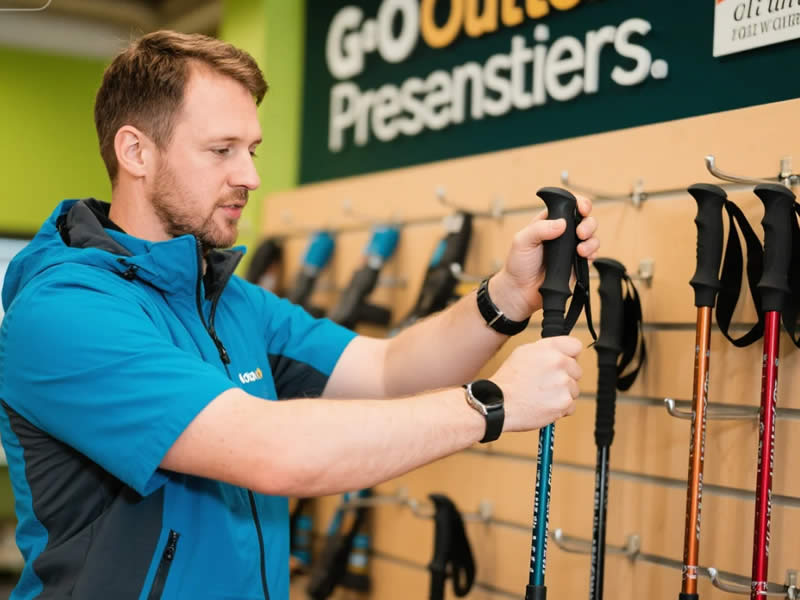
Go Outdoors does not have a formal, appointment‑based "fitting clinic" for trekking poles in the same way they might offer for ski boots or bicycle fitting. However, they do offer a professional, in‑store fitting service as part of their standard customer support. Here's what that typically involves:
1. Dedicated staff assistance
The outdoor advisors at Go Outdoors are trained to help with pole selection and adjustment. Many of them are keen walkers and climbers themselves, so they bring practical experience to the conversation. They will:
- Ask about your height, walking style, and the type of terrain you frequent.
- Measure or estimate your ideal pole length.
- Show you how to adjust the length and demonstrate the correct technique for using the locking mechanism.
- Help you set the wrist straps so they are comfortable and effective.
2. In‑store testing
You are encouraged to pick up poles, extend them to your height, and walk around the store. Some larger branches even have a small "terrain" area with artificial rock or gravel where you can plant the poles and get a sense of how they grip. This is not just a theoretical exercise; you can actually feel the weight, the lock action, and the wrist strap comfort before you buy.
3. Not a formal biomechanical assessment
It's important to manage expectations: Go Outdoors does not have a dedicated "pole fitting centre" with high‑tech analysis like gait analysis or pressure‑mapping. The service is practical and manual, based on the assistant's experience and your own feedback. If you have specific biomechanical needs (e.g., arthritis, previous wrist injuries), it's worth mentioning these—the staff are generally knowledgeable and can offer sensible advice.
How to get the best fitting at Go Outdoors
To make the most of your visit, follow these steps:
1. Call ahead
Not every branch has every model in stock. If you're interested in a specific brand (say, Leki's Makalu or Black Diamond's Trail Pro), call the store to check availability and whether they have display models for you to try.
2. Wear your hiking boots
Your footwear affects the correct pole length. If you wear your actual boots, the assistant can adjust the poles to the height you'll actually walk with. This is often overlooked but makes a real difference.
3. Take your time
Don't rush. Try several pairs—aluminium vs. carbon, cork vs. foam grip, twist‑lock vs. flick‑lock. Walk around the store with each pair, plant them firmly, and see how they feel. Ask the assistant to adjust the length for you so you can compare.
4. Ask about the lock tension
The same pole model can have different lock settings. Ask the assistant to show you how to adjust the screw on the lever‑lock (if applicable) so you can fine‑tune it later.
5. Check the return policy
Go Outdoors has a reasonable returns policy, but it's always good to ask. If the pole feels different after a full day on the trail, you may be able to exchange it for a different model.
Does it cost anything?
The fitting service is free when you are purchasing a pair of poles. If you simply want advice or an adjustment on an existing pair, they will usually help you at no charge, as a gesture of good customer service. However, large modifications (like changing baskets or tips) may incur a small cost if you buy the parts.
Comparison to other retailers
Compared to Cotswold Outdoor, which has a very similar approach, Go Outdoors offers comparable in‑store expertise. Some independent outdoor shops may provide a more tailored, one‑on‑one consultation, but Go Outdoors is a solid, reliable choice for the vast majority of walkers.
Final verdict
Yes, Go Outdoors offers a professional fitting service for trekking poles—it's practical, hands‑on, and provided by knowledgeable staff. While it's not a biomechanical clinic, it covers all the essential adjustments: length, wrist strap, lock tension, and grip choice. With a little preparation (wearing your boots and calling ahead), you can walk out with poles that are perfectly matched to your height, strength, and walking style. So visit your nearest Go Outdoors, take your time, and let the experts help you make the right choice. Happy walking!




