




How to use trekking poles to engage core muscles during a brisk walk?
Yes—and when done correctly, trekking poles can transform a simple walk into a full‑body workout that actively engages your core. Many walkers use poles primarily for balance or knee support, but the technique can be refined to recruit your abdominal muscles, obliques, and lower back stabilisers. This isn't just about swinging your arms; it's about creating a coordinated, core‑driven rhythm that improves posture, burns more calories, and strengthens the muscles that support your spine. This guide breaks down the precise technique, the underlying biomechanics, and a progression to help you master core‑engaged pole walking.
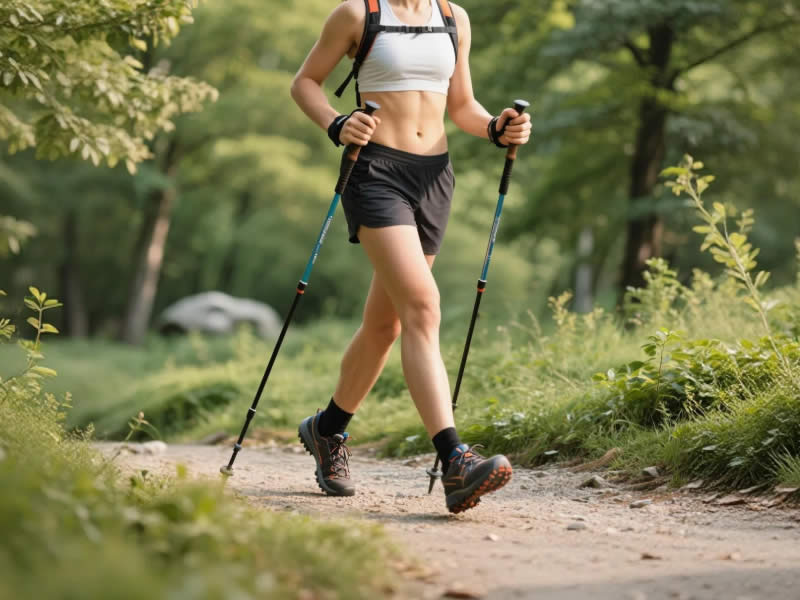
Why core engagement matters in pole walking
Your core is the central link between your upper and lower body. When you walk, your pelvis and trunk need to rotate slightly with each step to maintain balance and absorb ground reaction forces. If your core is weak or disengaged, your lower back and hips compensate, leading to poor posture, lower back pain, and inefficient movement.
Using trekking poles with a core‑focused technique:
- Increases energy expenditure: Actively engaging your core while pushing with the poles raises your heart rate and burns more calories than regular walking.
- Improves posture: A braced core encourages a taller, more upright spine, reducing hunching and opening your chest for better breathing.
- Strengthens stabilisers: The controlled rotation of the torso works the obliques and deep abdominal muscles.
- Reduces lower back strain: By using your abdominals to stabilise the pelvis, you take pressure off the lumbar spine.
Step 1: Get the pole length right
Correct pole length is the foundation for core engagement. If the poles are too short, you'll hunch forward, disengaging your core. If they are too long, you'll be reaching up, which alters your posture and reduces the effectiveness of the push.
The rule: Stand upright with the pole tip on the floor. Your elbow should be at roughly 90°. For a brisk walk with core engagement, a fraction longer (just a centimetre or two) can be helpful—it encourages a taller, more upright torso. As a general formula, multiply your height (in cm) by 0.68 for Nordic‑style walking (which emphasises core and arm drive). For example, a person 170 cm tall would set their poles to about 115–116 cm.
Pro tip: Wear the shoes you'll walk in when measuring. The heel thickness of a trainer or hiking boot affects the ideal length.
Step 2: Master the wrist strap
Many walkers grip the pole handle tightly, but this inhibits core engagement and causes arm fatigue. The correct use of the wrist strap is to bear the weight, allowing you to relax your grip.
The technique:
- Put your hand up through the strap from underneath.
- Bring your hand down over the strap so it rests across the base of your fingers and the back of your hand.
- Loosely grip the handle—your thumb and forefinger should be relaxed. The strap should support the weight of the pole and your pushing force.
With a relaxed grip, you free your mind to focus on your core, and you reduce the tension in your shoulders, which allows the push to originate from your torso rather than your arms alone.
Step 3: Establish a tall, braced posture
Before you start walking, set your posture:
- Stand tall, imagining a string pulling you up from the crown of your head.
- Draw your navel in and up towards your spine. This braces your deep core muscles (the transversus abdominis).
- Gently tilt your pelvis to a neutral position—neither tucked under nor swayed back.
- Keep your shoulders relaxed and down, not hunched.
This is your "neutral core" posture. You want to maintain this feeling throughout the walk.
Step 4: The core‑driven push
Now comes the active technique. As you walk briskly:
- Plant the pole: As you step forward, plant the pole of the opposite side (e.g., left foot forward, right pole planting).
- Push down and back: Instead of just pushing straight down, drive the pole backwards with a controlled, forceful motion. Your arm extends behind your hip.
- Engage your core: As you push, consciously tighten your abdominal muscles. Imagine you are about to take a punch to the stomach—that's the level of engagement.
- Twist, don't sway: Allow a slight, controlled rotation of your torso towards the pole you are pushing. This rotation should come from your obliques, not from your hips twisting excessively.
The push should feel like it's originating from your core, not just from your arm. Your lats (the large back muscles) and your abdominals work together to generate the force.
Step 5: Add rhythm and cadence
For core engagement to be effective, you need a brisk, steady cadence. A good target is 120–140 steps per minute (which may feel faster than your normal walking pace). This rhythm forces your core to work continuously to stabilise your torso.
- Use a 2:2 rhythm (two steps, two pole plants) for a natural walking flow.
- As you walk, keep your core braced. Don't let your lower back arch excessively.
Step 6: Practice without poles
To truly master core engagement, practice the posture and core‑bracing technique without poles first. Stand tall, brace your core, and walk briskly for a few minutes. Then add poles while maintaining that same core feeling. This mental connection is the key to making the technique automatic.
Common mistakes to avoid
- Swinging the arms without pushing: Don't just let the poles swing with you. You need an active push.
- Hunching forward: Keep your chest open and your shoulders back. Hunching disengages the core.
- Holding the poles too tightly: Relax your grip—the strap does the work. A tight grip tenses your shoulders and reduces core activation.
- Over‑rotating the hips: The twist should be subtle and come from the torso, not from swinging your hips excessively.
Progression: building core strength over time
- Week 1: Focus on posture and the braced core while walking briskly with poles.
- Week 2: Add the push technique, consciously driving the poles backwards.
- Week 3: Incorporate the slight torso twist, feeling your obliques engage.
- Week 4: Increase speed and stride length to challenge your core further.
The verdict
Trekking poles can be a powerful tool for engaging your core during a brisk walk. The key is in the technique: correct length, relaxed grip, tall posture, and a core‑driven push. With practice, the engagement becomes automatic, and you'll feel the difference in your posture, your calorie burn, and the strength of your abdominal muscles. So, on your next walk, don't just plant and step—push with purpose, brace your core, and turn a simple stroll into a full‑body workout. Happy—and strong—walking!




