




What is the best grip angle to prevent wrist extension fatigue in the UK hills?
The short answer is there is no single "best" degree—it depends on your anatomy, terrain, and walking style—but the neutral wrist position (0° to 5° of extension) is the safest starting point. The real key to preventing fatigue on UK hills isn't just the angle of the grip itself, but how you use the wrist strap and how you adjust pole length for the terrain. This guide explains the biomechanics, the options available, and the practical steps to keep your wrists fresh through a long day on the fells.
The biomechanics of wrist extension fatigue
Wrist extension is the movement where you bend your hand back towards the top of your forearm. When you plant a trekking pole—especially on a descent—the force of your body weight travels up the pole and pushes against the palm of your hand. If your wrist is forced into a constantly extended position, the extensor muscles (on the back of your forearm) have to work continuously to resist this force. Over thousands of steps, this leads to fatigue, aching, and sometimes even tendinitis.
On a descent, you naturally lean forward, and your poles are planted ahead of your body. This tends to push your wrist into extension. The steeper the hill, the more extension is required, and the more your extensors have to work.
The case for ergonomic (angled) grips
Many premium poles now come with ergonomic or angled grips. The most famous is Black Diamond's 15° forward angle (found on models like the Trail Ergo). The theory is that by tilting the grip forward, your wrist remains neutral even when the pole is planted ahead of you on a descent. Instead of the pole pushing your hand into extension, the angle allows the force to travel straight down your forearm, bone-to-bone, reducing muscle activity.
Leki takes a different approach with their Aergon grip, which features a raised thumb rest and a neutral, slightly palm-friendly shape. It doesn't have a fixed forward angle, but it encourages a more natural hand position that reduces the need for gripping force.
Pacerpoles go even further with a negative angle (approx. 10-15° backwards), which encourages a very upright posture and a neutral wrist throughout the entire swing, but this is a more specialised technique.
So which angle is best? For most UK hill walkers, a neutral-to-slight forward angle (10-15°) is highly beneficial for descents, which are the primary cause of wrist fatigue. On flat ground, a neutral grip works perfectly. On steep uphills, you choke up on the grip or hold the foam extension, making the grip angle largely irrelevant.
The unlikely hero: the wrist strap (more important than angle)
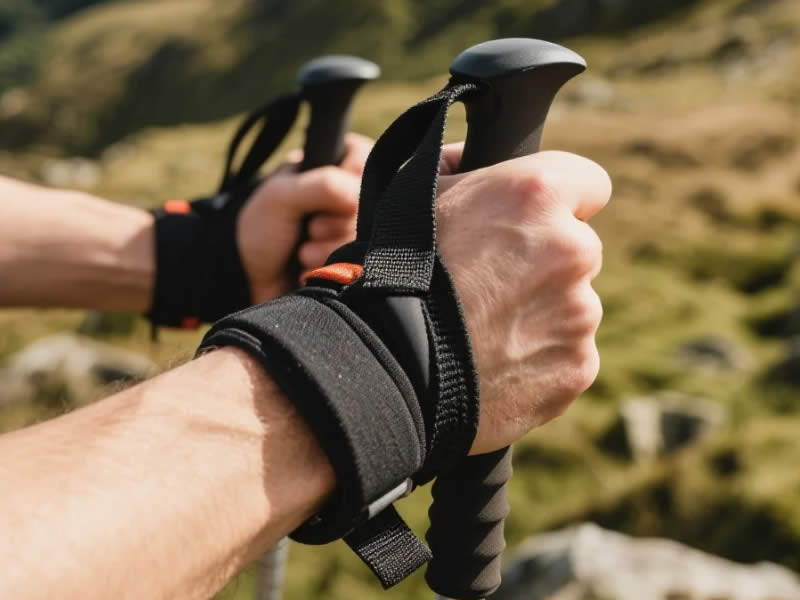
Here is the most overlooked truth: the grip angle matters far less than how you use the wrist strap. If you are gripping the handle tightly, your extensor muscles are working hard regardless of the angle. If you use the strap correctly, you can relax your grip entirely, and the load is transferred through the strap, not your fingers or wrists.
The correct technique: Put your hand up through the strap loop from underneath, then bring it down so the strap rests diagonally across the back of your hand (around the base of your thumb). Now, grip the handle loosely. When you plant the pole and push down, the strap takes the weight. Your wrist stays relaxed, and the extensor muscles aren't fighting the load.
A word on "pistol grip" vs. "standard grip": Some walkers prefer a "pistol grip" (hand more vertical), while others use a standard horizontal grip. Neither is inherently better for fatigue; the critical factor is the strap. A well-adjusted strap allows your hand to relax, whatever the angle.
Terrain-specific adjustments (the UK factor)
The UK hills are not a uniform surface. You might be on a grassy, boggy flat one minute and a rocky, steep descent the next. The "best" angle changes with the terrain.
- On flat or gentle terrain: A neutral 0° grip is perfectly adequate. Your wrist is in a natural position, and the strap is only carrying moderate load.
- On long, steep descents (the knee-breakers): This is where ergonomic angles shine. If your poles have a fixed angle, you'll appreciate the relief. If they have a neutral grip, you can compensate by lengthening your poles by 5-10 cm on a descent. This means you don't have to reach forward as far, reducing the wrist extension angle.
- On steep ascents: Shorten your poles and choke up on the grip. The wrist angle is not a major issue here, as you are pushing vertically rather than bracing horizontally.
Practical advice: finding your personal "best"
Since no single degree works for everyone, here is how to find your optimal grip angle:
- Test in-store: Visit a retailer like Cotswold Outdoor or Go Outdoors. Hold a Black Diamond (15° angle), a Leki Aergon (neutral ergonomic), and a standard straight pole. Walk around the store, planting the poles on the floor, and feel which one aligns your wrist most naturally.
- Check your strap: Ensure the strap is adjusted so it sits snugly across the back of your hand without digging in. A loose strap forces you to grip harder, causing fatigue.
- Adjust length for descents: A common mistake is keeping poles the same length throughout. Extending them for descents reduces the angle of wrist extension, acting as a "dynamic angle adjustment."
- Listen to your body: If you feel aching on the top of your forearm after a walk, you are over-gripping or the angle is forcing your wrist into extension. Try a pole with a more forward angle, or simply lengthen your poles on the next descent.
The verdict
The best grip angle to prevent wrist extension fatigue in the UK hills is a forward angle of 10-15° on descents, and a neutral 0° on the flat. However, proper wrist strap technique is more crucial than the grip angle itself. A relaxed grip and a correctly adjusted strap will do more to prevent fatigue than a specific degree of tilt. If you are buying new poles, strongly consider models with ergonomic or adjustable angles, especially if you walk steep, rocky routes. But above all, learn to use the strap—it is the simplest and most effective fatigue-fighting tool you have. Happy—and pain-free—walking!




