




Can trekking poles reduce the risk of IT band syndrome on long-distance trails?
Yes—significantly. Iliotibial (IT) band syndrome is one of the most common overuse injuries among long-distance walkers and trail runners. It typically presents as a sharp, burning pain on the outside of the knee, often flaring up after miles of repetitive descent. Trekking poles, when used correctly, can reduce the risk of ITBS by altering the biomechanics of walking—reducing impact forces, improving gait mechanics, and offloading the muscles that are most implicated in the condition. This article examines the biomechanical link between poles and ITBS, reviews the evidence, and provides a practical guide to using poles for prevention.
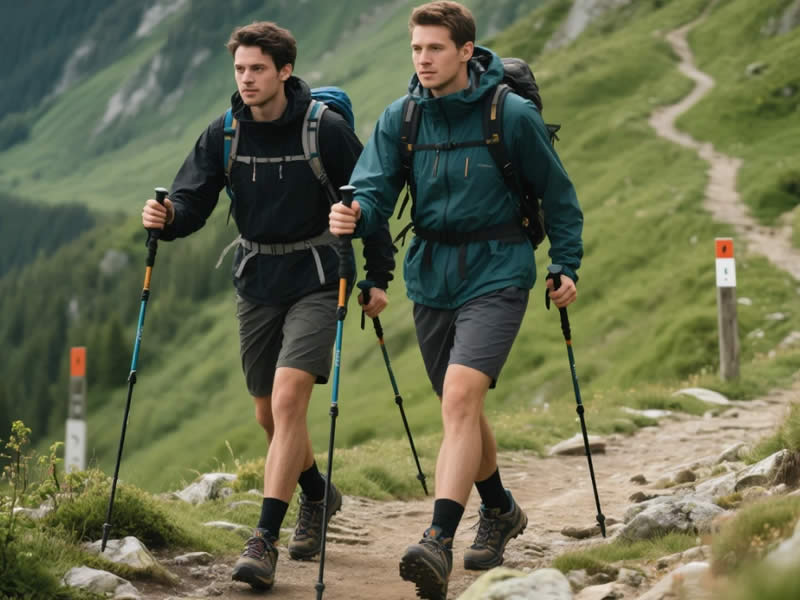
Understanding IT band syndrome
The iliotibial band is a thick band of connective tissue that runs down the outside of the thigh, from the hip to the knee. It plays a key role in stabilising the knee during walking and running. ITBS occurs when the band becomes irritated as it rubs against the bony prominence of the femur (the lateral femoral condyle). This friction is exacerbated by:
- Repetitive knee flexion: Each step on a descent involves a high degree of knee bending, which increases the friction of the IT band over the condyle.
- Hip adduction and internal rotation: When the gluteus medius (a key hip stabiliser) is weak, the hip tends to drop inward, increasing tension on the IT band.
- Heel striking and high impact: The jarring force of a heel strike travels up the leg, increasing the load on the knee and hip.
On long, steep descents, you may take 10,000 steps, each one of which can subtly irritate the band. Over time, this cumulative micro-trauma leads to the classic lateral knee pain.
How trekking poles reduce ITBS risk
1. They reduce impact forces on the knee
The most direct biomechanical effect of poles is load transfer. By planting a pole ahead of your foot and pushing down, you transfer a portion of your body weight (up to 30%) from your lower limbs to your upper body. This reduces the peak ground reaction force that travels up through your heel and knee. With less impact, there is less shock absorbed by the knee joint, which in turn reduces the compression and friction on the IT band. A 2000 study by Bohne et al. found that walking poles reduced the vertical ground reaction force by 20% on a decline, a reduction that is clinically meaningful for knee health.
2. They promote a more upright posture
The classic "hiker's lean" on a descent—where you lean forward into the slope—increases the load on the quadriceps and the IT band. Trekking poles, especially when set to the correct length, encourage a taller, more upright posture. This reduces the anterior pelvic tilt and the internal rotation of the hip that tensions the IT band. An upright trunk angle has been shown to correlate with reduced knee joint load.
3. They reduce muscle fatigue
ITBS is not just a friction issue; it is also a fatigue issue. When your glutes and quadriceps tire, your form degrades. Your pelvis drops, your knee caves inward (valgus collapse), and your IT band becomes overstressed. By offloading some of the work to your arms and shoulders, poles allow your lower limb muscles to maintain a more efficient, stable pattern for longer periods. This delayed fatigue is a critical factor in preventing the poor form that leads to ITBS.
4. They encourage a smoother, shorter stride
On a descent, many walkers over-stride, taking long, jarring steps that put high loads on the knee. Poles naturally encourage a shorter, more controlled stride because you are timing the plant of the pole with your footfall. A shorter stride reduces the knee flexion angle at heel strike, decreasing the range of motion over which the IT band must slide.
5. They improve hip stability
When you use poles with a proper, pushing motion (planting the pole and pushing down and back), you engage your lats and core. This upper body engagement helps to stabilise the torso and reduce the lateral sway that contributes to pelvic drop. A more stable pelvis means less hip adduction and less tension on the IT band.
The research evidence
There is no large-scale clinical trial directly linking poles to ITBS prevention, but the indirect evidence is strong. Studies consistently show that poles reduce knee joint loads, reduce muscle fatigue, and improve gait mechanics—all of which are established risk factors for ITBS. A 2019 study in the Journal of Sports Science and Medicine concluded that using trekking poles on downhill sections reduced perceived knee pain and the activation of the vastus lateralis (the lateral part of the quadriceps), indicating a reduced reliance on the structures that stress the IT band.
Practical guide to using poles for ITBS prevention
1. Lengthen poles for descents
The standard advice is to set your poles for flat ground (elbow at 90°). On a descent, lengthen them by 5-10 cm. This allows you to reach ahead and plant the pole before your foot lands, creating a greater braking effect and offloading more weight from your knee.
2. Plant ahead, not beside
On a descent, plant the pole slightly ahead of your foot, not parallel to it. This allows you to push down and create a braking force, reducing the impact on your knee.
3. Push down actively
Don't just place the pole on the ground—push down firmly with each plant. This is the "push" technique that transfers load to your arms.
4. Use a relaxed grip
The wrist strap should bear the weight, not your grip. A tight grip tenses your shoulders and reduces the efficiency of the load transfer.
5. Keep your core engaged
Brace your core on each descent. This stabilises your pelvis, reducing the internal rotation and adduction of the hip that stresses the IT band.
Important caveats
Poles are a preventive tool, not a cure. If you already have ITBS, poles can help manage symptoms during walking, but you also need a rehabilitation programme that includes:
- Strengthening the gluteus medius (clamshells, side-lying leg lifts).
- Stretching the IT band and the surrounding fascia (though passive stretching is of limited benefit; active release is more effective).
- Rest and graduated return to activity.
The verdict
Trekking poles can significantly reduce the risk of IT band syndrome on long-distance trails by reducing impact forces, promoting an upright posture, reducing muscle fatigue, and improving hip stability. For walkers who regularly tackle steep descents, poles are a cost‑effective, evidence‑based tool for protecting the knees and the IT band. Learn the correct technique, adjust the length for the terrain, and you'll be walking pain‑free for many more miles. Happy—and healthy—walking!




