




How to walk with trekking poles to minimize stress on the metatarsals?
Minimising stress on the metatarsals—the five long bones in the forefoot—is a critical concern for many walkers, particularly those with metatarsalgia, Morton's neuroma, or a history of stress fractures. The forefoot bears the brunt of propulsion during walking, and on uneven or hard surfaces, the repeated pressure can lead to pain and injury. Trekking poles, when used with a specific technique, can significantly reduce the load on the metatarsals by offloading weight, improving gait mechanics, and providing a more controlled, rolling foot strike. This article provides a detailed, technique‑focused guide on how to walk with poles to protect your forefoot.
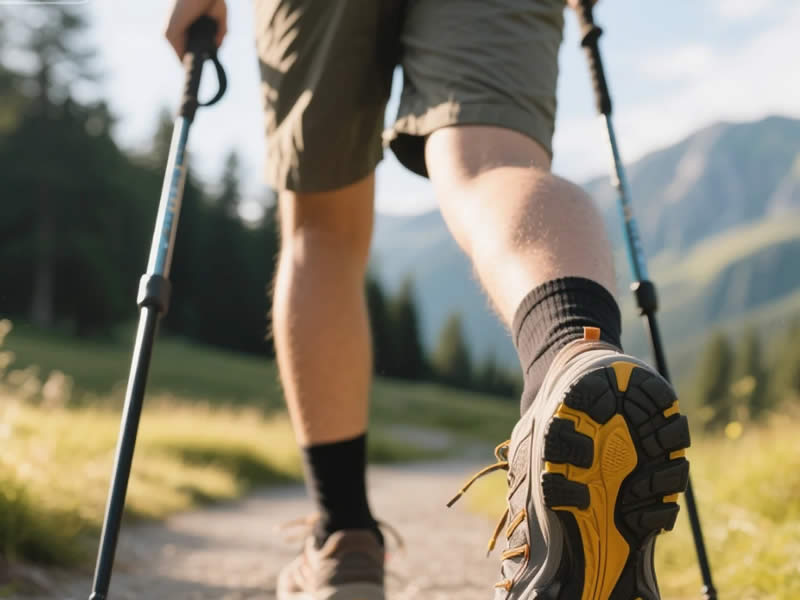
Understanding metatarsal stress in walking
During a normal walking stride, the metatarsals bear the highest load during the propulsion phase—the moment when your heel lifts and your forefoot pushes off to move you forward. On a hard surface, this push‑off force can be up to 2‑3 times your body weight. The load is concentrated on the heads of the metatarsals, particularly the second and third, which are the longest and most vulnerable. Repeated loading can cause inflammation (metatarsalgia), nerve compression (Morton's neuroma), or, in severe cases, stress fractures.
Trekking poles intervene in this cycle by:
- Reducing the overall load on the lower limbs.
- Altering the gait pattern to reduce the push‑off force.
- Creating a smoother, more rolling foot strike that distributes pressure more evenly.
Key technique 1: plant ahead and push
The most important technique is to plant the pole slightly ahead of your foot and push down firmly. This action creates a braking effect that reduces the forward momentum and the force of heel strike. Importantly, it also reduces the need for a powerful push‑off from the forefoot. When you push down on the pole, you transfer a portion of your body weight from your lower limbs to your upper body. This is a direct offloading of the metatarsals.
How to do it:
- On flat ground, plant the pole so the tip is level with the heel of your forward foot.
- As your foot lands, push down firmly through the pole.
- The push should be a deliberate, active movement—not just a passive placement.
On descents, this technique is even more effective. Lengthen your poles by 5‑10 cm, plant them ahead of your feet, and push down with extra force. This reduces the impact of each step and minimises the load on your forefoot.
Key technique 2: shorten your stride
A shorter stride reduces the heel‑strike force and limits the amount of weight that rolls onto the metatarsals during push‑off. When you overstride—taking a long, reaching step—the heel strikes the ground with greater force, and the forefoot has to generate more power to propel you forward. By shortening your stride, you reduce the impact and the push‑off effort.
How to do it:
- Consciously shorten your step so your front foot lands under your centre of gravity, not ahead of it.
- The poles should help you maintain this shorter stride. The rhythm of planting a pole with each step encourages a shorter, more controlled gait.
Key technique 3: use a "rolling" gait
Instead of a heavy heel strike or a toe‑first landing, aim for a midfoot or light heel‑first landing, followed by a smooth, rolling motion from heel to toe. This spreads the load over a larger area of the foot, reducing the peak pressure on the metatarsals.
How to do it:
- Land on the outer edge of your heel or the midfoot.
- Roll smoothly through the arch and onto the metatarsals.
- Push off gently, not forcefully.
The poles help maintain this rolling gait by providing a constant, steadying contact that stabilises your rhythm. The tactile feedback from the poles encourages a more relaxed, flowing gait.
Key technique 4: adjust pole length for descents
Descents are the most demanding phase for the metatarsals. The forward lean and the braking effect of a descent increase the load on the forefoot. Lengthening your poles on a descent gives you more leverage, allowing you to push down harder and offload more weight from your feet.
How to do it:
- Lengthen your poles by 5‑10 cm from your flat‑ground height.
- Plant the poles ahead of your feet and push down firmly.
- This creates a braking effect that reduces the forward momentum and the impact on your forefoot.
The role of footwear and insoles
While poles can reduce the load on your metatarsals, they are not a substitute for good footwear. If you have a history of metatarsal issues, you should consider:
- Wide‑toe‑box shoes: Allow the metatarsals to spread naturally.
- Metatarsal pads or insoles: These support the transverse arch and redistribute pressure away from the metatarsal heads.
- Cushioned midsoles: Reduce the shock transmitted to the forefoot.
Combine these with the pole technique described above for the best protection.
Pole selection for metatarsal protection
- Correct length: This is essential for efficient load transfer. A pole that is too long or too short reduces the effectiveness of the push.
- Cork grips: These are more comfortable and absorb sweat better than rubber.
- Wrist straps: A correctly adjusted strap allows you to push down without gripping, which reduces tension that can radiate to your feet.
- Lightweight poles: A lighter pole reduces the effort required to swing it, allowing you to focus on technique.
Sample practice drill
To master the technique, try this drill on flat ground:
- Set your poles to the correct height (elbow at 90°).
- Walk at a moderate pace, planting each pole slightly ahead of your foot.
- Push down firmly with each plant.
- Consciously shorten your stride—aim for a shorter step than you would normally take.
- Focus on a rolling foot strike: heel or midfoot landing, smooth roll, gentle push‑off.
After 10 minutes, you should feel less pressure on your forefoot. If you feel any discomfort, adjust the pole length by 1‑2 cm.
The verdict
Walking with trekking poles to minimise stress on the metatarsals is a technique that combines load offloading, stride modification, and gait smoothing. The key is to plant the pole ahead of your foot and push down firmly, shortening your stride and using a rolling foot strike. These techniques, combined with good footwear and, if necessary, orthotic insoles, can significantly reduce the pressure on the metatarsals, allowing you to walk longer and with less pain. Happy—and pain‑free—walking!




