




Are there trekking poles with a built‑in flint or emergency whistle for safety?
Yes—there are trekking poles that integrate an emergency whistle, but a built‑in flint is extremely rare and generally not a practical feature. While a whistle is a sensible and common safety addition, fire‑starting is typically better handled with a dedicated, separate tool. This article explains what is available, why flints are uncommon, and what you should prioritise in a safety‑conscious pole.
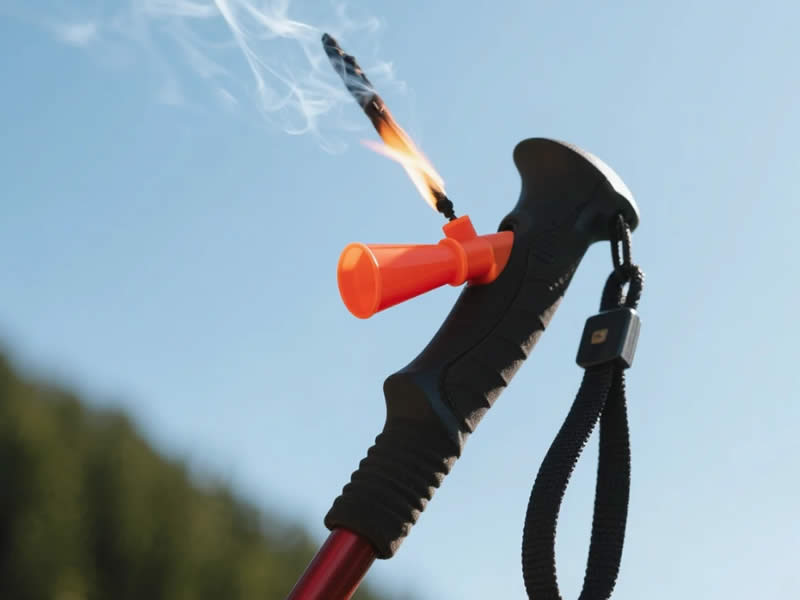
The emergency whistle: a practical safety feature
Why a whistle on a pole makes sense
An emergency whistle is a lightweight, passive safety device. When attached to your trekking pole, it is always within reach—you cannot lose it, and it doesn't require batteries. In a UK hill‑walking context, where sudden fog or injury can occur, a whistle is an essential part of the standard mountain safety kit (often recommended by Mountain Rescue). A whistle integrated into the grip means you don't have to fumble for a separate whistle in an emergency.
Brands that offer whistle‑integrated grips
- Leki: Many Leki models, including the Makalu and Micro Vario, feature a high‑decibel whistle moulded into the top of the grip. The whistle is directional; you blow into the handle, and the sound projects forward.
- Komperdell: Some Komperdell poles, such as the Contour series, also have a whistle in the grip.
- Generic brands: Budget poles sometimes include a whistle as a marketing feature, though the sound quality may be lower.
Effectiveness
A built‑in whistle is effective in all weather conditions (wet, cold, or hot) and produces a sound that can carry a considerable distance, typically 100‑200 metres, depending on the terrain and wind. It is a reliable signal for attracting attention.
Limitations
- Sound quality: A built‑in whistle is often not as loud as a dedicated, high‑powered whistle (like a Fox 40), which is designed to produce a piercing, directional sound.
- Placement: If you are using the pole, the whistle is at hand. However, if you are using both poles and need to blow the whistle, you will have to put a pole down, which can be inconvenient in a rescue situation.
The flint or fire‑starter: a rare and flawed feature
Why a flint is rarely built into poles
A built‑in flint or fire‑starter would require a striking surface on the pole. Trekking poles are typically made of anodised aluminium or carbon fibre. Neither material is suitable for striking a flint:
- Anodised aluminium: The anodised coating is hard but brittle. Striking it with a ferrocerium rod would scratch and damage the coating, exposing the aluminium to corrosion.
- Carbon fibre: Carbon is brittle and would not withstand the repeated force of a striker.
Even if a small steel striking plate were embedded in the grip or lower section, the ergonomics of striking a flint at an awkward angle (while holding a pole) would be impractical. Fire‑starting requires a specific, controlled motion—usually a downward, scraping action—that is difficult to achieve with a rigid pole held in the hand.
Are there any exceptions?
Some niche survival‑oriented poles, often sold by smaller, specialist brands, may have a survival kit integrated into the handle (which could include a small ferro rod). However, these are not mainstream products and often compromise the grip comfort or locking mechanism.
A better solution: separate fire‑starting tools
For emergency fire‑starting, carry a dedicated tool:
- Ferro rod (e.g., Light My Fire): Small, lightweight, and reliable. It produces sparks even when wet.
- Waterproof matches: Packed in a waterproof container.
- Flint and steel: Classic but less reliable in damp conditions.
These tools are small, cheap, and far more effective than any integrated solution. They can be kept in a waterproof pouch on your rucksack's hip belt, ensuring they are always accessible.
What to look for in a safety‑conscious pole
1. A comfortable and functional grip
The grip is the most important part of the pole. A cork grip is the best choice for comfort and moisture control. A built‑in whistle is a bonus, but it should not compromise the grip's ergonomics.
2. Reliable locking mechanism
A flick‑lock (lever‑lock) is more reliable and easier to adjust than a twist‑lock. In an emergency, you need to be able to lock the pole quickly and securely.
3. A reflective or bright shaft
For visibility in low light or fog, a pole with reflective decals or a bright colour (e.g., orange, yellow) is a valuable safety feature. This makes you more visible to rescue services.
4. A wrist strap that does not tangle
The wrist strap should be wide, padded, and easy to adjust. A strap that is too loose can be a hazard, while a correctly adjusted strap ensures you can use the pole effectively without losing it.
Recommended models
| Brand | Model | Whistle? | Flint? | Notes |
|---|---|---|---|---|
| Leki | Makalu, Micro Vario | Yes | No | Standard, reliable poles; cork grip |
| Komperdell | Contour | Yes | No | Good quality, comfortable grip |
| Black Diamond | Trail Pro | No | No | No whistle, but excellent locks |
| Decathlon | Forclaz MT900 | No | No | Budget option; no whistle |
The verdict
Trekking poles with a built‑in emergency whistle are a practical, useful safety feature, particularly for UK hill walking. A whistle integrated into the grip is always on you, cannot be lost, and works in all weathers. However, a built‑in flint is not a practical feature—the materials of the pole are not suited to striking, and the ergonomics would be poor. For fire‑starting, carry a separate, dedicated tool such as a ferro rod or waterproof matches. When choosing a safety‑conscious pole, prioritise a comfortable, ergonomic grip, a reliable locking system, and, if possible, a built‑in whistle. The whistle is a bonus, but the pole's primary function is to support your walking, not to start a fire. Stay safe, and always carry a complete emergency kit.




