




What are the safest folding trekking poles for a teenager with weak wrists?
For a teenager with weak wrists, the safest folding trekking poles are those with quick-locking external levers (flick-locks) , ultralightweight shafts (carbon or thin-wall aluminium), and ergonomic grips that reduce wrist strain. The primary goals are to minimise the force required to operate the pole, reduce the load on the wrist during use, and provide a secure, reliable lock that does not require forceful twisting. This article reviews the top models, explains the critical safety features, and provides practical advice for selecting and using poles for a teenager with wrist concerns.
Why wrist strain is a particular issue for teenagers
Teenagers are still growing, and their bones, tendons, and ligaments are not yet fully developed. Their wrists are more vulnerable to overuse injuries, such as tendinitis or repetitive strain injuries (RSI), which can be exacerbated by:
- Heavy poles: A heavy pole requires more force to lift and swing, increasing the load on the wrist.
- Twist-locks: These require a twisting motion to extend and secure. This motion can be difficult and painful for a weak wrist.
- Hard grips: A grip that is too thin or too hard can create pressure points, leading to discomfort and fatigue.
- Poor technique: A young walker may not yet have developed the correct pole technique, leading to over-gripping or excessive force.
A well-chosen pole can mitigate these risks, making the walk safer and more enjoyable.
The safest folding pole designs
1. Flick-locks (lever-locks) over twist-locks
For a teenager with weak wrists, flick-locks are the only safe choice. A twist-lock requires a rotational force to tighten and loosen, which can strain the wrist. A flick-lock, by contrast, uses a simple lever. You push the lever down to lock, and pull it up to release. This action uses the strength of the arm, not the wrist, and requires minimal effort.
- Black Diamond FlickLock: A benchmark in the industry. The lever is easy to operate and holds securely.
- Leki SpeedLock 2: A robust flick-lock that is also easy to operate.
- Decathlon flick-lock: A budget-friendly option that is just as easy to use.
2. Ultralightweight shafts
A lighter pole reduces the effort required to lift and swing it. For a teenager, this is a significant safety benefit.
- Carbon fibre: The lightest option (e.g., Black Diamond Distance Carbon Z at 155g per pole). Carbon is also shock-absorbing, reducing the vibration transmitted to the wrist.
- Thin-wall aluminium: Lightweight but slightly heavier than carbon. The Decathlon Forclaz MT900 (250g) is a good example, though heavier than carbon.
Recommendation: For weak wrists, a carbon pole is the best choice, despite the higher cost.
3. Ergonomic, padded grips
A grip that is too thin or too hard can cause pressure points on the palm and wrist.
- Cork grips: Cork is naturally comfortable, conforms to the hand, and absorbs sweat. It is an excellent choice for reducing fatigue.
- Foam grips: Lightweight and shock-absorbing, but may not be as durable as cork.
- Grip size: The grip should be large enough to fill the hand but not so large that it causes the fingers to stretch. For a teenager, a smaller grip (e.g., a 'junior' grip) may be necessary. Brands like Leki offer youth-specific grips.
4. Shock-absorbing tips
Some poles have a spring or elastomer in the lower section that absorbs the impact of each plant. This reduces the shock transmitted to the wrist, which is beneficial for a weak wrist. However, shock-absorbing poles are heavier and can feel bouncy on hard surfaces. They are not essential if the teenager uses a lightweight pole with a flexible shaft.
Top recommendations
1. Black Diamond Distance Carbon Z
- Weight: 155g (ultra-light).
- Lock: Z-Pole twist-lock (folding design, but locks with a simple pull).
- Grip: EVA foam, which is lightweight and comfortable.
- Why it's safe: The carbon shaft is shock-absorbing, and the pole is so light that it requires minimal force to swing. The locking mechanism is simple to operate.
- Drawback: The foam grip is not as comfortable as cork for long days.
2. Leki Micro Vario Carbon
- Weight: 210g.
- Lock: SpeedLock 2 (flick-lock).
- Grip: Cork, with a foam extension.
- Why it's safe: The flick-lock is easy to operate, and the cork grip is very comfortable. The carbon shaft is lightweight and shock-absorbing. The 4-section folding design makes it compact.
- Drawback: Slightly heavier than the Black Diamond, but the cork grip is a significant advantage.
3. Decathlon Forclaz MT900 (budget)
- Weight: 250g.
- Lock: Flick-lock.
- Grip: Cork/foam hybrid.
- Why it's safe: The flick-lock is easy to operate, and the grip is comfortable. It is a good budget option, though the heavier weight may be a limitation for a weak wrist.
- Drawback: Heavier than the premium options; the weight may cause fatigue over a long day.
4. Komperdell Contour Pro Compact
- Weight: 220g.
- Lock: Power Lock (flick-lock).
- Grip: Cork.
- Why it's safe: A reliable flick-lock and a comfortable cork grip. The 4-section design makes it compact.
- Drawback: Similar weight to the Leki, with a slightly less refined lock.
Practical advice for the teenager and parent
1. Check the wrist strap
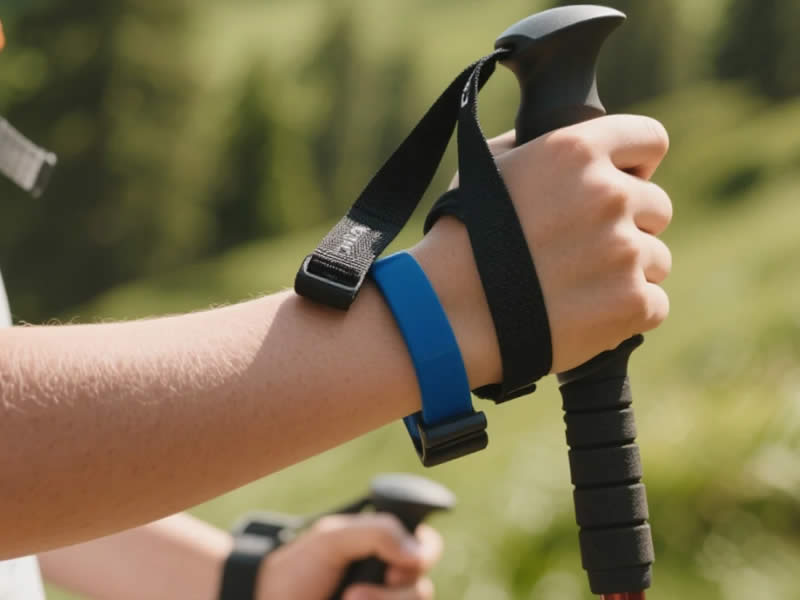
The wrist strap is critical for reducing wrist strain. It should be adjusted so that the strap sits diagonally across the back of the hand, not across the fingers. The teenager should not have to grip the pole tightly; the strap should bear the load.
2. Shorten the poles
For a young walker, a slightly shorter pole (about 3-5 cm less than the 90° rule) can reduce the leverage and make the pole easier to control. This is especially true on descents.
3. Practice technique
A common mistake is to grip the pole too tightly. The correct technique is to use the wrist strap to support the weight, and to push down with the arm, not the wrist. Practice this on a flat, safe surface before tackling a steep slope.
4. Test in-store
If possible, visit a store like Cotswold Outdoor or Decathlon. Have the teenager hold the poles, adjust the length, and try the locking mechanism. This hands-on test is the best way to ensure comfort and safety.
Summary table
| Model | Weight | Lock | Grip | Best For |
|---|---|---|---|---|
| Black Diamond Distance Carbon Z | 155g | Z-Pole twist | Foam | Extreme lightweight, minimal wrist effort |
| Leki Micro Vario Carbon | 210g | SpeedLock 2 (flick) | Cork | Comfort and ease of use |
| Decathlon Forclaz MT900 | 250g | Flick-lock | Cork/foam | Budget-conscious families |
| Komperdell Contour Pro Compact | 220g | Power Lock | Cork | A reliable, all-rounder |
The verdict
For a teenager with weak wrists, the Black Diamond Distance Carbon Z is the safest folding trekking pole due to its ultra-light weight and easy-to-use locking mechanism. The Leki Micro Vario Carbon is a close second, offering a more comfortable cork grip at a slightly higher weight. For budget-conscious families, the Decathlon Forclaz MT900 is a solid alternative, though its heavier weight may cause more fatigue. Prioritise a flick-lock over a twist-lock, a lightweight shaft over a heavy one, and a comfortable grip that fills the hand. With the right pole and the correct technique, a teenager can walk with confidence and enjoy the trails without wrist pain.




