




Can trekking poles help an elderly person stand up from a muddy seat?
Yes, trekking poles can assist an elderly person in standing up from a muddy seat, but only under very specific conditions and with significant precautions. While they can provide an extra point of support to reduce strain on the knees, the soft, unstable nature of muddy ground introduces serious risks that often outweigh the benefits. For most elderly individuals, especially those with limited upper-body strength or balance issues, a trekking pole is not the safest or most reliable tool for this task-.
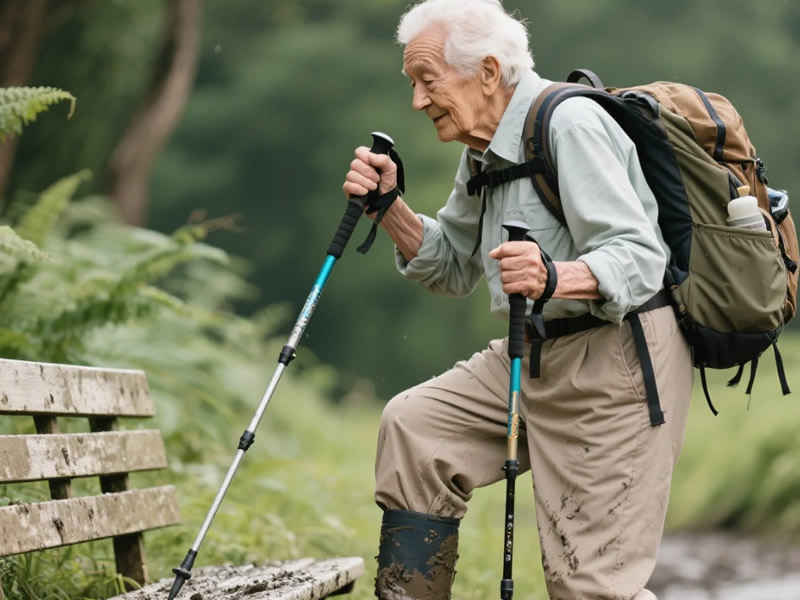
How trekking poles can help
In an ideal scenario, a trekking pole can assist with standing by:
- Providing a third point of contact: When you push down on a pole, you create a tripod effect (two feet + one pole), which is more stable than standing on two feet alone.
- Transferring weight: By pushing down on the pole, you transfer some body weight from the legs to the arms and shoulders, reducing the effort required by the knees and hips-.
- Offering leverage: The pole can act as a lever to help lift the body upwards, provided the user has sufficient arm strength.
For elderly individuals with mild mobility challenges, a trekking pole can offer an extra sense of security and independence-.
The major risks: why muddy ground changes everything
1. The pole may sink into the mud
This is the most significant hazard. If the ground is muddy, the pole's tip can sink, causing the user to lurch forward or sideways unexpectedly-. A sudden drop can lead to a loss of balance and a potentially serious fall. Even with mud baskets fitted, sinking remains a risk in deep, soft mud-. Large, solid baskets can help prevent sinking, but they are not a guarantee on unstable ground-.
2. The pole may slip on wet surfaces
If the pole is planted on damp grass, wet rock, or slick mud, the tip can skid sideways-. This is particularly dangerous when the user is applying weight to rise. On wet, slippery ground, the pole's grip is compromised, turning a support into a hazard-.
3. The pole may not be the right length
If the seat is low, the pole may be too short to provide effective leverage. Having to reach down to use the pole reduces mechanical advantage and can strain the back and shoulders.
4. The user may lack sufficient upper-body strength
Pushing down on a pole requires arm, shoulder, and grip strength. If the user has arthritis, weak wrists, or limited shoulder mobility, they will not be able to generate the necessary force to rise safely.
Safer alternatives for standing from a muddy seat
For most elderly individuals, a trekking pole is a compromise. The following tools are specifically designed for stability and are far safer choices:
1. Quad cane (four-point cane)
A quad cane features a four-point base that provides significantly greater stability than a standard walking stick or trekking pole-. The wide base:
- Stands independently and will not fall over when placed beside a seat-.
- Offers better grip on uneven surfaces-.
- Reduces the risk of falls and provides maximum stability-.
However, quad canes are heavier and bulkier, which can be tiring for long walks-. Some models feature a second handle to make standing up and sitting down easier-.
2. Walking stick with a rubber ferrule
A standard walking stick with a large, rubber tip provides a larger contact area than a trekking pole's carbide tip. The rubber offers better traction on wet or muddy ground and is less likely to sink.
3. Seat with armrests
The simplest and safest solution is to use a seat with sturdy armrests-. Armrests allow the person to push up using their arms without needing any external support-. For those with significant mobility challenges, a power lift recliner can assist with standing-.
4. Walking frame (walker)
For individuals with moderate mobility challenges, a walking frame provides more stability than a cane-. It offers a larger frame to stabilise movement and can be used for support when standing.
If you must use a trekking pole: essential safety precautions
If a trekking pole is the only option available, follow these critical safety steps:
- Plant the pole on solid ground: Find a firm patch of ground, a stone, a tree root, or a piece of wood. Do not plant it directly into soft mud.
- Use two poles: Two poles provide a wider, more stable base. Plant one on either side of the seat.
- Check the lock: Ensure the flick-lock or twist-lock is firmly tightened-. A loose pole can collapse under weight.
- Position the pole vertically: The pole should be as vertical as possible. An angled pole can slide sideways.
- Push down with the arm, not the shoulder: Use the strength of the arm to push, avoiding strain on the shoulder joint.
- Do not pull on the pole: Pulling can cause the pole to slip or the lock to fail. Push down only.
- Stand up slowly: Use leg muscles as much as possible; the pole is for support, not for lifting the entire body weight.
- Fit mud baskets: If available, fit large mud baskets to the poles to reduce sinking in soft ground-.
When to avoid trekking poles entirely
Trekking poles are not suitable if the elderly person:
- Has weak wrists, shoulders, or grip strength.
- Has significant balance issues or a history of falls.
- Is unable to generate enough force to push down on the pole.
- Has a condition such as Parkinson's or tremors that affects fine motor control.
In these cases, a quad cane, walking frame, or a seat with armrests is a safer choice-. Always consult a physiotherapist or occupational therapist for a personalised assessment and recommendation-.
The verdict
A trekking pole can help an elderly person stand up from a muddy seat, but it is not a safe or reliable solution for most elderly individuals. The risk of the pole sinking in mud, slipping on wet surfaces, or simply not providing enough leverage is significant. For the vast majority of elderly people, a quad cane or a seat with armrests is a far safer and more effective choice-. If you are unsure, always consult a healthcare professional who can assess the individual's specific needs and recommend the correct equipment. When it comes to standing up, especially in muddy conditions, safety must always come first.




