




Should I shorten poles for a fast-paced flat walk and lengthen for hills?
Yes—but only for hills, not for a fast-paced flat walk. For a fast-paced flat walk, keep your poles at the standard length (elbow at 90°). This provides the most efficient arm swing and allows you to maintain a steady cadence. For hills, you should adjust dynamically: shorten for uphills and lengthen for downhills. This article explains the biomechanics behind these adjustments and provides a practical guide for when and how to change your pole length.
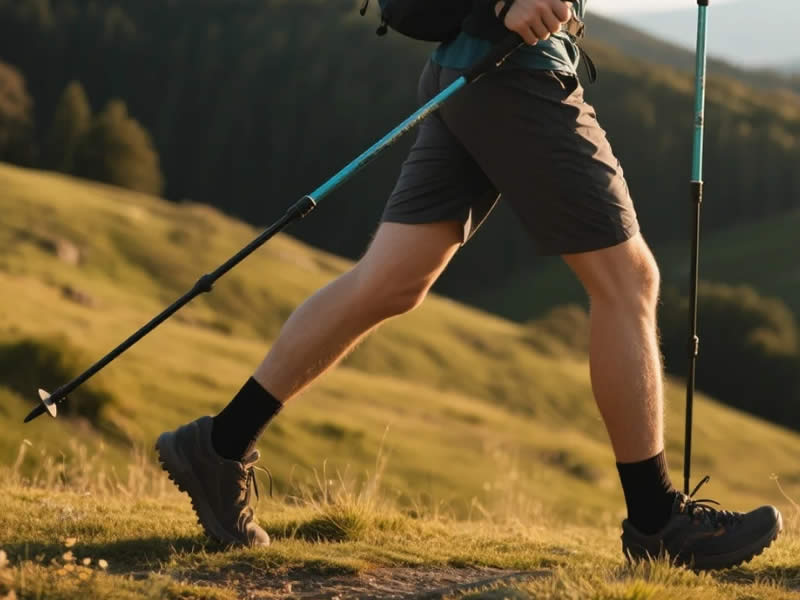
The flat-ground case: keep them at 90°
On flat terrain, the primary function of the poles is to support a steady, rhythmic cadence. Your arms swing in a natural pendulum motion, in time with your legs. The correct pole length for this is the "90° rule" : when you stand upright with the tip on the ground, your elbow should be at a 90° angle.
Why this is the most efficient length:
- Optimal arm swing: The 90° angle allows your arms to swing naturally, with a full range of motion.
- Efficient energy transfer: At this length, the pole is in the correct position to transfer force from your arm to the ground.
- Reduced fatigue: A well‑adjusted pole reduces the effort required to swing your arms, allowing you to maintain a fast pace for longer.
Shortening poles for flat ground is a mistake. A shorter pole would force you to reach downwards, reducing your arm swing and making you less efficient. It would also increase the effort required to lift the pole, leading to arm fatigue.
The uphill case: shorten for greater efficiency
On a steep ascent, the angle of the ground changes. The standard 90° length is now too long: you would have to overreach to plant the pole, forcing you to lean forward and strain your shoulders.
The adjustment: Shorten your poles by 3‑5 cm (or more, depending on the steepness) from your flat‑ground length.
Why this works:
- You keep your arms closer to your body: A shorter pole allows you to push upwards without overreaching, reducing the load on your shoulders.
- You stay upright: The shorter length encourages an upright posture, which is more efficient for climbing.
- You engage your triceps: The shorter pole places your arm in a more vertical position, allowing you to use your triceps to push upwards.
The downhill case: lengthen for control and knee protection
On a descent, the standard 90° length is too short. You would have to lean forward to plant the pole, which is inefficient and reduces your braking effect.
The adjustment: Lengthen your poles by 3‑5 cm (or more) from your flat‑ground length.
Why this works:
- You plant the pole ahead of your foot: A longer pole allows you to reach ahead and plant the pole before your foot lands, creating a braking effect.
- You protect your knees: By absorbing some of the impact, the longer pole reduces the load on your knees.
- You stay upright: The longer length encourages a more upright posture, which is safer and more efficient on descents.
How to find your flat‑ground length
- Stand upright with your walking boots on.
- Place the pole tip on the ground beside your foot.
- Adjust the length until your elbow is at a roughly 90° angle.
- Mark this length on the shaft with a permanent marker. This is your "flat‑ground" length.
Adjustment for extreme terrain
| Terrain | Adjustment | Reason |
|---|---|---|
| Flat, fast walk | No adjustment (90°) | Optimal arm swing |
| Gentle uphill | Shorten 3‑5 cm | Reduce overreaching |
| Steep uphill | Shorten 5‑7 cm | Keep arms close to body |
| Gentle downhill | Lengthen 3‑5 cm | Increase braking effect |
| Steep downhill | Lengthen 5‑7 cm | Maximise knee protection |
The Nordic walking exception
In Nordic walking, the technique is different. Nordic walkers use a longer stroke and a more forceful push. They often use a slightly longer pole than the 90° rule (0.68 × height). However, this is a specific technique, not a general rule.
Practical tips for adjusting on the trail
- Practice adjusting: If you are new to poles, practice adjusting the length on flat ground before you hit the trail.
- Mark your settings: Use a permanent marker to mark your flat‑ground, uphill, and downhill settings on the shaft. This allows you to quickly adjust without having to measure each time.
- Adjust one pole at a time: When walking, adjust one pole at a time to maintain your balance.
- Keep them clean: Mud and grit can make the locking mechanism stiff. Clean your poles regularly.
Summary table
| Scenario | Pole Adjustment | Effect |
|---|---|---|
| Fast‑paced flat walk | Keep at 90° | Efficient arm swing, steady cadence |
| Uphill | Shorten 3‑5 cm | Keep arms close, upright posture |
| Downhill | Lengthen 3‑5 cm | Plant ahead, brake, protect knees |
The verdict
Yes, you should shorten your poles for uphills and lengthen them for downhills. For a fast‑paced flat walk, keep them at the standard 90° length. This is the most efficient length for flat terrain, allowing you to maintain a steady, rhythmic cadence. For hills, adjust dynamically: shorten for uphills (to keep your arms close and push upwards) and lengthen for downhills (to plant ahead and brake). Mark your flat‑ground length on the shaft so you can quickly reset your poles after adjusting. With the right length for each terrain, you'll walk faster, more efficiently, and with less fatigue.




