




Can a 120kg hiker safely use carbon fibre trekking poles in the UK hills?
If you weigh 120 kilograms and love the rugged beauty of the British hills—from the peat bogs of the Pennines to the rocky scrambles of Snowdonia—you've probably wondered whether lightweight carbon fibre trekking poles can handle your frame. The short answer is yes, absolutely—provided you choose the right model and use them correctly. However, the long answer involves understanding carbon fibre's unique properties, the specific demands of UK terrain, and how to match pole design to your weight and walking style. This guide will give you the confidence to make an informed decision and enjoy safer, quieter treks across the British uplands.
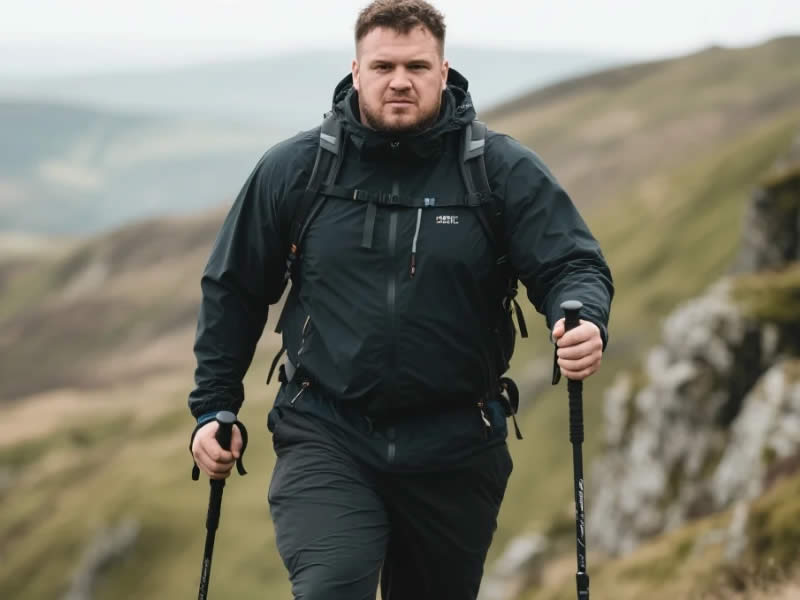
1. Carbon Fibre Strength – It's Not About Weight, It's About Engineering
Carbon fibre is often misunderstood as fragile. In reality, high‑grade carbon composites have a tensile strength higher than steel and a stiffness‑to‑weight ratio that exceeds aluminium. The critical factor is not the material itself but the layup, wall thickness, and resin system. A well‑made carbon pole with a 16‑18 mm diameter and a 1.2 mm wall can easily support a static vertical load of over 150 kg—well above your 120 kg weight.
The key is direction of force. Carbon fibre is exceptionally strong under compression (pushing straight down) and tension, but it is weaker under point‑load impacts (e.g., hitting a sharp rock edge) and lateral bending. For walking, the primary force is vertical compression, which carbon handles superbly. So weight alone is rarely the limiting factor—it's how you apply that weight.
2. Check the Manufacturer's Rated Weight – The Golden Rule
Never assume all carbon poles are equal. Reputable brands (Leki, Black Diamond, Komperdell, Fizan) clearly state a maximum user weight or recommended load for each model. For your 120 kg, you need a pole rated at least 120 kg, but ideally 130‑140 kg to provide a safety margin. Look for terms like "heavy‑duty," "expedition," or "reinforced" in the product description. Many premium carbon poles are rated up to 130‑140 kg, so they are well within your range.
If a product page doesn't list a weight limit, contact the manufacturer directly. Avoid generic, unbranded carbon poles—they often have unknown resin quality and inconsistent wall thickness, which can fail unexpectedly.
3. The UK Hills – A Unique Challenge
British hills present specific hazards that test any pole, regardless of material:
- Wet, slippery rock – The Lake District and Scottish Highlands are famously damp. Carbon poles don't corrode (unlike aluminium), which is a plus, but wet rock increases the chance of a sideways slip, which can apply lateral force to the shaft.
- Gritstone and quartzite – Many UK summits have sharp, abrasive rocks. A hard side‑impact against a jagged edge can chip or crack a carbon tube, while aluminium would simply dent. This is the main risk for carbon users.
- Peat hags and deep mud – Poles often sink and get stuck; yanking them out sideways can bend or snap any pole. Carbon is more brittle under torsion.
- Variable weather – Cold temperatures (near freezing) slightly reduce carbon's impact resistance, though modern epoxies perform well down to -20°C.
These conditions mean that technique and terrain awareness are more important than material. A 120‑kg walker with poor technique can break any pole; a skilled user can keep carbon intact for years.
4. How to Use Carbon Poles Safely at 120kg in the UK
Follow these best practices to maximise safety and longevity:
- Use two poles, always – Distribute your weight evenly. Never lean all your weight on a single pole, especially when stepping down steep drops.
- Plant vertically – When you place the pole, keep the shaft as close to vertical as possible. Angled planting creates bending moments that carbon hates.
- Avoid prying or levering – If the tip gets stuck between rocks, pull it out straight—never use the pole as a lever to free yourself.
- Choose the right tip – Tungsten‑carbide tips give excellent grip on rock. For extra cushioning and reduced shock, add a rubber tip on hard surfaces (though they wear quickly on gritstone).
- Adjust length correctly – Shorter poles (when going uphill) reduce leverage on the shaft. Keep the lower sections well overlapped (at least 4‑5 inches) to avoid stress concentration at the joint.
- Inspect before every hike – Run your hand along the shaft; feel for any splinters, soft spots, or cracks. Tap the pole lightly—a dull thud is fine; a hollow rattle may indicate internal delamination.
5. Choosing the Right Carbon Pole Model
Not all carbon poles are created equal. For 120 kg on UK terrain, look for:
- Wall thickness – ≥1.0 mm (some ultralight models use 0.8 mm – avoid those).
- Fibre weave – 3K or 6K woven fabric with a high‑quality epoxy (e.g., Toray or Mitsubishi resin).
- Locking mechanism – Flip‑locks with metal cams offer more reliable clamping than twist‑locks, especially under load.
- Reinforced ferrules – The junction where the tip meets the shaft should have a metal or thick composite collar to prevent splitting.
- Warranty – Brands offering a 2‑3 year warranty against breakage are usually more confident in their products.
Popular models suitable for your weight include the Black Diamond Pursuit Carbon (rated 130 kg), Leki Makalu FX Carbon (rated 125 kg), and Komperdell Carbon C3 (rated 140 kg). Always verify the current specification.
6. Alternatives – When Aluminium Might Be Better
If you're still uneasy, consider 7075‑T6 aluminium poles. They are heavier (by 50‑100g per pole) but much more forgiving of side‑impacts and prying forces. Aluminium bends before breaking, which can be a lifesaver if you fall—you can often straighten a bent section to finish your walk. For the wet, rocky UK hills, many heavy‑duty guides still prefer aluminium for its toughness, even though it's noisier and less damped.
However, carbon's benefits—lighter weight, reduced fatigue, quieter action, and vibration absorption—are real. For a 120‑kg hiker covering long distances, those advantages can significantly improve comfort. It's a trade‑off between durability against sharp edges and all‑day performance.
7. Real‑World Experience – What Other Heavy Hikers Say
In online forums and gear reviews, many walkers over 110 kg report successfully using high‑end carbon poles in the UK for years without failure. The common theme is that they never abuse their poles—they treat them as precision instruments, not crowbars. Conversely, complaints of snapped carbon poles almost always involve a sideways fall, a wedged tip, or an unseen manufacturing defect. The takeaway: with careful handling, carbon is perfectly reliable at 120 kg.
8. Final Verdict – Safe, But With Conditions
To directly answer the question: Yes, a 120‑kg hiker can safely use carbon fibre trekking poles in the UK hills, provided that:
- The poles are rated by the manufacturer for ≥120 kg (preferably 130+).
- You use two poles and maintain a vertical planting technique.
- You avoid using the pole as a lever or prying tool.
- You inspect the poles regularly for any damage.
- You choose a model with sufficient wall thickness and a reputable brand.
UK hills are demanding, but they don't mandate aluminium. Thousands of walkers, including many heavier ones, enjoy the lightness and silence of carbon every day. The key is knowing your gear's limits and respecting the terrain. If you're willing to adopt a mindful walking style, carbon poles will serve you admirably across the moors, ridges, and valleys of Britain—keeping your steps steady and your pack weight low.




