




How much downward force can the locking mechanism withstand before slipping?
If you've ever leaned heavily on a trekking pole and felt it suddenly shorten by a centimetre—that unsettling slip—you know how critical the locking mechanism is. It's the difference between a confident stride and a jarring lurch. But how much force can these locks actually hold before they give way? The answer isn't a single number. It depends on the lock type, its adjustment, the materials involved, and even the weather. In this deep dive, we'll break down the real‑world performance of twist‑locks and flip‑locks, explain what causes slipping, and give you practical ways to maximise holding power.
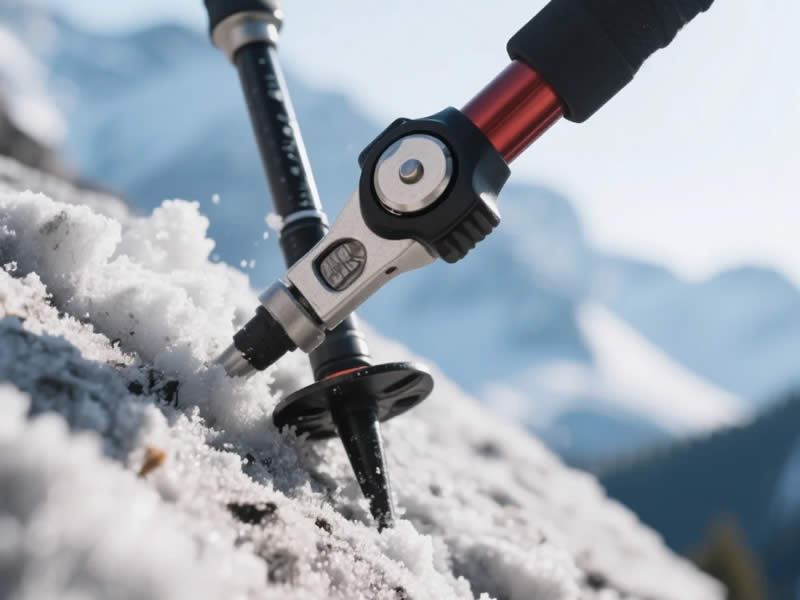
1. The Two Main Lock Types and Their Typical Capacities
Trekking poles use either a twist‑lock (rotating the lower section to expand an internal wedge) or a flip‑lock (a cam lever that clamps the outer tube around the inner one). Each has a distinct force‑holding profile.
Flip‑locks (cam‑locks) are generally stronger and more consistent. Quality models with metal cams and wide clamping bands can hold 120–180 kg (265–400 lbs) of vertical compressive force before the inner tube begins to slip. Premium examples, like the Black Diamond FlickLock or Leki SpeedLock, often exceed 150 kg in factory tests. The force is concentrated on a broad contact area, distributing pressure evenly.
Twist‑locks rely on friction between an internal expanding collet and the tube walls. Their holding capacity is more variable—typically 80–130 kg (175–285 lbs) when correctly tightened. Because the friction surface is smaller and more sensitive to dirt or wear, they can slip earlier. However, some high‑end twist mechanisms (e.g., Komperdell's TÜV‑tested models) claim up to 140 kg.
It's crucial to note that these are static vertical compression figures—meaning pure downward force with the pole aligned straight. In real hiking, you often apply angled or dynamic loads, which reduce the effective threshold.
2. What Determines the Actual Slipping Point?
The rated numbers are just starting points. Actual performance depends on several factors:
- Tightening torque – A flip‑lock's cam tension screw can be adjusted. A half‑turn more on the adjuster screw increases clamping force significantly. For twist‑locks, how many degrees you turn the collar matters. Under‑tightening is the number one cause of slipping.
- Surface condition – Grease, oil, or moisture on the clamping area reduces friction. Even a thin film of silicone lubricant, if applied to the overlap zone, can cut holding power by 20‑30%. Keep friction surfaces clean and dry.
- Wear and tear – Over time, the inner tube's anodised coating wears down, and the outer tube's internal wall polishes smooth. This lowers the coefficient of friction, so a lock that held 150 kg when new might slip at 110 kg after 500 km.
- Tube ovality – If the pole has been bent even slightly, the circular cross‑section becomes oval, reducing the contact area and allowing the lock to slip under lower loads.
- Temperature – Cold weather makes plastics and rubbers stiffer, which can reduce the grip of some twist‑lock collets. Conversely, heat can soften certain polymer cams, decreasing their clamping force.
3. How Manufacturers Test Locking Strength
Reputable brands perform standardised tests. They extend the pole to its maximum length, lock it, and apply a gradually increasing vertical load until the sections slip by 5 mm. The load at that point is recorded as the "slip threshold." Some brands test dynamically—dropping a weight onto the pole to simulate shock loads. Dynamic thresholds are typically lower (by 20‑30%) than static ones because impact forces spike momentarily.
For example, Leki publishes that their SpeedLock 2 mechanism holds over 140 kg in static tests. Black Diamond states that their FlickLock Pro can withstand 160 kg. However, these are lab values with perfectly clean, new tubes. In the field, expect about 80‑90% of the lab figure.
4. How to Test Your Own Pole's Holding Force at Home
You don't need a hydraulic press. Here's a safe, practical test:
- Extend the pole to your typical walking length and lock it.
- Place the tip on a non‑slip surface (e.g., a rubber mat on concrete).
- Stand on a bathroom scale with both feet. Note your weight.
- Gently transfer all your weight onto the pole by leaning on the handle, using the scale to monitor the load. Increase gradually until you feel or hear a slip, or until you reach 1.2× your body weight.
- If it slips below your full body weight, the lock needs adjustment or service.
Always do this slowly and near a wall for balance. Never use a jerky motion—that can stress the tubes.
5. How to Increase Holding Force Without Breaking Anything
If your pole slips too easily, try these fixes in order:
- Flip‑locks: Turn the small tension screw (usually on the cam) clockwise by 1/8 turn. Test again. Repeat until the lock holds firmly with a moderate lever effort. Avoid over‑tightening—it can strip the screw or crack the cam.
- Twist‑locks: Clean the inside of the outer tube and the inner tube with isopropyl alcohol. Then tighten the collar an extra half‑turn while the pole is extended. If it still slips, the collet may be worn—replace it.
- Add anti‑slip tape – A thin strip of double‑sided carpet tape or friction tape on the inner tube (in the clamp area) can dramatically boost grip, though it may make extension/retraction stiffer.
- Replace worn sections – If the tube is polished smooth, lightly abrade it with fine sandpaper (600‑grit) in the overlap zone to restore some roughness—but do this sparingly.
6. When Slipping Signals a Bigger Problem
Occasional slip after a hard fall or in muddy conditions is normal. But if your lock consistently slips at under 50 kg, inspect for:
- A cracked or deformed clamp band.
- A worn‑out twist‑lock collet that no longer expands fully.
- A bent inner tube that cannot maintain uniform contact.
- A stripped cam adjustment screw.
In these cases, tightening won't help—you need replacement parts or a new pole. Never ignore persistent slipping; a sudden collapse on a descent can cause serious injury.
7. Practical Recommendations for Different User Weights
- Under 80 kg – Most locks, even budget twist‑locks, will hold fine if adjusted correctly.
- 80–100 kg – Choose flip‑locks or high‑quality twist‑locks. Check and re‑tighten periodically.
- Over 100 kg – Invest in a dual‑cam flip‑lock (e.g., BD FlickLock or Leki SpeedLock 2). Avoid cheap twist‑locks. Always use two poles to distribute load, reducing the peak force on each lock.
8. Final Thoughts – It's Adjustable, Not Fixed
To directly answer the question: a well‑adjusted flip‑lock typically holds 120‑180 kg, while a twist‑lock holds 80‑130 kg. But these numbers are not destiny—they are highly dependent on your maintenance and adjustment. Treat your locks like the precision components they are: keep them clean, adjust them correctly for your weight, and replace worn parts promptly. A lock that holds your full body weight with a safety margin (at least 20% above your weight) is the goal. Test yours today, and hike with confidence knowing exactly what your gear can take.




