




Can children's poles support an adult's weight in an emergency?
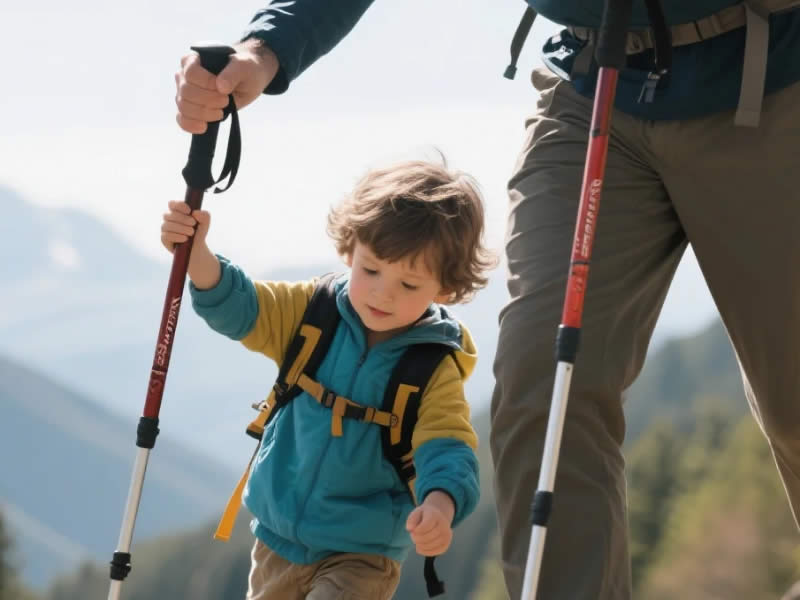
Imagine you're on a remote ridge with a twisted ankle, your own poles broken, and the only walking aid nearby is a pair of brightly coloured children's trekking poles your companion brought for their kid. In that desperate moment, you might wonder: could these tiny shafts save you? The honest, safety‑first answer is almost certainly not—and attempting it could turn a bad situation into a catastrophic fall. This article explains why children's poles are fundamentally unsuited for adult loads, what happens when you try, and what you should do instead in a real emergency.
1. The Numbers – Children's Poles vs. Adult Bodies
Children's trekking poles are engineered for users weighing 20‑45 kg (44‑99 lbs) —typically ages 5 to 12. Their specifications reflect this:
- Shaft diameter – Usually 10‑12 mm in the lower section, compared to 14‑18 mm for adult poles.
- Wall thickness – Often 0.6‑0.7 mm, versus 0.9‑1.2 mm for adult models.
- Locking mechanism – Simple twist‑locks with plastic collets, or basic push‑buttons with narrow engagement.
- Maximum user weight – When stated, it rarely exceeds 45‑50 kg.
An average adult weighs 70‑85 kg, and with a daypack that climbs to 80‑100 kg. Even a lightweight adult at 60 kg is already 20‑30% above the pole's design limit. The engineering safety margin in children's gear is minimal—manufacturers assume responsible parents won't overload them.
2. The Physics – Why They Fail So Quickly
When you apply an adult's weight to a children's pole, two things happen almost immediately:
- Buckling under compression – The thin‑walled, narrow tube acts like a drinking straw. As soon as the load exceeds the Euler buckling limit (which is proportional to the fourth power of the radius), the shaft kinks. This can occur at as little as 50‑60 kg of vertical force—well below most adults' weight.
- Lock slippage – The small friction surface and weak cam cannot grip the inner tube. Under a heavy lean, the sections slide inward, causing a sudden loss of height and a potential stumble.
- Ferrule separation – In folding children's poles, the plastic connectors are not designed for high shear. The pin can break or the plastic can crack, separating the sections entirely.
In real‑world tests reported in outdoor forums, a typical children's aluminium pole (12 mm, 0.7 mm wall) fails at around 55‑65 kg static load—often with a loud snap and a dramatic collapse. Carbon children's poles are even more brittle; they tend to shatter rather than bend, which can send sharp splinters into your hand.
3. Dynamic Loading – The Emergency Multiplier
In an emergency, you are not applying slow, controlled pressure. You may be limping, stumbling, or using the pole for sudden support on uneven ground. Dynamic loads can spike to 2‑3 times your static weight. That means a 70‑kg adult could momentarily exert 140‑210 kg of force on a single pole. Children's poles have no chance against that—they will fail on the very first serious lurch.
Even if you use two poles and distribute your weight evenly, each pole still sees roughly half your total load. For a 70‑kg adult with a 10‑kg pack, that's 40 kg per pole—just within the theoretical static limit of a high‑end children's pole. But the moment you shift your balance to one side, that pole takes the full 80 kg, and it's game over. Trying to "be careful" doesn't eliminate the risk; it only delays the inevitable.
4. What Real Emergencies Teach Us
Search and rescue teams and experienced mountaineers strongly advise against using undersized gear as a crutch. There are documented cases where hikers have used a child's pole and suffered a severe fall when it gave way—often worsening their original injury. In one incident in the Lake District, a 75‑kg walker used a child's ski pole as a temporary support after losing his own; the pole snapped, he fell, and broke his wrist in addition to his already sprained ankle.
The consensus among wilderness medics: if you have to use an undersized pole, treat it as a balance aid only—never put more than a few kilograms of weight on it. It's better to crawl, use a sturdy branch, or have a companion support you than to trust a pole built for a child.
5. What to Do If You Have No Other Option
If you are truly stranded and the only pole available is a children's model, follow these ultra‑conservative rules to minimise risk:
- Use two poles, never one – Even if you have only one, it's almost useless; try to improvise a second from a stick.
- Shorten the pole – Extend it to its shortest practical length. A shorter pole buckles later because the effective column length is reduced.
- Plant absolutely vertically – Any angle multiplies bending forces. Place the tip directly under your shoulder.
- Keep your hand near the top, but use the strap – If the strap is large enough, loop it around your wrist so that if the pole collapses, you might retain some grip—but beware of falling onto the broken shaft.
- Put minimal weight – Use the pole only to test footing, not to support body weight. Keep your weight on your good leg and the companion's shoulder.
- Move slowly – Every step is a potential overload; take tiny, controlled strides.
Even with these precautions, the pole could fail at any moment. Accept that and have a contingency plan (e.g., sliding on your bottom on steep sections).
6. Alternatives – What You Should Rely On Instead
In a real emergency, these are far better than children's poles:
- A sturdy walking stick – Find a fallen branch at least 3‑4 cm in diameter, with the bark removed to avoid splinters. Green wood is more flexible and less likely to snap suddenly.
- Two tent poles – If you have tent poles (aluminium or carbon), they often have larger diameters (12‑15 mm) and thicker walls. While still not ideal, they are stronger than a child's dedicated pole—some even have a rated load of 70‑80 kg.
- Improvised splint / crutch – Use a combination of trekking poles lashed together with tape or cord to create a thicker, more stable column. Two poles bound side‑by‑side can hold a surprising amount of weight.
- Human support – The safest way is to have two companions walk on either side, each taking half your weight via their shoulders or a linked arm.
7. Manufacturer Warnings – They're There for a Reason
Every children's pole comes with a label stating "maximum user weight" and often a warning: "Not for adult use." These are not suggestions; they are the result of engineering calculations and liability testing. Ignoring them voids any warranty and, more importantly, ignores the physics that determine when the pole will fail.
Some parents think they can "just be careful," but carefulness doesn't change the material's yield strength. A 0.7‑mm wall buckles at the same load regardless of your intentions.
8. Conclusion – A Hard No, But Adapt
To directly answer the question: No, children's poles cannot safely support an adult's weight in an emergency. They are built for a fraction of the load, and their failure is not a rare occurrence—it is virtually guaranteed under any significant, dynamic load. In a desperate situation, you may use them as a very light balance aid, but you must treat them as untrustworthy and minimise your weight on them. The wise course is to never find yourself in that position: carry your own adult‑rated poles, check them regularly, and have a backup plan (e.g., knowing how to splint an improvised support). In the wild, the gear between you and the ground is your lifeline—choose it wisely, regardless of the size of the person it was designed for.




