




What trekking poles are best for the Watkin Path up Snowdon in wet weather?
The Watkin Path is one of the most dramatic and demanding routes up Snowdon (Yr Wyddfa). Starting from the Nant Gwynant valley, it ascends through ancient woodland, past cascading waterfalls, and up the steep, rocky ridge of Bwlch Ciliau, before joining the South Ridge to the summit. In wet weather—which on Snowdon is more the rule than the exception—this path transforms into a treacherous slide of greased slate, running water, and loose scree. Choosing the right trekking poles here isn't a luxury; it's a critical safety decision. This guide will walk you through the specific challenges of the Watkin Path in the rain and recommend the exact pole features that will keep you upright and confident.
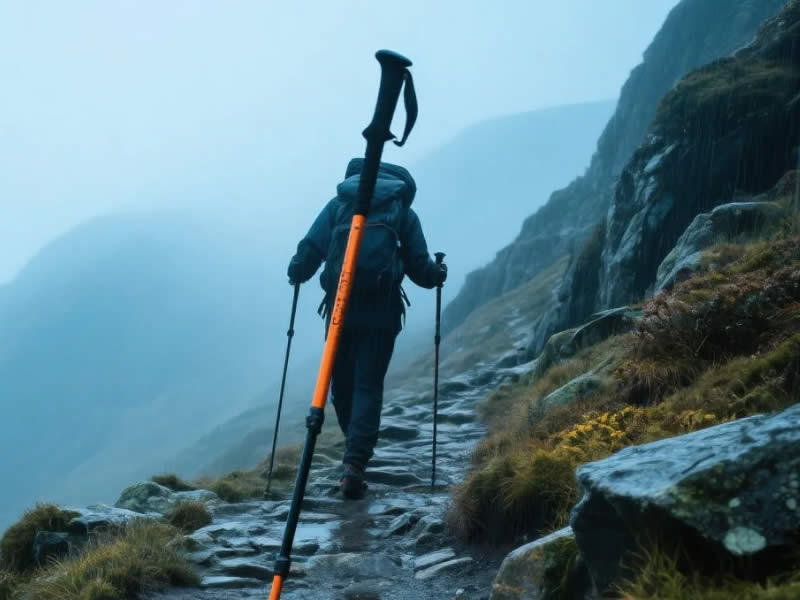
1. Understanding the Watkin Path in Wet Conditions
The Watkin Path is about 6.5 miles (10.5 km) round trip with an elevation gain of over 800 metres. Its character changes dramatically with moisture:
- The lower section – Through the forest, the path is rooty and muddy. Water channels down the track, making the packed earth slick.
- The waterfalls – You pass close to the Afon Llan and its cascades; spray from the falls coats the rocks with a fine, slippery film.
- The boulder fields – Above the tree line, the route crosses huge, jagged blocks of rhyolite and slate. When wet, these rocks become black and polished, offering minimal friction.
- The South Ridge – The final approach to the summit is exposed and windy; rain drives horizontally, chilling your hands and reducing dexterity.
In these conditions, poles need to provide exceptional grip, reliable length adjustment, and zero failure risk—because a slip on the Watkin Path can send you tumbling down a steep, rocky gully.
2. The Golden Rule – Aluminium Over Carbon for This Route
Let's address the single most important choice: material. While carbon fibre poles are lightweight and dampen vibration well, they are not the best choice for the Watkin Path in wet weather. The reason is brittle failure. When a carbon pole strikes a sharp wet slate edge at an angle, it can fracture or shatter without warning. The Watkin Path is strewn with such edges, and a broken pole at the wrong moment could be catastrophic.
Aluminium, specifically 7075‑T6 alloy, is the superior choice. It bends rather than breaks, giving you advance warning (a visible bend) before complete failure. It's also more resistant to the abrasive grit that gets washed onto the rocks. Choose a pole with a shaft diameter of at least 18 mm in the lower section—this provides the stiffness needed to avoid buckling when planting on uneven, wet surfaces.
3. Locking Mechanism – Flip‑Locks Over Twist‑Locks
In wet, cold, or gloved conditions, twist‑locks are a liability. They require you to rotate the lower section with a fine motor grip; wet hands slip, and cold fingers struggle to get enough torque. Moreover, water and grit can enter the twist mechanism, causing it to jam or slip.
Flip‑locks (cam‑locks) are far superior for the Watkin Path. They offer:
- Quick, positive adjustment – You can release and tighten with one thumb, even wearing thick waterproof gloves.
- Strong clamping force – High‑quality flip‑locks (like Black Diamond's FlickLock or Leki's SpeedLock 2) exert more than enough pressure to hold the sections firmly, regardless of rain.
- Easy maintenance – You can clean and lubricate the clamping surface quickly; twist‑locks are harder to service in the field.
If you already own twist‑locks, ensure they are thoroughly cleaned and adjusted before the hike, and carry a small cloth to dry the locking area. But for a dedicated wet‑weather pole, flip‑locks are non‑negotiable.
4. Tip and Basket – Grip and Flotation
The standard tungsten‑carbide tip is excellent for rocky surfaces, but on wet slate, you need the sharpest, most aggressive tip you can find. Look for a steel‑reinforced carbide tip with a conical shape that bites into the micro‑texture of the rock. Many brands offer "rock" tips with a more acute angle—these are ideal.
Now, about baskets: on the Watkin Path, the lower section passes through muddy, boggy areas where a large basket is essential to prevent the pole from sinking deep into the peat. But on the rocky upper section, a large basket can rattle or catch in cracks. The solution is a medium‑sized, flexible basket (about 5–7 cm diameter) that can be pushed up the shaft when not needed. In wet weather, mud will build up on the basket; choose one with a smooth, non‑stick surface (e.g., nylon or ABS) that sheds muck easily.
5. Grip and Strap – Ergonomics in the Rain
Wet weather means your grip on the handle is compromised. Cork grips are great for absorbing sweat but become slippery when soaked. Rubberised foam grips are much better in the rain—they stay grippy even when wet and offer some thermal insulation against the cold. Look for a grip with a wavy or textured surface and a small flange at the top to prevent your hand from sliding forward.
The strap is equally vital. In wet, windy conditions, you'll want to relax your grip periodically to let blood flow. A wide, padded, quick‑adjust strap allows you to lock your hand securely and take weight on the strap rather than crushing the handle. Ensure the strap buckle can be adjusted even with gloves; a simple slide‑lock design is preferable.
6. Recommended Models for the Watkin Path in Wet Weather
Based on the criteria above, here are three top‑tier choices that consistently perform well on Snowdon's slippery slopes:
- Black Diamond Trail Pro – 3‑section 7075 aluminium, 18 mm lower shaft, FlickLock Pro mechanism, and a rubberised foam grip with a cushioned strap. Rated for 140 kg and available in lengths up to 140 cm. The dual‑density basket is perfect for mixed terrain.
- Leki Makalu FX – A classic mountaineering pole with the robust SpeedLock 2 system, a 18 mm shaft, and a long cork/rubber hybrid grip. The carbide tip is extra‑sharp, and the basket is easily removable. Rated at 130 kg—ideal for the Watkin's heavy pack requirement.
- Komperdell Titan – 7075 aluminium with a 18 mm diameter, featuring the robust Power Lock mechanism (similar to a flip‑lock). The grip is a comfortable foam with a wide, adjustable strap. Rated 145 kg, giving plenty of safety margin.
For a more budget‑friendly option, the Decathlon Forclaz 500 Aluminium (18 mm, 7075, flip‑locks) holds up well in wet conditions and is rated 130 kg—a great value pick.
7. Additional Tips for Wet‑Weather Pole Use
- Set your length correctly – On the Watkin Path, you'll be ascending steeply; shorten the poles by 5–10 cm for uphill to keep your elbows at a comfortable angle. Descend in rain, extend them slightly to plant further ahead for braking.
- Check locks frequently – Rain can cause grit to wash into the clamp area. Every 30 minutes, wipe the overlap section with a cloth and retighten the flip‑lock.
- Dry your poles after the hike – Salt in the rain (if coastal) and acidic peat can corrode aluminium if left wet. Rinse with fresh water and dry thoroughly before collapsing.
- Consider a wrist loop – Some walkers tie a thin cord from the pole grip to their pack strap to prevent losing a pole if they slip—just an extra safety measure.
8. Final Verdict – Confidence in the Wet
The Watkin Path in wet weather is a true test of both hiker and gear. The best poles for the job are 3‑section aluminium poles with aggressive carbide tips, flip‑locks, foam grips, and a generous 18 mm shaft diameter, rated for at least 130 kg. They won't be the lightest, but they will be the most reliable. Invest in a quality pair, practise adjusting them with wet hands, and you'll climb Snowdon's most beautiful and challenging route with stability, safety, and enjoyment—rain or shine.




